


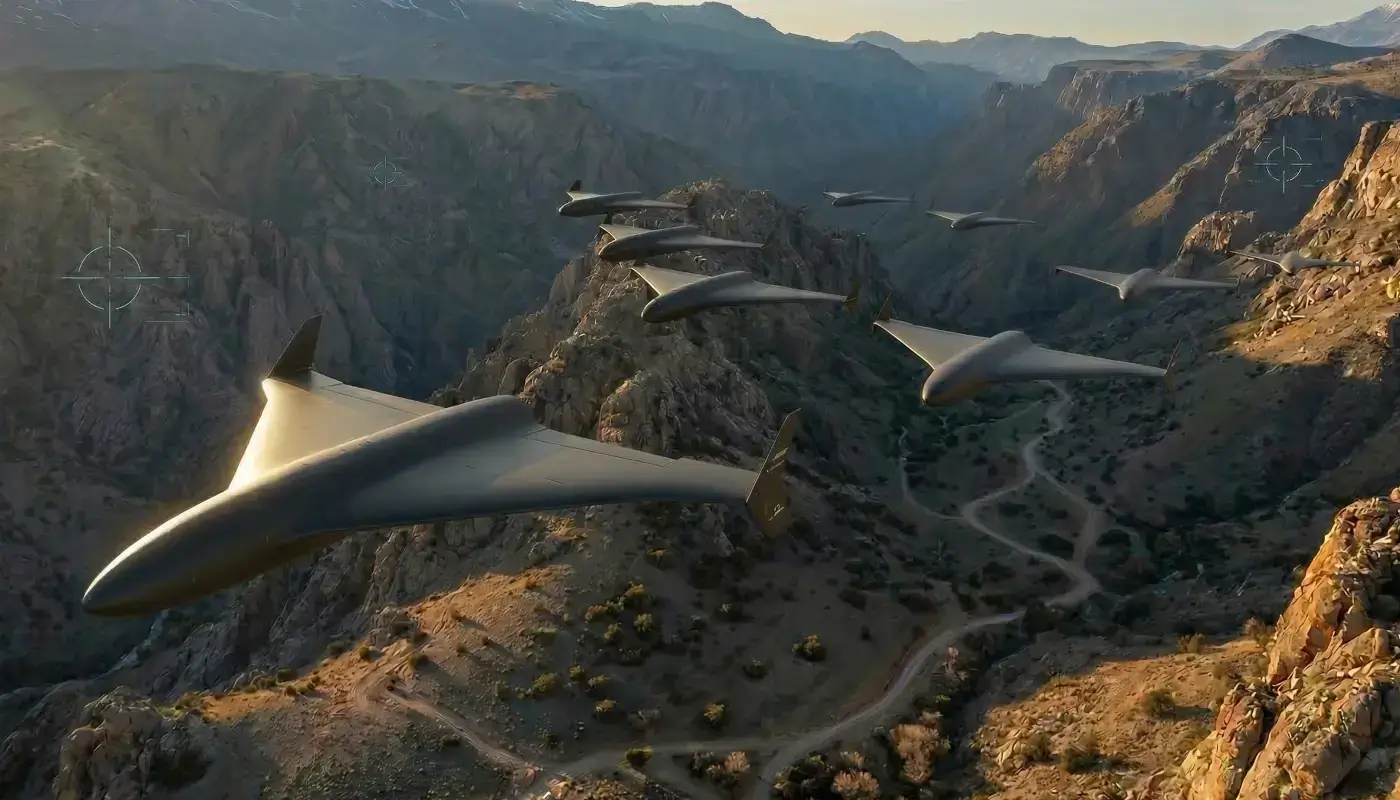
STM, one of the pioneering engineering companies of the Turkish defence industry, is completely redefining the future of unmanned systems with its Multi-Domain vision. Combining land, air, and naval platforms under a single artificial intelligence mind, the company aims to establish asymmetric superiority on the battlefield with the swarm UAV concept. Having proven its mettle in the field with tactical systems like KARGU and ALPAGU to date, STM is now preparing to change the rules of the game in the global market with its Long-Range Kamikaze UAV project, which will be the Turkish counterpart of the Shahed 136 Kamikaze.
Under the leadership of the Presidency of Defence Industries (SSB), STM, which develops innovative systems in line with Türkiye's goals for a fully independent defence industry, is breaking new ground in the field of unmanned systems. Having successfully developed KARGU, ALPAGU, TOGAN, BOYGA, and the unmanned underwater vehicle STM NETA in the tactical field to date, the company is now implementing the Multi-Domain concept that will enable all these systems to operate in an integrated and coordinated manner.
Heterogeneous Swarm Architecture and Asymmetric Superiority
Today's battlefield environment necessitates coordinated action of elements as a whole, rather than individual success. With the asymmetric power approach developed by STM, the aim is to generate high destructive power with smaller, flexible, and intelligent platforms instead of large, cumbersome, and costly systems. At the heart of this vision lies the heterogeneous swarm UAV concept.
Heterogeneous swarm UAV refers to the coordinated operation of unmanned systems of different types and capabilities (fixed-wing, rotary-wing, underwater, surface, etc.) within the same mission scope, orchestrated by artificial intelligence. Thus, reconnaissance, infiltration, harassment, and swarm attack missions can be executed jointly by being instantly distributed among different elements. This architecture maximises operational flexibility while offering multi-layered operational superiority through real-time data sharing.
GNSS-Independent Operation and a World First
The foundation of STM's swarm technologies is the ability to operate independently of the Global Navigation Satellite System (GNSS) and a software infrastructure with a high level of autonomy. Thanks to visual navigation algorithms, unmanned systems continue their missions without being blinded even in environments where the enemy applies intense electronic jamming. Swarm UAV platforms share real-time threat information among themselves and perform dynamic task distribution.
Last January, STM successfully completed a live-ammunition swarm attack mission with a swarm consisting of 20 KARGUs. This success, a world first, provided a unique foundation for transferring multi-domain swarm architecture to the field. Scenarios developed specifically to saturate and destroy enemy air defence elements clearly proved the decisive role of this technology in future warfare.
The Turkish Counterpart of the Shahed 136 Enters the Field
Preparing to elevate its autonomous unmanned systems product family from the tactical level to the strategic level in the coming period, STM is counting down the days to bring next-generation solutions such as the Mini Gözcü UAV, Anti-Radiation Kamikaze UAV, Anti-UAV systems, and Large Autonomous Underwater Vehicle into the inventory.
However, the member of this expanding portfolio that will undoubtedly make the biggest strategic impact is the Long-Range Kamikaze UAV system. Türkiye is producing its own national solution against systems used to strike strategic targets on the global battlefield. This new-generation Turkish kamikaze UAV system, which can be described in the global defence press as the Turkish counterpart of the Shahed 136 Kamikaze, will deliver precise and devastating blows to enemy depths, radar bases, and logistical lines hundreds of kilometres away.
In conclusion, STM is taking its quarter-century engineering expertise and Multi-Domain approach to a much higher level. Türkiye is moving beyond being a country that merely produces individual platforms, building an integrated, high-impact cyber-physical ecosystem where all autonomous vehicles on land, sea, and air communicate with each other.
