


Türkiye is transitioning to a new international model in global technology diplomacy that breaks the mould and focuses directly on production. Minister of Industry and Technology Mehmet Fatih Kacır and Italian Minister of Enterprises and Made in Italy Adolfo Urso came together in Ankara on March 23-24, 2026, and signed a historic memorandum of understanding. This strategic meeting was recorded as the first concrete step of Türkiye's new international cooperation brand, STI³. The two countries are joining forces in critical areas such as space, biotechnology, artificial intelligence, and the defence industry. This agreement, which brings the National Technology Move vision together with the quality of Made in Italy on the same table, goes far beyond a classic diplomatic contact, offering a massive commercial market and joint R&D infrastructure to the industrial giants of both countries.
International agreements we often encounter in the world of technology and economics often remain at the level of declarations of intent. However, the STI³ (Science, Technology, Innovation, Industry, and Investment) brand developed by Türkiye is an innovative and aggressive ecosystem designed to solve this theoretical bottleneck. This model promises to eliminate the "valley of death" in the process of transforming an idea born in a laboratory into a prototype, and then the prototype into mass production in a factory.
This first signature between Türkiye and Italy is designed to bring the scientist who produces the idea, the industrialist who will turn that idea into a product, and the investor who will fund mass production together to the same table.
Türkiye's Strategic Gains and the European Market
This strategic partnership creates an immense opportunity for Turkish industry and technology enterprises to climb higher in the global supply chain. Italy holds a unique position in the global market with its automotive, industrial design, and advanced manufacturing (machinery) technologies. Türkiye, on the other hand, has built an exceptionally agile, young, and dynamic technology ecosystem in recent years in the fields of defence industry, space, artificial intelligence (AI), and software.
Thanks to the STI³ model, Turkish companies will combine their developed high technologies with the established production lines of Italian industry. This partnership between the two Mediterranean giants, spanning biotechnology, health, artificial intelligence, and the automotive industry, will directly accelerate Türkiye's "co-development" processes targeting European Union markets. Thus, our domestic engineering will transform into a global game-changer shaping Europe's stringent industrial standards, rather than remaining confined to the domestic market.
Minister Kacır: We Are Turning Common Priorities into Concrete Projects
Minister of Industry and Technology Mehmet Fatih Kacır outlined the vision and goals of the STI³ brand in very clear terms during the meeting. Minister Kacır summarised this innovative cooperation model with the following striking words:
"The STI³ approach we have developed as Türkiye is an innovative and strategic cooperation model that brings science, technology, innovation, industry, and investment together under a single strategic platform, institutionalises multi-dimensional collaborations, transforms common priorities into concrete projects, and jointly addresses the entire value chain from research to production, from prototyping to commercialisation and investment."
Minister Kacır also emphasised that a massive institutional force supports this process on the Turkish side. Major institutions such as all critical institutes of TÜBİTAK (BİLGEM, MAM, UZAY, SAGE), the Turkish Space Agency (TUA), KOSGEB, TSE, the Presidency of Defence Industries, Informatics Valley, and DEİK form the pillars of this bridge. Minister Kacır particularly noted that in the coming period, they will not limit cooperation in technology to just idea generation but will carry it to a much stronger foundation through direct commercialisation and investments.
A Shared Horizon in Space Technologies: Visit to TÜBİTAK UZAY
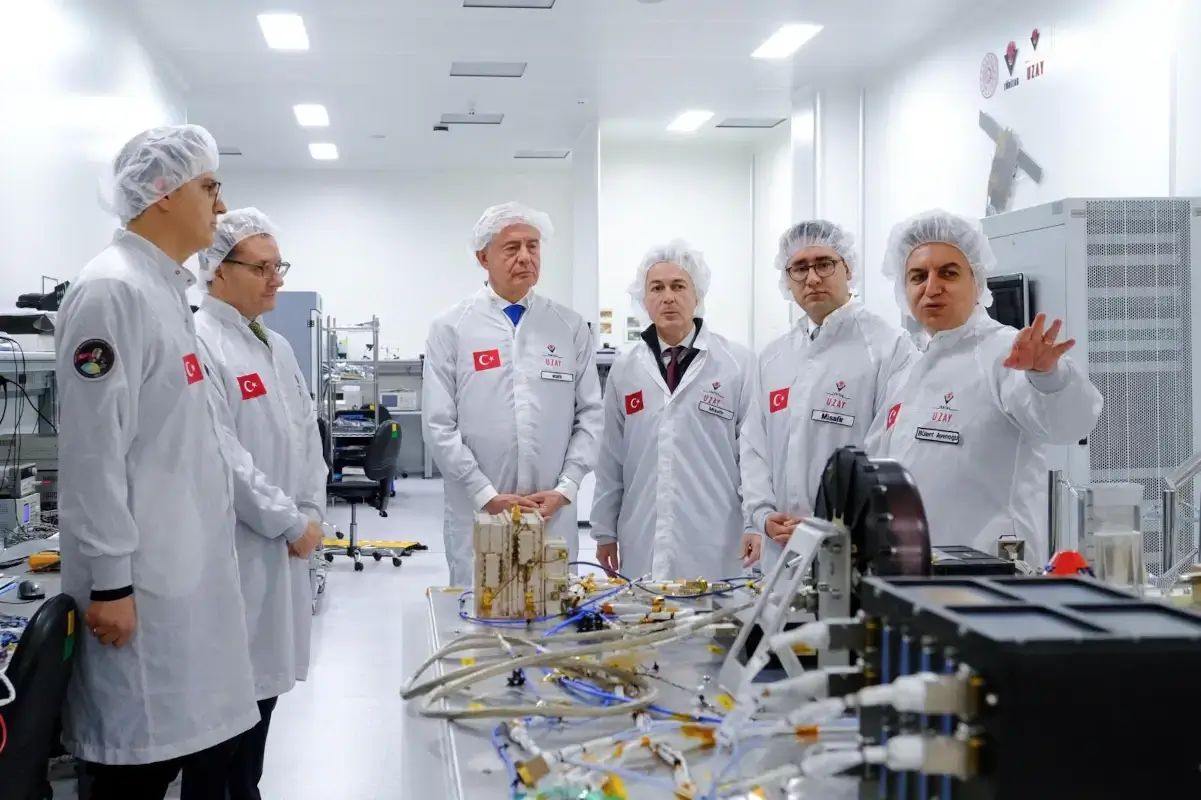
The most concrete example of this multi-dimensional integration between the two countries emerged during the Italian delegation's technical visit to the TÜBİTAK UZAY campus in Ankara. Accompanied by Deputy Minister of Industry and Technology Muhammet Kasım Gönüllü and TÜBİTAK President Prof. Dr. Orhan Aydın, the Italian delegation examined the clean room facilities, the ground station, and the satellite museum, considered the heart of satellite production, on-site.
Deputy Minister Gönüllü, in his speech, drew attention to Türkiye's position in the space race:
"Through the coordinated efforts of TÜBİTAK UZAY, the Turkish Space Agency, TUSAŞ, and our other institutions, we have built a strong ecosystem in the fields of satellite design, production, and system integration."
This massive infrastructure, showcased to the Italian delegation on-site, forms the foundation for the two countries' future joint satellite projects and deep space research. TÜBİTAK President Prof. Dr. Orhan Aydın, expressing his satisfaction with the visit, stated that they attach great importance to strengthening international collaborations and see this contact as a very valuable opportunity for joint R&D studies.
Commercialisation-Focused Growth
With the STI³ brand, Türkiye sits at the table as a game-changer rewriting the rules in technology diplomacy. This signature, made with the participation of Italian Minister of Enterprises and Made in Italy Adolfo Urso, guarantees that research and development (R&D) activities will not remain merely academic presentations. On the contrary, this model clearly proves that ideas will be directly transformed into factories and global investments.
In the coming period, we will begin to see the fruits of this strategic cooperation model in major joint investments in the automotive, health technologies, and artificial intelligence sectors.
