


Turkey has taken a significant step in chip manufacturing. A cooperation agreement signed between TÜBİTAK (The Scientific and Technological Research Council of Turkey) and Hamad Bin Khalifa University in Qatar will establish a chip production facility in Gebze.
On April 26, 2023, the opening ceremony for the Chip Production Facility Investment and the “IDEA Incubation” incubation center took place at the TÜBİTAK Gebze Campus. The ceremony was attended by the Minister of Industry and Technology, Mustafa Varank, the Rector of Hamad Bin Khalifa University (HBKU) in Qatar, Prof. Dr. Ahmad M. Hasnah, and the President of TÜBİTAK, Prof. Dr. Hasan Mandal.
Minister of Industry and Technology Mustafa Varank stated that the global market size of the chip industry has reached $600 billion and is expected to approach $1.5 trillion by 2030, adding that Türkiye needs to gain a competitive edge in this field. Varank noted that they had introduced TÜBİTAK's new Chip Production Facility and that this facility would be one of the hallmarks of the "Turkish Century.".
Varank stated that they attach great importance to the chip investment that they will realize through the cooperation between TÜBİTAK and Hamad Bin Khalifa University in Qatar, and that the machinery and equipment necessary for the establishment of the chip production line, amounting to 30 million dollars, will be provided by HBKU. He explained that TÜBİTAK BİLGEM will be responsible for the construction of clean rooms, bringing and installing the machinery from Qatar, and operating the facility.
Varank stated that after the machinery and equipment are brought to the Gebze campus, they will start producing 65-nanometer chips in this facility within about a year, and that they will have a facility where critical components needed by both countries are produced and brought to market. Varank also announced that they will provide 600 million lira in financial support to chip design companies.
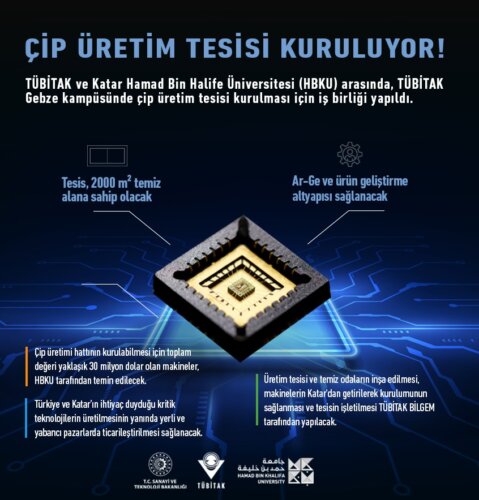
65-nanometer chips, known as gallium nitride-based chips, are used in strategic technologies such as defense radar, electronic warfare, power electronics, space technologies, electricity transmission infrastructure, electric cars, aviation, high-speed rail, and 5G mobile phone systems. Through these chips, Turkey aims to both achieve value-added exports and gain a strategic capability in terms of national security.
