


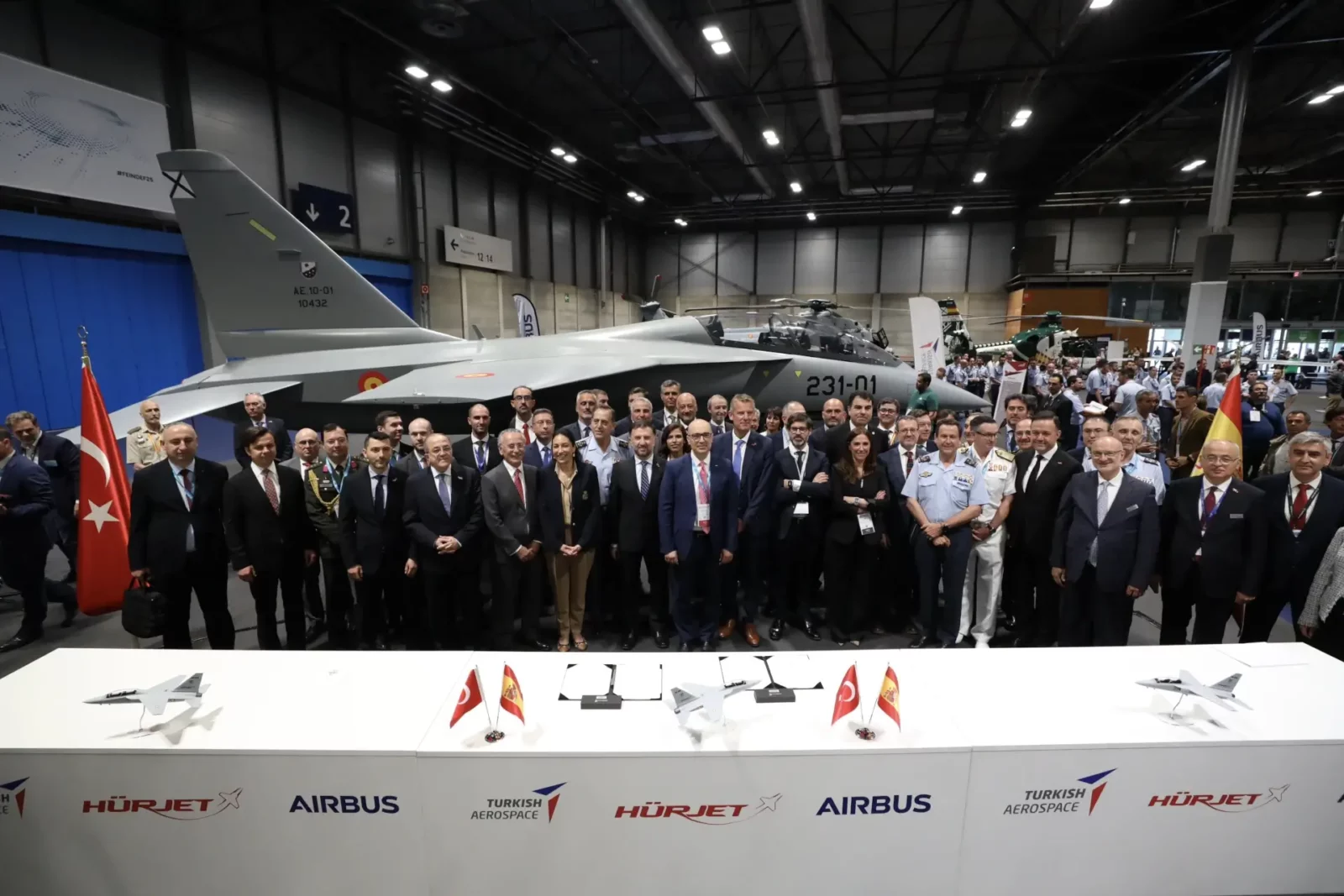
Developed domestically by Turkish Aerospace Industries (TUSAŞ), the HÜRJET supersonic jet training aircraft is preparing to soar through European skies. The Memorandum of Understanding signed with Spanish companies under the coordination of Airbus marks HÜRJET's first major step into the international market. This development reinforces the narrative of "The Golden Age of Turkish Aviation," while once again showcasing Türkiye's technological competence and export potential in the defense industry.
HÜRJET, Türkiye's national pride in the skies, has achieved another success that has resonated on the international stage. Turkish Aerospace Industries (TUSAŞ) announced that it has signed a strategic Memorandum of Understanding (MoU) with Spanish companies, in coordination with European aviation giant Airbus, for the HÜRJET Jet Training Aircraft. This agreement is considered a giant step towards HÜRJET's inclusion in the Spanish Air Force inventory and opens a new chapter in Turkish aviation history.
In a statement released on TUSAŞ's official social media accounts, it was stated: “A SIGNIFICANT STEP ON THE ROAD TO EUROPE! The Golden Age of Turkish Aviation continues its rapid progress. We have opened a new page in our aviation history. We have signed a Memorandum of Understanding with Spanish companies, in coordination with Airbus, for our Supersonic Jet Training Aircraft HÜRJET. A new chapter will be opened in HÜRJET's international journey, and HÜRJET, which we developed with national resources, will further strengthen Spain. May it be beneficial for our country and our beloved nation.” This exciting announcement was met with great enthusiasm both in defense industry circles and among the public.
What Does the Memorandum of Understanding Mean? An International Door Opens for HÜRJET!
The signed Memorandum of Understanding (MoU) signifies a declaration of intent and the establishment of a framework for cooperation between the parties. Such agreements are generally an important preliminary step towards a more comprehensive and final contract. In the case of HÜRJET, this MoU indicates that TUSAŞ and the Spanish companies will explore cooperation opportunities in various areas such as technology transfer, joint production, maintenance and repair, and training.
Airbus's role as coordinator in this process reinforces the international dimension and seriousness of the agreement. As one of the largest players in the global aerospace and defense industry, Airbus demonstrates its confidence in the technical and commercial feasibility of the project. The involvement of Spanish companies is also of great importance in terms of adapting HÜRJET to Spain's specific needs and contributing to the local industry.
This agreement demonstrates that HÜRJET is gaining value not only as a training aircraft but also as a strategic cooperation platform. Spain's status as a NATO member and European country is a significant factor in increasing HÜRJET's visibility and acceptability in the European market. Successful cooperation could make HÜRJET an attractive option for other European countries as well.
HÜRJET: The New Star of the Skies, The Pinnacle of Turkish Engineering
HÜRJET is Türkiye's first manned supersonic jet aircraft project, brought to life through years of intensive work and dedication by Turkish engineers and technicians. Equipped with a single engine, tandem cockpit, and modern avionics systems, HÜRJET is designed for both basic jet training and combat readiness training. Work is also underway on HÜRJET-C, a version of the aircraft capable of undertaking light attack and close air support missions.
Key Technical Specifications of HÜRJET:
- Maximum Speed: 1.4 Mach (1.4 times the speed of sound)
- Service Ceiling: 45,000 ft (Approximately 13,700 meters)
- G Limits: +8g / -3g (High maneuverability)
- Viewing Angles: Tandem cockpit design offering a wide field of view.
- Avionics Systems: Modern, digital cockpit, mission computer, helmet-mounted sighting system (optional)
- Weapon Systems: Capable of carrying various missiles and bombs for light attack missions (HÜRJET-C version)
With its superior performance characteristics, modern avionics, and mission flexibility, HÜRJET is poised to play a critical role in training today's and tomorrow's jet pilots. The aircraft's modular design allows for easy configuration to meet different mission requirements. Furthermore, its development using domestic resources provides Türkiye with complete independence in maintenance, repair, modernization, and spare parts supply.
This project went beyond simply producing an aircraft; it elevated Türkiye's technological expertise, design capabilities, and production infrastructure in the aviation sector to a higher level. The engineers, technicians, and test pilots trained through the HÜRJET project constitute a valuable human resource for Türkiye's future, larger and more complex aviation projects.
Why Did Spain Choose HÜRJET? Strategic Advantages and Needs
The Spanish Air Force is seeking to modernize its existing fleet of training aircraft and train future fighter pilots with the latest technologies. HÜRJET offers several significant advantages for Spain in this regard:
- Performance and Modernization: With its supersonic speed, high maneuverability, and modern avionics systems, HÜRJET offers Spanish pilot candidates an ideal training platform for transitioning to 5th generation fighter aircraft. Its significantly more advanced technology compared to existing training aircraft will improve the quality of training.
- Cost-effectiveness: The advantage of domestic production and TUSAŞ's competitive pricing policy could make HÜRJET a more cost-effective option compared to its Western rivals with similar capabilities. Long-term operating and maintenance costs will also play a significant role in this choice.
- Industrial Cooperation and Technology Transfer: TUSAŞ's open approach to collaborating with Spanish companies and transferring technology could contribute to Spain's development of its own aviation industry and job creation. Joint production and local contribution would increase the attractiveness of the agreement for Spain.
- NATO Compatibility and Strategic Partnership: Turkey and Spain being NATO allies is important in terms of compatibility and joint operational capabilities between military equipment and systems. The fact that HÜRJET is designed in accordance with NATO standards will facilitate its integration into Spain's existing infrastructure. Furthermore, this cooperation will further strengthen the strategic partnership between the two countries.
- Delivery Times and Flexibility: TUSAŞ's production capacity and the current stage of the project indicate that HÜRJET can meet Spain's urgent needs with relatively short delivery times. Furthermore, TUSAŞ's customer-focused approach may allow for modifications to HÜRJET according to Spain's specific requirements.
The Spanish Air Force's search for a modern platform to replace its aging CASA C-101 Aviojet training aircraft presents a significant opportunity for HÜRJET. HÜRJET appears to be a strong candidate for this need, both in terms of its technical specifications and its potential for strategic cooperation.
The Golden Age of Turkish Aviation: Export Successes and Future Vision
The Memorandum of Understanding signed between HÜRJET and Spain is one of the latest and most brilliant examples of what is described as the "Golden Age" of Türkiye's defense and aerospace industry. In recent years, many domestically produced products such as ATAK helicopters, unmanned aerial vehicles like Bayraktar TB2 and ANKA, armored land vehicles, naval platforms, and ammunition systems have attracted great interest in the international market and achieved significant export successes.
These successes are based on Türkiye's strategic investments in the defense industry over the last 20 years, its localization and nationalization policies, the creation of a strong ecosystem, and the dynamism of the private sector. Leading organizations such as TUSAŞ, ASELSAN, ROKETSAN, HAVELSAN, and BAYKAR have developed world-class products, making Türkiye a global player in this field.
The potential export of HÜRJET to Spain could add a new and strong link to this chain of success. This would not only be an economic gain but also a testament to Türkiye's technological competence, engineering capabilities, and international credibility. Spain, a NATO and European Union member, choosing a Turkish-designed jet trainer would set an important benchmark for other countries as well.
From a future vision perspective, HÜRJET's first international step serves as a source of morale and motivation for larger and more ambitious projects such as the National Combat Aircraft KAAN. Turkey is moving beyond being a country that only meets its own needs and is confidently progressing towards becoming a technology and production hub that also offers solutions to the defense and aerospace needs of friendly and allied countries.
Key words: HÜRJET, TUSAŞ, Spain, Airbus, Turkish Aviation, Jet Training Aircraft, Supersonic Aircraft, National Aircraft, Domestic Production Defense Industry, Aircraft Export, Memorandum of Understanding, Defense Industry Export, Aviation Agreement, Spanish Air Force, Turkish Engineering.
