


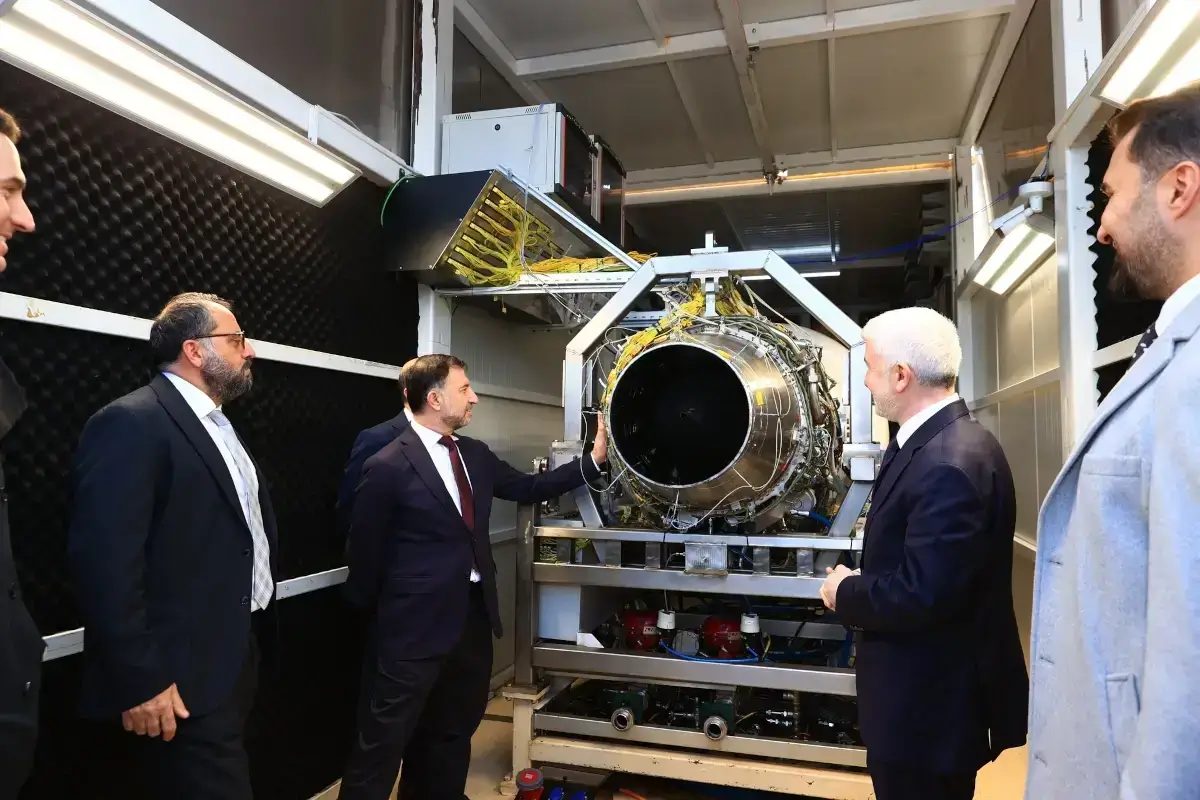
TUSAŞ General Manager Dr. Mehmet Demiroğlu made an official post on social media regarding his engagements in Eskişehir. However, the real big news of this routine visit update was hidden not between the lines of the text, but in one of the shared photographs. In the visit photos, the domestic turbofan engine TEI TF6000, which will power Türkiye's combat unmanned aircraft ANKA-3 and Bayraktar KIZILELMA, was seen on a test rig. This surprise image proves that the testing phases of the TF6000, one of the significant steps in Türkiye's march towards independence in aviation engines, are ongoing.
Engineering Power Reflected from the Test Cell
The photographs from the meetings held by Dr. Mehmet Demiroğlu with the Commander of the Combat Air Force, General Rafet Dalkıran, and TEI General Manager Prof. Dr. Mahmut Akşit, show that intensive work is underway at TEI's facilities in Eskişehir. The TF6000 engine featured in the images is located on a test bed surrounded by sensors and measurement cables.
This stage represents a critical phase where the engine design moves beyond paper and its physical limits are tested. In this test setup, engineers measure the engine's thermodynamic cycles, component durability, and thrust generation capacity in conditions closest to the real world. In aviation, an engine must prove its maturity by undergoing thousands of hours of ground testing before being installed on an aircraft.
Strategic Transformation for KIZILELMA and ANKA-3
The TF6000 engine is designed to eliminate one of the Turkish defence industry's biggest dependencies. Currently, the KIZILELMA platform developed by Baykar and the ANKA-3 platform developed by TUSAŞ conduct their test flights using Ukrainian-origin engines. However, geopolitical risks and supply chain security necessitate a domestic engine for these domestic platforms.
Developed entirely by Turkish engineers, the TF6000 produces 6,000 pounds (lbf) of thrust. The engine's compact design and high power-to-weight ratio make it an ideal power source for unmanned combat aircraft. Moreover, this engine will not only power existing platforms. The TF10000 version, to be obtained by adding an afterburner module to the system, will also serve as a technological stepping stone on the path towards the National Combat Aircraft KAAN's indigenous engine.
Full Independence in the Sky
This photograph, shared by TUSAŞ leadership during their visit to TEI facilities, indicates that the integration between the platform manufacturer and the engine manufacturer is nearing its final stage. Dr. Demiroğlu's statement that they "evaluated current developments in the defence industry ecosystem" points to the engine integration schedule being on the table.
In conclusion, the journey of the TF6000 engine from the test cell to being integrated into the airframes of KIZILELMA and ANKA-3 will formally place Türkiye into that narrow and elite club of nations capable of producing their own combat aircraft and engines. The next step will be the sound of that national power resonating in the sky with the ignition of the domestic engine.
