


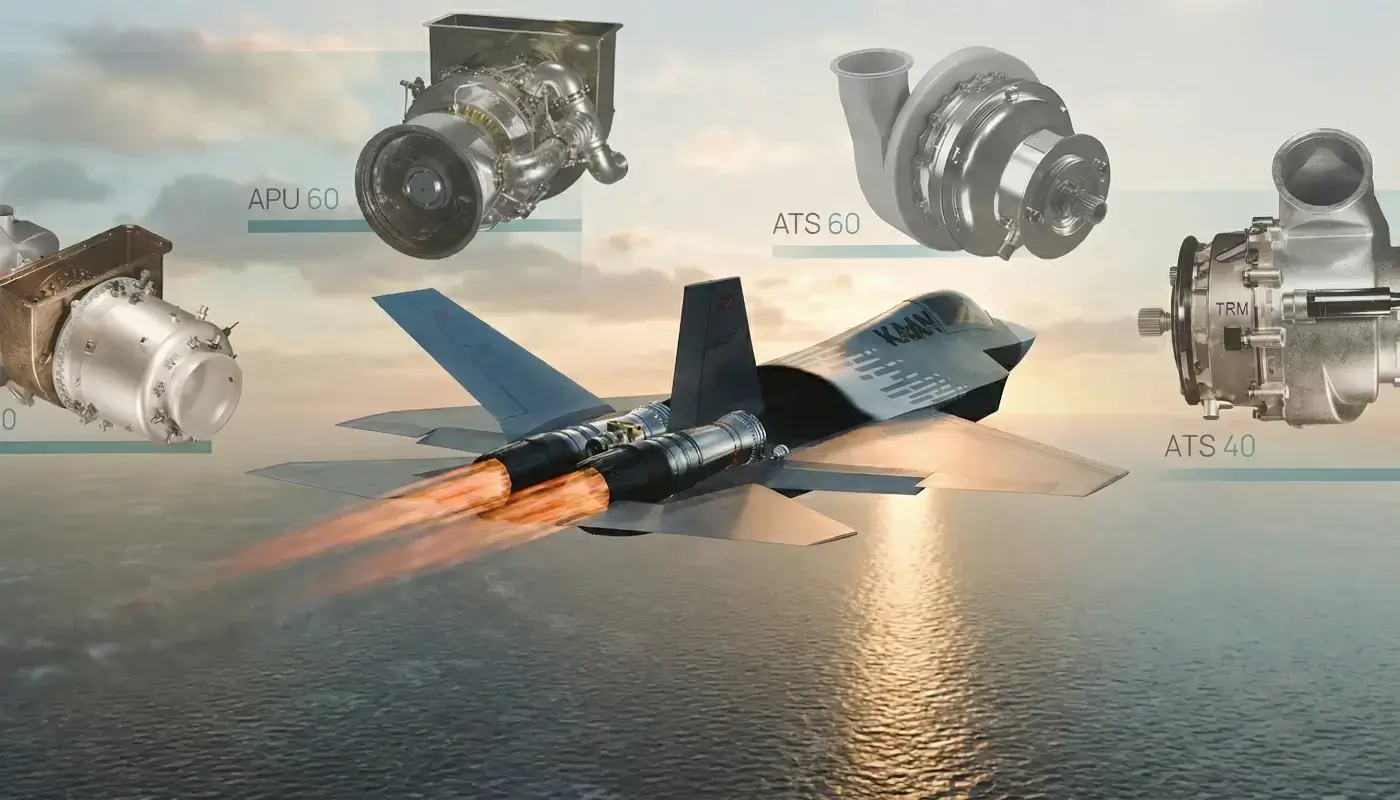
TRMOTOR, the developer of engine and power systems for the National Combat Aircraft KAAN, has clarified the current roadmap for the project. While the company continues the design and subsystem development for the aircraft's main engine, the TF35000, it has reached the final stages for the indigenous Auxiliary Power Unit (APU) systems. According to information published in TUSAŞ's media organ Gökvatan, Türkiye's first indigenous APU system, "APU-60," will be integrated into KAAN within 2026.
Operating as Türkiye's design center in the field of aviation engines, TRMOTOR is conducting simultaneous operations on the systems (TF35000 and APU) that will meet the thrust and energy requirements of the KAAN project. Accelerating main engine efforts via the consortium established with TEI in 2024, the company has passed a significant milestone in nationalizing the critical subsystems that provide the aircraft's ground energy needs and engine starting functions. 2026 will be a critical year where indigenous power units meet the platform.
TF35000 and Holistic Subsystem Design
TRMOTOR plays a critical role in the development of the national engine TF35000, which falls into the 35,000-lb thrust class. Having signed the conceptual design contract for KAAN's main engine in 2022, the company approaches the engine not just as a machine but as an integrated system.
TRMOTOR’s responsibility on the TF35000 extends from the engine core to peripheral units. The company carries out the design and development of vital subsystems such as the FADEC (Full Authority Digital Engine Control), lubrication, fuel, ignition, actuation, pneumatic systems, and the gearbox. This holistic engineering approach ensures the engine performs reliably under demanding combat conditions.
APU and ATS: Independence on the Ground
For a fighter jet to operate independently of ground support equipment, the APU (Auxiliary Power Unit) and ATS (Air Turbine Starter) are essential.
TRMOTOR is realizing a first in Türkiye with these systems developed for KAAN:
- Operational Principle: The APU is a smaller gas turbine engine compared to the main engine. It activates before the main engines to power the aircraft's avionics, air conditioning, and electronic systems. The pressurized air produced by the APU is transferred to the ATS system; the ATS uses this air to rotate the turbine inside, turning the main engine's shaft to provide the initial start.
- Strategic Value: This system eliminates KAAN's dependency on ground support equipment, enabling operations from any base or civilian airfield.
2026 Target: APU-60 Integration
One of the most concrete projects TRMOTOR is conducting is the APU-60 system, developed entirely with domestic resources. Designed specifically for the KAAN project, this power unit is planned for first integration into the aircraft in 2026.
As test phases continue without interruption, the activation of the APU-60 will provide KAAN with a fully indigenous solution for engine starting and ground power requirements.
Commercial Solution: APU-40
TRMOTOR is also transferring the know-how gained from military projects to the commercial sector. Alongside the APU-60, the company is working on a more compact auxiliary power unit, the APU-40.
- Core Integration: While core engine integration studies for the APU-40 project are ongoing, test activities are targeted to begin in the first quarter of 2026.
- Scope: This model is intended to be integrated into commercial aircraft and rotary-wing (helicopter) platforms, aiming to become a high-export-potential product.
National Test Infrastructure
Validating and certifying an engine is as critical as designing it. TRMOTOR has established a vast test ecosystem through university-industry cooperation.
- Gebze Technical University: The "Altitude Systems Center of Excellence" established here simulates how engines behave under high-altitude conditions.
- METU (ODTÜ): Aerodynamic and thermal tests of engine parts are conducted in the combustion and flow laboratories within the Middle East Technical University.
Across Ankara, Eskişehir, and Kocaeli, TRMOTOR conducts verification activities ranging from compressor tests to combustion chamber tests, and from APU assembly to gearbox activation.
Indigenous Engine is a Matter of Survival
TRMOTOR General Manager Prof. Dr. Osman Saim Dinç emphasizes that these efforts should be viewed beyond engineering success. Defining engine technologies as the intersection of independence, sustainability, and supply security, Dinç stated:
"We evaluate indigenous engine studies with a focus on the issue of national survival (beka). This situation makes the strategic importance of establishing our own capability in propulsion and power systems even more visible. With these projects, a capability acquisition that will create a catalytic effect on Türkiye's indigenous aviation engine technologies will also be realized."
In line with KAAN’s goal of flying with a Turkish-made engine in 2028, TRMOTOR’s APU integration and sub-system tests planned for 2026 represent one of the project’s most critical milestones.
