


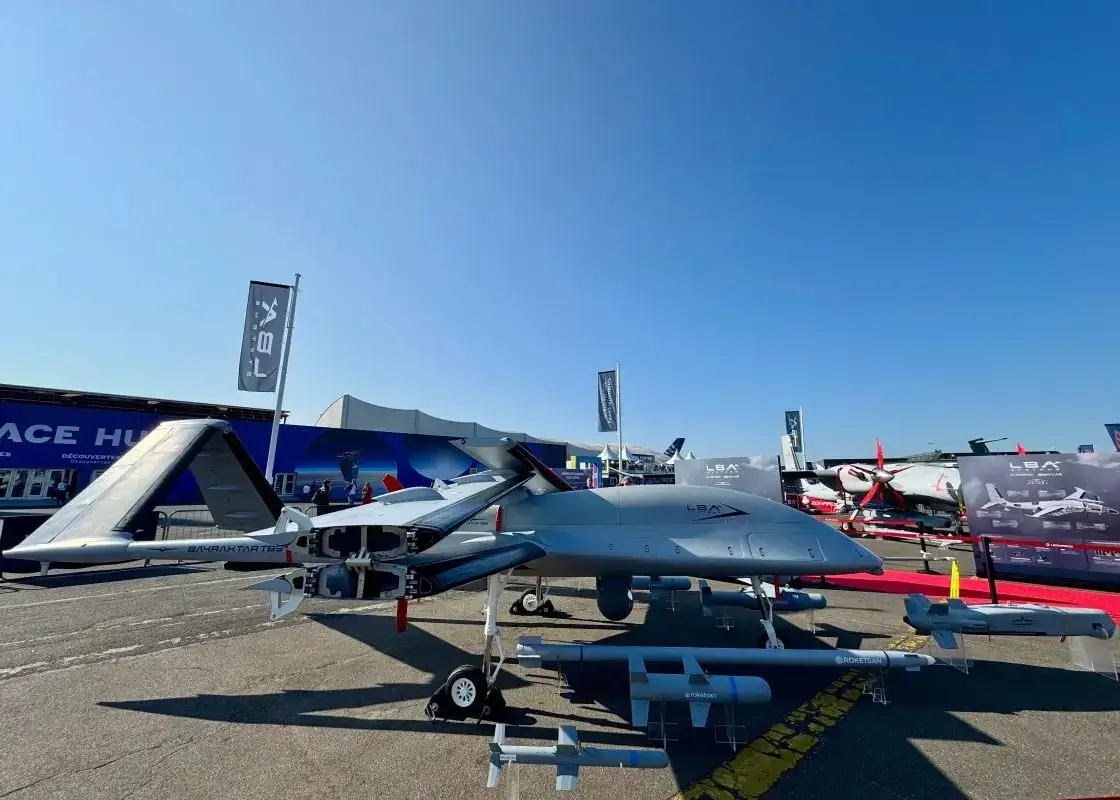
The global impact of the Turkish defence industry is reaching a new dimension with concrete steps taken in the heart of Europe. Italian aviation giant Leonardo has announced that the first medium-class Unmanned Aerial Vehicles (UAVs) will roll off the production line in Italy in April, within the scope of its strategic partnership with Baykar. Leonardo CEO Roberto Cingolani stated that they have reached this stage in a record time of just 8 months, adding that the vehicles will be equipped with swarm intelligence and the capability to land in challenging conditions.
Türkiye's position in the global unmanned systems market is evolving beyond being merely an exporter to the status of a technology development partner. During its earnings call for the preliminary results of the 2025 financial year, Leonardo, one of the world's largest defence companies, shared critical details regarding the project carried out with Baykar. The company's top executive, Roberto Cingolani, announced to investors that the Turkish-Italian partnership is progressing much faster and more successfully than expected.
Record Speed in 8 Months: Production Base in Northern Italy
In aviation projects, moving from concept design to the production phase typically takes years. However, the collaboration between Leonardo and Baykar has turned standard industry processes upside down.
CEO Roberto Cingolani described the progress in the drone programmes as "tremendous acceleration." Cingolani stated, "Our strategic partnership is yielding very good results. In just 8 months, this April, we will complete the assembly and production of our first medium-class UAVs at our facility in Ronchi dei Legionari in northern Italy." This statement proves that Baykar's agile engineering capability in autonomous systems is integrating with European production standards.
Swarm Intelligence and Challenging Landing Tests Begin
The jointly produced medium-class UAVs will immediately enter an intensive qualification process after assembly. Leonardo's management plans a demonstration schedule lasting approximately 6 months to a year before moving to the series production and sales phase involving hundreds of units.
This test process involves scenarios far more challenging than standard flights. According to Cingolani's statements, the new platforms will prove two critical capabilities in the field within the coming months:
- Landing in Special Conditions: The platforms' capacity for autonomous landing in non-standard situations, such as damaged runways or adverse weather conditions, will be tested.
- Swarm Operation: The UAVs will demonstrate their ability to carry out missions "as a swarm" by communicating with each other in a network-centric structure.
Not Just Fixed-Wing, but Rotary-Wing UAVs Also on the Way
The scope of the project is not limited to classic fixed-wing UAVs. One of the most striking details in Cingolani's statements was his indication that they are also working on rotary-wing (rotorcraft / helicopter-type) unmanned platforms.
Furthermore, Leonardo emphasised that they are working shoulder-to-shoulder with Baykar engineers on a daily basis to integrate brand new technologies into the platforms. The next-generation UAVs, emerging from the combination of electronic warfare, avionics, and autonomy systems, are expected to create a significant competitive advantage in the European defence market.
Türkiye's proven expertise in unmanned aerial vehicles has been validated at the highest level by a G7 and NATO country choosing to manufacture products on its own soil using Turkish engineering. Leonardo will announce the latest details of the project and plans to the international public through a comprehensive presentation to be held within the next two weeks.
LBA Systems Partnership: History and Scope
The foundation of the collaboration was laid with a Memorandum of Understanding (MoU) signed in Rome on March 6, 2025. Subsequently, on June 16, 2025, a 50-50 joint venture named LBA Systems was officially established at the Paris Air Show. The company's legal and operational headquarters is located in Italy. LBA Systems aims to offer next-generation unmanned systems to the European market by combining Baykar's proven platforms (TB2, TB3, Akıncı, Kızılelma) with Leonardo's advanced sensor, electronics, certification, and multi-domain technologies. Production is distributed across Leonardo's following facilities:
- Ronchi dei Legionari - Centre of excellence for unmanned systems (initial assembly for medium-class UAVs)
- Grottaglie - Advanced composite platforms such as Kızılelma
- Villanova d'Albenga (Piaggio facilities) - TB2 and Akıncı
- Turin and Rome - Engineering, certification, and multi-domain integration
