


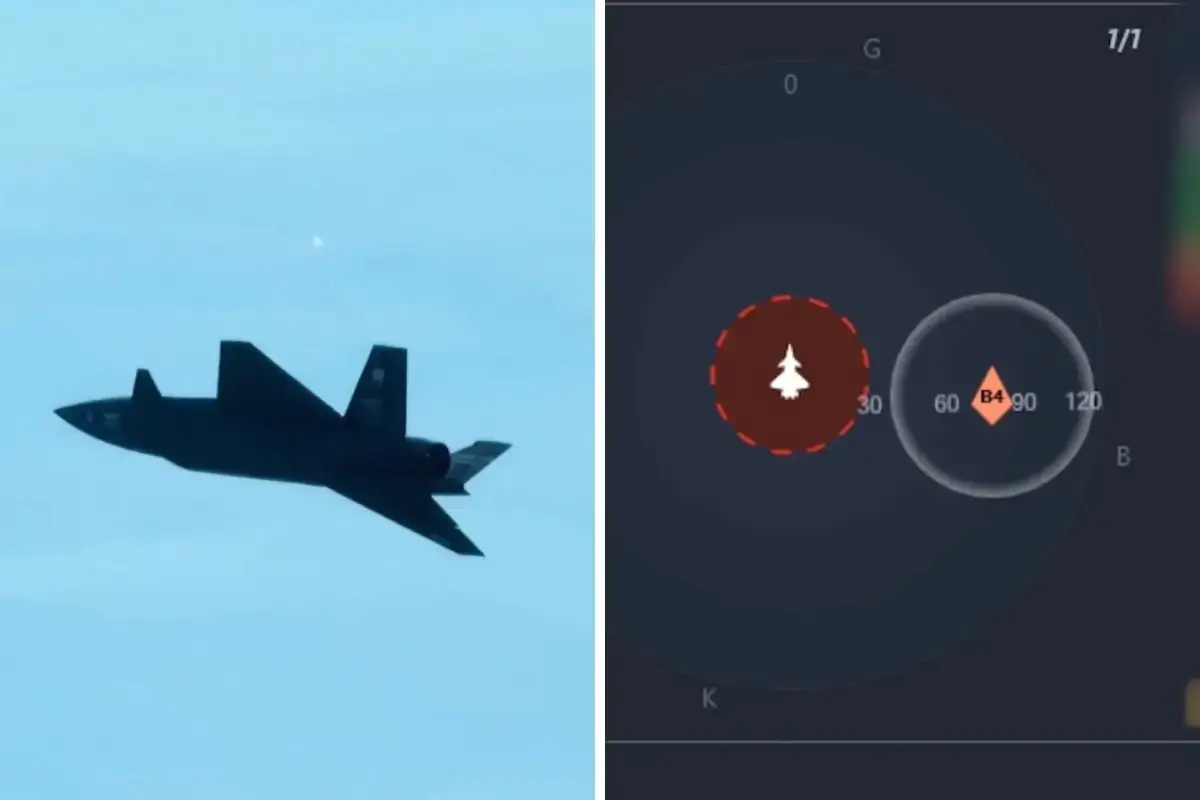
Turkey's first unmanned fighter jet, the Bayraktar KIZILELMA, has gained its most critical capability to strengthen its dominance in the skies. The FEWS-U Electronic Warfare Suite, developed by ASELSAN and one of the first systems in the world designed specifically for unmanned combat aerial vehicles, has been integrated into the KIZILELMA and successfully completed its inaugural flight test. With this integration, the KIZILELMA, already possessing a low radar signature, has transformed into a stealth hunter capable of detecting enemy radars before they can see it.
The most important rule of modern aerial warfare is the principle of see without being seen, strike without being struck. The Bayraktar KIZILELMA, which already features a low Radar Cross Section (RCS) thanks to its airframe geometry and material technology, is now complementing this with ASELSAN's electronic warfare intelligence. According to the announcement made by ASELSAN General Manager Ahmet Akyol and BAYKAR, the KIZILELMA, equipped with the FEWS-U (Fighter Electronic Warfare System - Unmanned) system, has successfully passed its first test in the electronic spectrum.
Technical Anatomy of FEWS-U: More Than Just a Warner, a Cube of Intelligence
At its core, FEWS-U is an advanced Radar Warning Receiver (RWR) and Electronic Support Measures (ESM) system. However, what sets it apart from standard systems is its customisation to provide data for the autonomous decision-making mechanisms of an unmanned platform.
The system's technical capabilities transform KIZILELMA from a passive flight platform into a flying intelligence station that listens to and analyses the electromagnetic spectrum:
- 360-Degree Spectral Coverage: Thanks to the multi-antenna arrays placed on the aircraft, FEWS-U scans its surroundings 360 degrees. These sensors instantly detect even the slightest activity in the radio frequency (RF) spectrum, identifying an enemy radar's "Search" or "Lock-on" modes.
- High-Accuracy Direction Finding (DF): It determines not only the presence of a threat but also its Angle of Arrival with high precision. This data is vital for KIZILELMA to autonomously perform threat avoidance manoeuvres or to turn its nose towards the threat for counter-attack.
- Rapid Threat Identification: The system compares detected signals with its library database, answering within seconds the question: "Is this an S-300 radar or an F-16 fire control radar?"
Critical Advantage: The Synergy of Low RCS and RWR
The greatest strategic gain from the integration of FEWS-U into KIZILELMA is the combination of passive detection and stealth technology.
The placement of the simulated radar very close to KIZILELMA in the test footage points to a technical reality: Thanks to its low RCS value, KIZILELMA can only be detected by enemy radars (especially X-Band fire control radars) at very short ranges. However, the FEWS-U system detects the energy (signal) emitted by the radar from much longer distances, before the radar itself can even see KIZILELMA.
This creates the following scenario on the battlefield:
While an enemy air defence system is scanning the sky, it does not yet see a trace on its screen. However, KIZILELMA, thanks to its onboard FEWS-U, has already pinpointed the enemy's location, operating frequency, and mode. With this early warning, KIZILELMA can change course before entering the enemy's engagement range or deploy countermeasures (Chaff/Flare or Electronic Attack) to blind the enemy radar.
F-16 Capabilities on an Unmanned Platform
Electronic warfare protection of this level, which we are accustomed to seeing on manned fighter jets like the F-16 or F-35, is being used for the first time so comprehensively on an indigenous unmanned combat aerial vehicle.
Described by ASELSAN General Manager Ahmet Akyol as a "significant force multiplier," FEWS-U elevates KIZILELMA from being a simple drone to a robotic warrior capable of surviving in intense electronic warfare environments (A2/AD zones), making its own decisions, and executing the most dangerous missions without risking a pilot.
The Digital Shield in the Sky
The successful functional flight test proved that the system works not just in the laboratory but under the dynamic conditions of the sky. FEWS-U will serve as KIZILELMA's digital nervous system, detecting threats, analysing them, and ensuring the aircraft's survivability. This integration is also an indicator of the Turkish defence industry gaining vertical depth, extending from platform production to the production of the sub-systems that make those platforms intelligent and survivable.
