


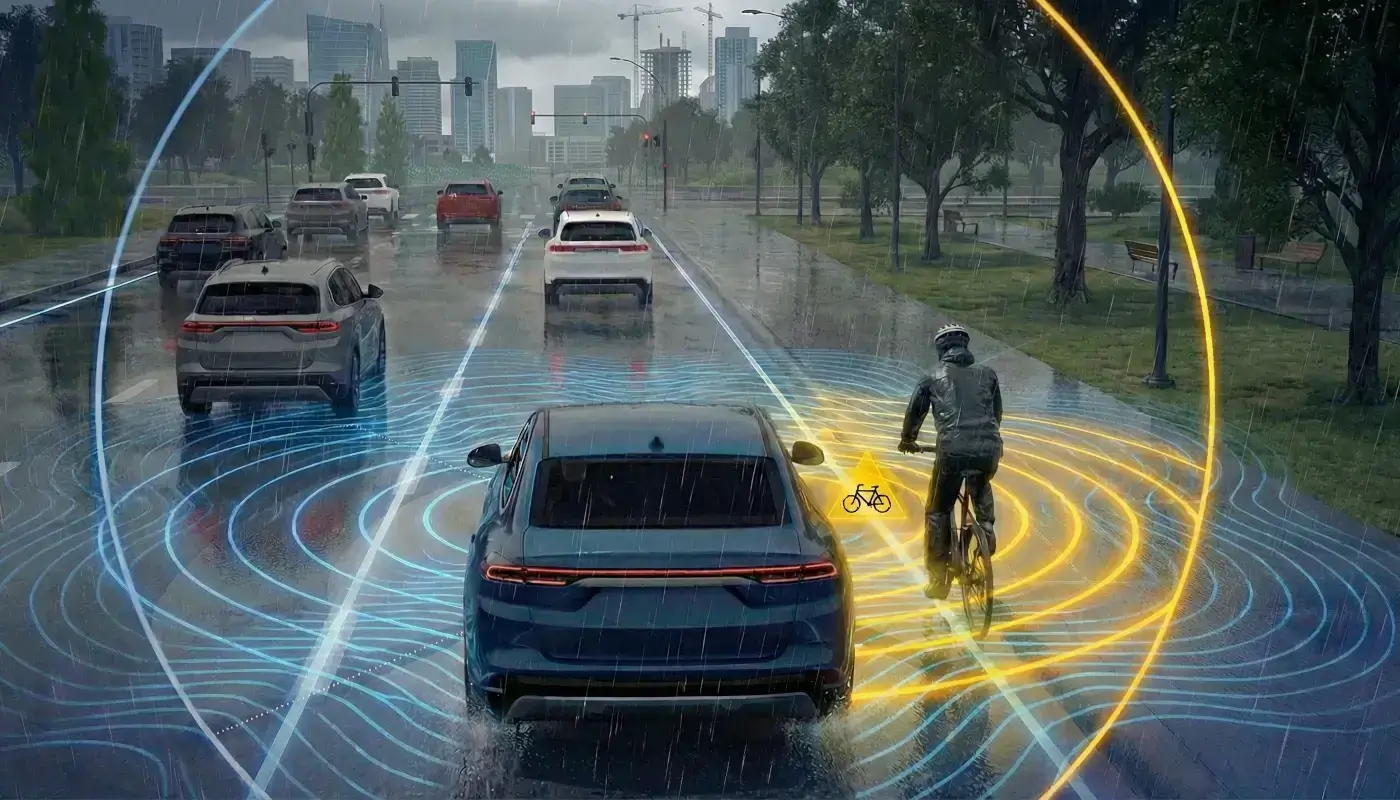
Türkiye's automotive industry is successfully crossing another critical threshold in the production of high value-added technology. Technology company Büyütech has announced the development of AI-based Advanced Driver Assistance Systems (ADAS) technology in collaboration with the TOFAŞ R&D Centre. Supported within the scope of the Technology-Focused Industrial Move (HAMLE) Programme, run by the Ministry of Industry and Technology and TÜBİTAK, this project was produced entirely with domestic resources, from hardware to software. Aiming to minimise traffic accidents, the new system, with its adaptations specifically for Türkiye's challenging road conditions, is being prepared for integration into mass-produced vehicles.
The automotive industry is rapidly evolving from hardware-oriented production towards software-based vehicles. At the heart of this transformation lie sensor and camera technologies that enable the vehicle to perceive its surroundings. The new ADAS project, realised by Büyütech together with TOFAŞ engineers, proves that Türkiye is not just a market but also a technology-producing centre in this new-generation mobility ecosystem.
Technical Capabilities Transforming the Vehicle into a Smart Travel Companion
The system developed by Büyütech engineers goes far beyond an ordinary camera, endowing the vehicle with the ability to see, analyse, and make decisions. The system incorporates critical safety functions that scan the driving environment in real-time and tolerate driver errors.
The key features offered by the new-generation ADAS platform in the field are as follows:
- Lane Keep Assist (LKA): The system reads road markings using high-resolution image processing algorithms. If the vehicle unintentionally drifts out of its lane without signalling, it warns the driver and intervenes in the electronic steering system to keep the vehicle in the lane.
- Automatic Emergency Braking (AEB): Potential collision risks are detected within milliseconds. In situations where the driver is slow to react, the system activates the brake actuators to bring the vehicle to an immediate stop.
- Intelligent Speed Assistance (ISA) and Night Vision: The camera reads traffic signs, automatically integrating speed limits into the vehicle. Furthermore, its AI-powered analysis capability can detect pedestrians or obstacles in advance during night driving that might be missed by the human eye.
- Driver Drowsiness Warning: The behaviour and attention level of the driver behind the wheel are continuously monitored. When signs of fatigue or distraction begin to appear, the system ensures driving safety through audible and visual warnings.
Rigorous Testing Process in Real Road Conditions
For a safety system to go into mass production in passenger cars, it must fully meet international automotive standards. Therefore, Büyütech and the TOFAŞ R&D Centre subjected the system to a demanding test marathon, ranging from simulations to real roads.
In the first phase, various accident and weather scenarios were modelled using digital twins. Subsequently, emergency braking and manoeuvre validation tests were conducted on closed test tracks. The system's greatest technical advantage is that it has been trained under Türkiye's unique geographical and climatic conditions. Tests carried out in rainy weather, on faded lane markings, or in heavy city traffic elevated the system's hardware reliability to the highest level. With the completion of vehicle integration and electrical validation tests at the TOFAŞ R&D Centre, the ADAS technology has reached the maturity to be directly introduced to the assembly line.
The HAMLE Programme and High Value-Added Domestic Production
The HAMLE (Technology-Focused Industrial Move) Programme is a strategic initiative designed to increase Türkiye's high value-added production. Managed by institutions such as the Ministry of Industry and Technology, TÜBİTAK, and KOSGEB, the programme provides R&D and investment support in medium-high technology sectors. Launched in 2022, this programme offers grant rates of up to 60% for large companies and up to 75% for SMEs.
Calls are made within the scope of HAMLE based on predetermined priority product lists. Initiatives like Büyütech's ADAS project develop innovative solutions by resolving scientific uncertainties. As part of the 2030 Industry and Technology Strategy, the programme encourages investments across a wide spectrum, from automotive to the defence industry. With recent updates, new calls have also been opened in fields such as health and chemicals. The programme aims to reduce Türkiye's foreign dependency.
Global Vision and the Zero Accident Goal
As emphasised in the company's official announcements, the ultimate goal of this technology is to minimise traffic accidents, aiming for the target of zero accidents, zero loss of life. International research proves that effective ADAS systems such as AEB and LKA can reduce accident-related injuries by 47% to 93%.
By adding TOFAŞ to its collaborations with giants like Togg and Ford Otosan, the company is advancing towards a dominant position in the domestic mobility market. Consequently, this technology will not only make Türkiye's roads safer but will also increase the competitiveness of the Turkish automotive industry in European and global markets, creating a brand new, high value-added technology export item.
