


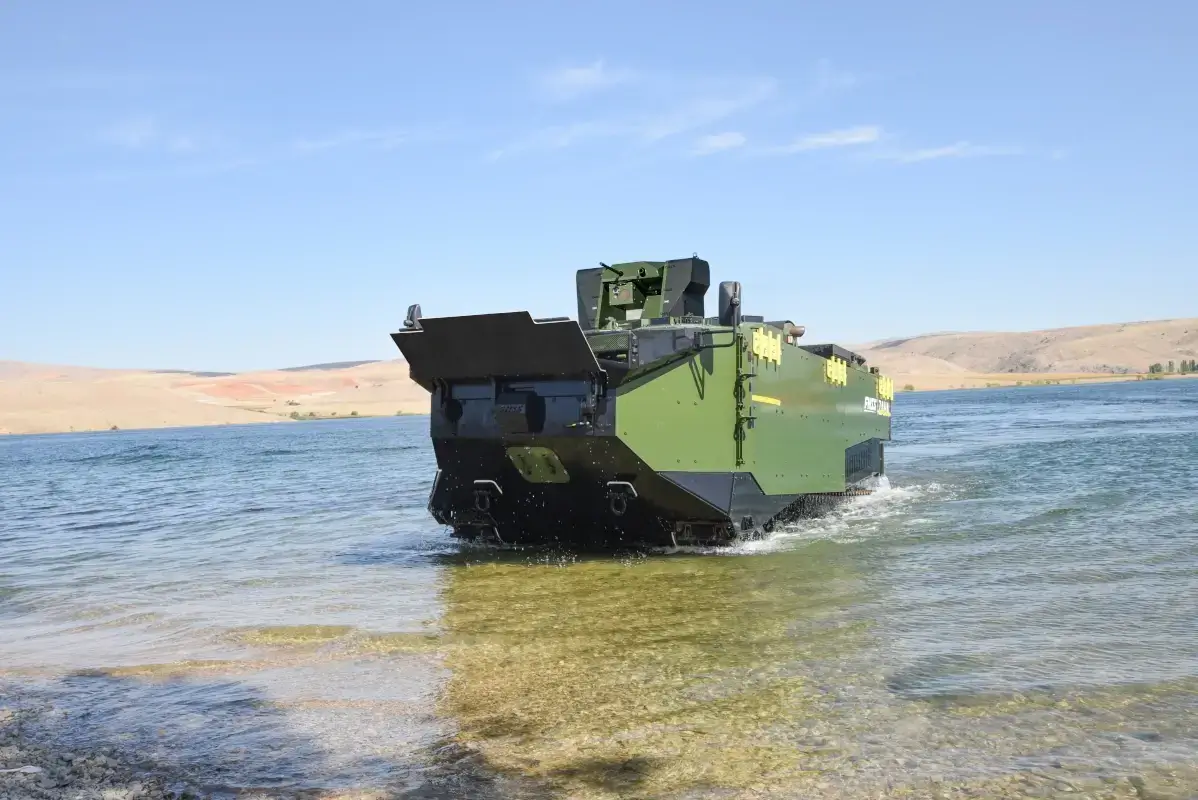
The world's first UAV carrier ship, TCG Anadolu, delivered a powerful display of strength during the NATO Exercise Steadfast Dart 2026, not just with its air power, but with its amphibious capabilities as well. As Bayraktar TB3s launched from its deck made history in the sky, the FNSS-manufactured Armoured Amphibious Assault Vehicles (ZAHA) launching from the ship's well dock into the water captured the attention of NATO commanders just as much as the UAVs. Here is an insight into the development process, technical superiority, and global comparison of this strategic platform, designed as the master of both sea and land, a asset possessed by only a select few militaries in the world.
Amphibious operations are one of the most complex and risky types of operations in military doctrine. A unit must disembark from a safe ship, cross the undefended surface of the sea, and land on a beach exposed to enemy fire, and hold on there. The solution that Türkiye developed to bridge this deadly gap is called ZAHA. Launched from the dock of TCG Anadolu during the Steadfast Dart 2026 exercise, the ZAHA fleet, cutting through the waves to reach the shore, has taken the operational range and strike power of the Turkish Marines to a new level.
An Engineering Challenge: The Development and Testing Process
When FNSS engineers embarked on the ZAHA project, they faced a formidable equation on the table: a vehicle needed to be hydrodynamic like a boat at sea, armoured and agile like a tank on land, and fully compatible with an LHD ship like TCG Anadolu.
Throughout this process, the ZAHA underwent tests that few vehicles in the world are subjected to. The most iconic among these was the Self-Righting Test. In the event of a rollover in challenging sea conditions (Sea State 4), the vehicle needed to be able to right itself within seconds, along with its crew. Thanks to the precise engineering of its centre of gravity, the ZAHA successfully passed this test. Furthermore, during mine and ballistic tests, the hull design's shock-absorption capability and armour resistance were proven.
Armoured on Land, a Vessel at Sea
The primary feature distinguishing the ZAHA from standard Armoured Personnel Carriers (APCs) is its hybrid structure.
- Maritime Performance: The ZAHA can reach speeds of up to 7 knots (approximately 13 km/h) at sea, thanks to its specially designed, powerful water jets located at the rear. This is a remarkably high speed for an armoured box weighing several tonnes. Its hull is manufactured in a hydrodynamic form to minimise water resistance.
- Land Performance: The ZAHA, which switches off its water jets and powers its tracks as soon as it reaches the shore, can reach speeds of 70 km/h on land. Its ability to climb a 60% steep incline and maintain traction on a 40% side slope makes it unstoppable in challenging coastal terrain (sand, mud, rocky). Furthermore, its ability to overcome 90 cm vertical obstacles and 2-meter deep trenches makes it a fully-fledged armored combat vehicle.
- Power and Transmission: With a power-to-weight ratio of 20 Bhp/tonne, the ZAHA is one of the most agile vehicles in its class. Its fully automatic transmission provides the driver with maximum control both at sea and on land.
Firepower: The ÇAKA Remotely Controlled Turret
ZAHA is not just a personnel carrier, but also a fire support platform. FNSS developed the ÇAKA Remote Controlled Turret (RCT) system specifically for this vehicle. This turret, named after Çaka Bey, is:
- It is equipped with a 12.7 mm machine gun and a 40 mm automatic grenade launcher.
- Specially reinforced against the corrosive effects of seawater, ensuring corrosion resistance.
- Designed to allow the gunner to acquire and engage targets using day/night vision systems without leaving the vehicle's armour protection.
Global Competitors and ZAHA's Position
The number of countries capable of producing vehicles in the ZAHA class worldwide can be counted on one hand. ZAHA's position on the global stage becomes clearer when compared to its competitors:
- AAV7 (USA): The legendary vehicle long used by the US Marine Corps. However, the AAV7, built on 1970s technology, suffers from weak ballistic protection and is considered inadequate against modern threats. ZAHA offers significantly superior armour protection, mine resistance, and a modern electronic infrastructure compared to the AAV7.
- ACV (BAE Systems / Iveco - USA): The US Marine Corps' new-generation 8x8 wheeled vehicle replacing the AAV7. While the wheeled ACV is fast on land, the ZAHA's tracked design provides superior mobility and traction in difficult and soft terrain (wet sand, marshes) compared to its wheeled rival.
- ZBD-05 (China): China's amphibious vehicle can achieve very high speeds (20+ km/h) by planing on the water's surface. However, this speed comes at a significant cost, with a major compromise in armour protection. The ZAHA, in contrast, optimises the balance between speed and protection with its NATO-standard survivability (STANAG 4569), maximising the chances of personnel survival.
Strategic Importance for TCG Anadolu and the Blue Homeland
The induction of the ZAHA into the inventory has solidified the Turkish Naval Forces' Over the Horizon operational capability. Without the need for a valuable asset like TCG Anadolu to approach too close to the shore, ZAHAs can launch from kilometres offshore, conducting surprise raids on enemy coastlines.
Thanks to advanced onboard communication systems and the Battlefield Management System, ZAHA vehicles contribute to Network-Centric Warfare capabilities by continuously sharing data with ships, UAVs in the air, and other ground elements.
With a carrying capacity of 21 personnel (Driver, Gunner, Commander + 18 Marines), a ZAHA can rapidly transport an amphibious battalion ashore. With variants including personnel carrier, command, recovery, and engineer versions, this platform has become the new symbol of deterrence in the defence of the Blue Homeland, serving as the Steel Claw of TCG Anadolu.
