


The history of warfare has followed a trajectory parallel to the evolution of launch technologies. The transition from bows and arrows to catapults, and then to firearms with the discovery of gunpowder, fundamentally changed the striking power and strategic depth of armies. The centuries-long era of "chemical propulsion" (gunpowder) has reached its physical limits in the first quarter of the 21st century. The burning rate and expansion coefficient of gunpowder are insufficient to propel projectiles beyond a certain speed, creating a natural ceiling on range and striking power. It is precisely at this point that Electromagnetic Launch Systems (EMFS), or "Railgun" as it is commonly known, which has entered the defense industry literature as a "Game Changer," come into play.
By 2026, Turkey will be one of the few countries (along with the US, China, Russia, and France) that is not only following but also actively developing and testing this revolutionary technology. The work, coordinated by the Presidency of Defence Industries (SSB), and spearheaded by institutions such as TÜBİTAK SAGE, ASELSAN, YETEKNOLOJİ A.Ş., and MKE, has progressed from laboratory testing to open-field testing. This article delves into Türkiye's electromagnetic gun journey, the technical maturity levels of the projects in 2026, the engineering challenges encountered, and the current status of the project's path to inclusion in the Turkish Armed Forces (TSK) inventory.
What is electromagnetic launch?
Before delving into the details of national projects, it's necessary to understand the working principle of these systems and why they are called "weapons of the future." Unlike conventional cannons, electromagnetic cannons do not use gunpowder or any chemical explosives to generate propulsion. The system is based on the Lorentz Force principle. A conductive projectile (or armature) placed between two parallel conductive rails creates magnetic fields thanks to the enormous electric current supplied to the system. The interaction of these magnetic fields propels the projectile along the rails, causing it to be launched from the muzzle at hypersonic speeds (five times the speed of sound and above).
The strategic advantages offered by this technology are as follows:
- Hypersonic Speed: The projectiles can reach speeds of Mach 6 to Mach 9 (9 times the speed of sound). This speed leaves no time for the target to perform evasive maneuvers or for air defense systems to react.
- Kinetic Energy Destruction: The projectile is so fast that it doesn't need an explosive warhead upon impact. Its impact energy alone is sufficient to penetrate even the thickest armor or disable ships.
- Logistics and Security: The risk of transporting thousands of tons of explosive ordnance on ships or land vehicles is eliminated. This reduces the risk of the platform exploding in the event of a hit to zero.
- Cost-Effectiveness: While the cost of a missile is measured in millions of dollars, electromagnetic cannon ammunition is much less expensive and can provide similar range (100+ km).
Türkiye's National Projects and 2026 Vision
Turkey, under the leadership of the Presidency of Defense Industries (SSB), is adopting a "holistic" approach to this field. Instead of a single institution, state institutions, military companies, and private sector initiatives are carrying out projects in different areas. The status analysis of these projects as of 2026 is as follows:
A. TÜBİTAK SAGE and SAPAN Project
Türkiye's first serious step in this field is the SAPAN project, conducted by the TÜBİTAK Defense Industry Research and Development Institute (SAGE). Launched in 2014, the project was designed not to produce a weapon system, but rather for Türkiye to learn this technology, understand its physics, and develop national algorithms.
SAPAN, whose first prototype was introduced in 2016, achieved a level of success exceeding its targets when it was completed in early 2021. While the initial target was 1 Megajoule (MJ) of energy and a speed of 2040 meters per second; at the end of the project... 1.3 MJ of energy And 2070 m/s (approximately Mach 6) Muzzle velocity was obtained.
From a 2026 perspective, SAPAN is a "pioneer that has completed its mission." Although the project did not directly go into the field, the critical data obtained (in-barrel ballistics, high-current physics, material strength) formed the basis for Türkiye's hypersonic ammunition development efforts. As Institute Director Gürcan Okumuş stated, the "know-how" gained from SAPAN has now evolved into guided hypersonic ammunition technologies. SAPAN is the first concrete evidence that Türkiye can say, "We can do this technology.".
B. ASELSAN and TUFAN: Industrial Power and Speed Records
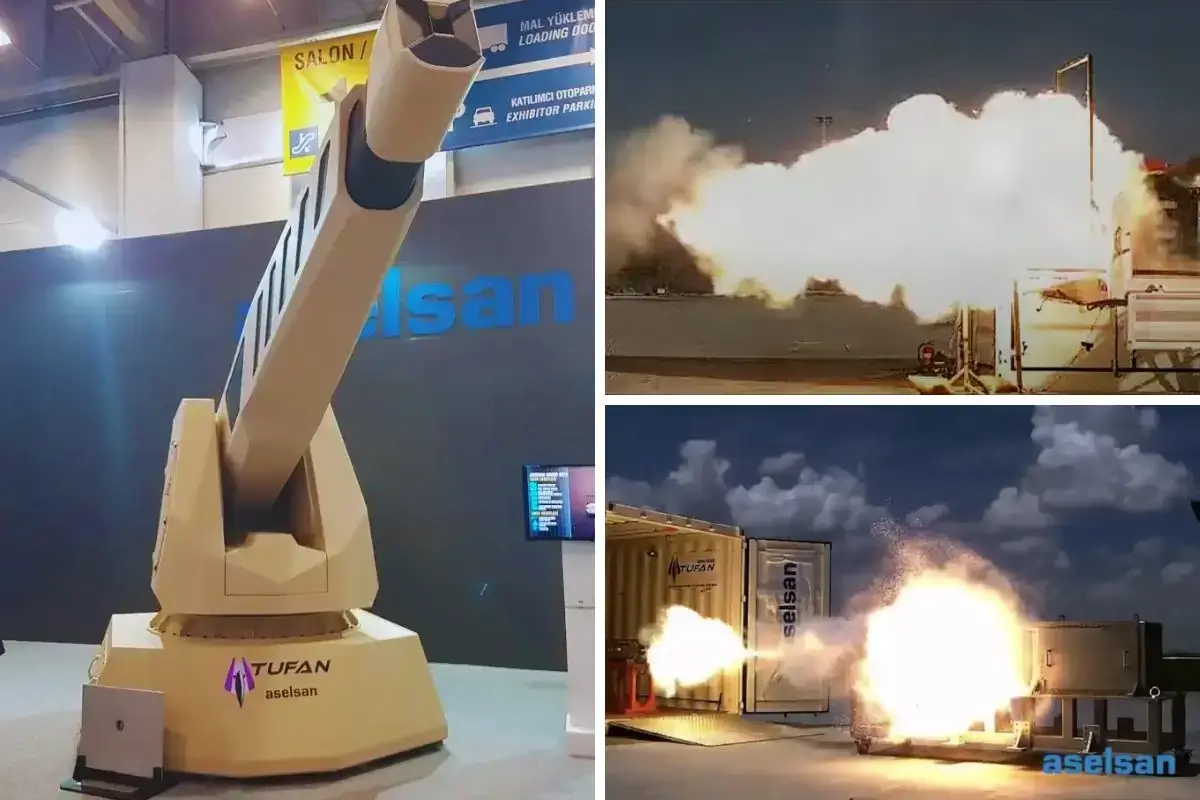
ASELSAN, Türkiye's defense industry giant, is conducting the most comprehensive program aimed at bringing electromagnetic launch technology from the laboratory to the battlefield with the TUFAN project. Work that began in 2014 became visible with the launch at the 2017 IDEF exhibition and gained momentum with the establishment of a dedicated laboratory infrastructure in 2019.
As of 2026, the TUFAN project has reached a point where it presents competitive data at world standards. In particular, the test firings conducted in Konya-Karapınar in 2023 marked a turning point for the project. During these tests, under the supervision of the Head of the Defense Industry, İsmail Demir, the ammunition... 3000 meters per second (approximately Mach 9This speed has been increased to three times that of conventional cannons, a speed unimaginable for gunpowder-based systems.
ASELSAN's approach is not limited to just developing gun barrels. The localization of massive capacitor banks, called "Pulsed Power Supplies," which store and release energy in milliseconds, is TUFAN's greatest achievement. The system, which surpassed the 1 MJ energy barrier in 2019, is now scaling to much higher energy levels (towards the 5-10 MJ range).
The ultimate target of TUFAN is the Turkish Armed Forces' naval and land elements. Specifically, TUFAN is planned to be used on future ships such as the TF-2000 Air Defense Warfare Destroyer, or on land-based long-range artillery batteries. Although not in mass production by 2026, TUFAN continues field testing as one of the most mature systems in terms of "technology readiness level" (TRL).
C. TECHNOLOGY and SHAHI-209
One of the most notable players in Türkiye's electromagnetic cannon ecosystem is YETEKNOLOJİ A.Ş., based in OSTİM. Operating with the dynamism of the private sector, far removed from the cumbersome nature of state institutions, the company is pursuing a strategy of progressing "in blocks" with its ŞAHİ-209 project.
- Block-1: It has proven its capabilities by launching a 300-gram projectile 12 km away with 1 MJ of energy.
- Block 2: This version, considered the main strategic product, is at the center of testing processes as of 2026. Block-2, with a barrel length of 7 meters, 10 Megajoules with its energy capacity, 35 mm diameter ammunition 50 km range It aims to deliver.
The most important feature that distinguishes the ŞAHİ-209 from its competitors is what it demonstrated in tests in 2019. “"Rape Shot"” And “"Warhead Munitions"” YETEKNOLOJİ has achieved the capability of launching not only kinetic penetrating munitions but also electromagnetically fired munitions with fuses that detonate on the target. Furthermore, thanks to their developed rapid-fire charging system, the system's ability to fire in quick succession is a critical advantage for tactical field use. While the company states that it can integrate the system into a land vehicle or ship within a year if requested, as of 2026, there has been no official inventory entry yet. However, the 10 MJ energy level is a significant threshold that elevates the ŞAHİ-209 from tactical to operational class.
D. MKE and Supply Chain
Machinery and Chemical Industry Corporation (MKE) plays a role as a "silent force" in this equation. With a century of experience in cannons and ammunition, MKE is a key stakeholder in the barrel metallurgy, high-pressure resistant materials, and ammunition body designs of electromagnetic cannons. The thermal shock and friction forces experienced by a railgun barrel during firing push the boundaries of materials science. MKE's contributions in this field are vital for solving the "barrel life" problem of these systems.
Turkish Armed Forces Inventory and Operational Status (2026)
By 2026, the question on the public's mind will be: "Will these weapons still be in the Turkish Armed Forces' inventory?"“
Based on current data and analysis, the Turkish Armed Forces have an active, combat-ready electromagnetic gun system in their inventory. It is not available yet. No operational railguns have been deployed in either ground forces or naval vessels.
However, this situation should not be interpreted as a failure, but rather as a "maturation process" inherent in the nature of technology. The Turkish Armed Forces are participating at a high level in the ŞAHİ-209 and TUFAN tests and are closely monitoring the concept. The Presidency of Defense Industries' vision is to acquire these systems for "trial purposes".
In the short term (2027-2028), it is highly likely that a limited number of prototypes will be added to the inventory for "user trials" on test ships or special-purpose land vehicles. The Turkish Armed Forces maintains its strategy of not making mass purchases without first experiencing the logistical burden (power supply), maintenance intervals (barrel replacement), and strike accuracy of the technology in the field.
Technical Challenges and the Search for Solutions
The obstacles to the integration of electromagnetic launch systems into the inventory are not unique to Türkiye; the laws of physics are universal. The main challenges that Turkish engineers are trying to overcome by 2026 are as follows:
- Power Density and Storage: A railgun shot demands an amount of power equivalent to the instantaneous electricity consumption of a city in milliseconds. Reducing the size of "Compact Pulse Power Units" (CPUs) that can store this energy in ships or tactical vehicles is the biggest engineering challenge. ASELSAN and YETEKNOLOJİ have succeeded in reducing these units to container size through modular designs.
- Barrel Wear (Erosion): The friction of metal moving at Mach 9 speed against the rails, and the resulting plasma arc, wears down the barrel with each shot. One of the reasons the US Navy halted the project was that the barrel became unusable after only 10-20 shots. In Turkish projects, the goal is to extend the barrel life to hundreds of shots through special alloy rails and advanced cooling techniques.
- Guided Munition Challenge: The "G-force" (thousands of G) and electromagnetic field that a projectile is subjected to as it leaves the barrel can burn or destroy the electronic circuits (guidance kit, fuse) inside the projectile. TÜBİTAK SAGE and ASELSAN are working on "hardened electronics" that can withstand these extreme conditions. Because "smart ammunition" is essential to hit a moving target 100 km away.
Global Competition and Türkiye's Position
To understand Türkiye's place in the electromagnetic ball league, one needs to look at its competitors:
- USA: At one point, it was a leader with its legendary 32 MJ prototype. However, in 2021, the Navy froze the project due to budget constraints and technical difficulties (barrel life) and focused on hypersonic missiles. This is proof of how challenging the technology is.
- Chinese: They are currently the most aggressive player. In 2018, they began sea trials with a massive railgun mounted on a landing craft. As of 2024, they are leading the way with guided missile tests and claims of a range of 200+ km.
- Russia: They mainly conduct scientific research on a laboratory scale, using small-weight projectiles. They are far from an operational weapon system.
What Makes Türkiye Different: Instead of focusing on "very large and cumbersome" (32 MJ) systems like the US, Turkey has focused on more manageable, tactical-scale (between 1-10 MJ) and "sustainable" systems. With the TUFAN system, which reaches Mach 9 (3000 m/s), and the ŞAHİ-209, capable of rapid fire, Turkey is one of the most agile members of the "capable" club in this technology. By filling the gap left by the US, Turkey, along with China, is one of the countries closest to bringing this technology to the field.
Future Perspective: What is Türkiye's Vision?
The 2026 Status Analysis shows that Türkiye has passed the "Proofing" phase in electromagnetic launch technology. The process is now in the "Productization" phase.
The expected developments in the next 5-year projection (2026-2030) are as follows:
- Air Defense Role: Railguns will evolve not only to hit ships, but also as "Air Defense Guns" to hunt down hypersonic missiles and aircraft. Their high muzzle velocity makes them a more effective interceptor than even the fastest missiles.
- Ship Integration: The MİLGEM TF-2000 Air Defense Destroyer project is the most suitable platform for the integration of TUFAN. The ship's high energy production capacity can provide the electricity required for the railgun.
- Hybrid Use: Intermediate solutions involving the hybrid use of electromagnetic cannons with gunpowder systems (e.g., electro-thermal chemical) may come into play.
Conclusion
Türkiye's journey in developing National Electromagnetic Launch Systems has reached strategic maturity by 2026. The seeds sown by TÜBİTAK SAGE with SAPAN, the speed records broken by ASELSAN with TUFAN, and the private sector agility brought by YETEKNOLOJİ with ŞAHİ-209 have made Türkiye a global player in this field.
We may not yet see thousands of railguns in the Turkish Armed Forces' inventory; however, projectiles reaching nine times the speed of sound in laboratories prove that the vision of the Turkish defense industry is "beyond the horizon." Having been dependent on or lagging behind in conventional gunpowder technology for centuries, Turkey is now at the "locomotive of the train" in the electromagnetic age. The engineering challenges are immense, but the potential reward—complete independence and asymmetric superiority in defense—more than makes the effort worthwhile.
Comparative Analysis Table of Railgun Systems
The table below summarizes the technical data and operational status of national projects in Türkiye and similar electromagnetic gun systems worldwide as of 2026.
| System Name | Developer / Country | Current Situation (2026) | Muzzle Velocity | Energy Capacity | Range / Notes |
| FLOOD | ASELSAN (Türkiye) | Field Tests (Prototype) | ~3000 m/s (Mach 9) | >1 MJ (Increasing) | Target: Long-Range Artillery / Air Defense |
| SHAHI-209 Block-2 | TECHNOLOGY (Türkiye) | Field Tests (Prototype) | ~2000+ m/sMach 6+) | ~10 MJ (Target) | 50 km (Ballistic Range) / Rapid Fire Capability |
| SLING | TÜBİTAK SAGE (Türkiye) | Completed (2021) | ~2070 m/sMach 6) | 1.3 MJ | Technology Demonstration / Provided Knowledge Accumulation |
| EMRG | U.S. Navy (US) | Project Halted (2021) | ~2500 m/s (Mach 7.5) | 32 MJ | The project was cancelled, and focus shifted to hypersonic missiles. |
| Naval Railgun | PLAN (China) | Testing on the Ship | Mach 5 | Estimated 5-10+ MJ | Claim of a 200 km+ range / The most active competitor |
| Lab Railgun | IVT RAN (Russia) | Laboratuvar Ar-Ge | ~3000 m/s | < 0.1 MJ | Sadece bilimsel araştırma, askeri ürün yok |
