


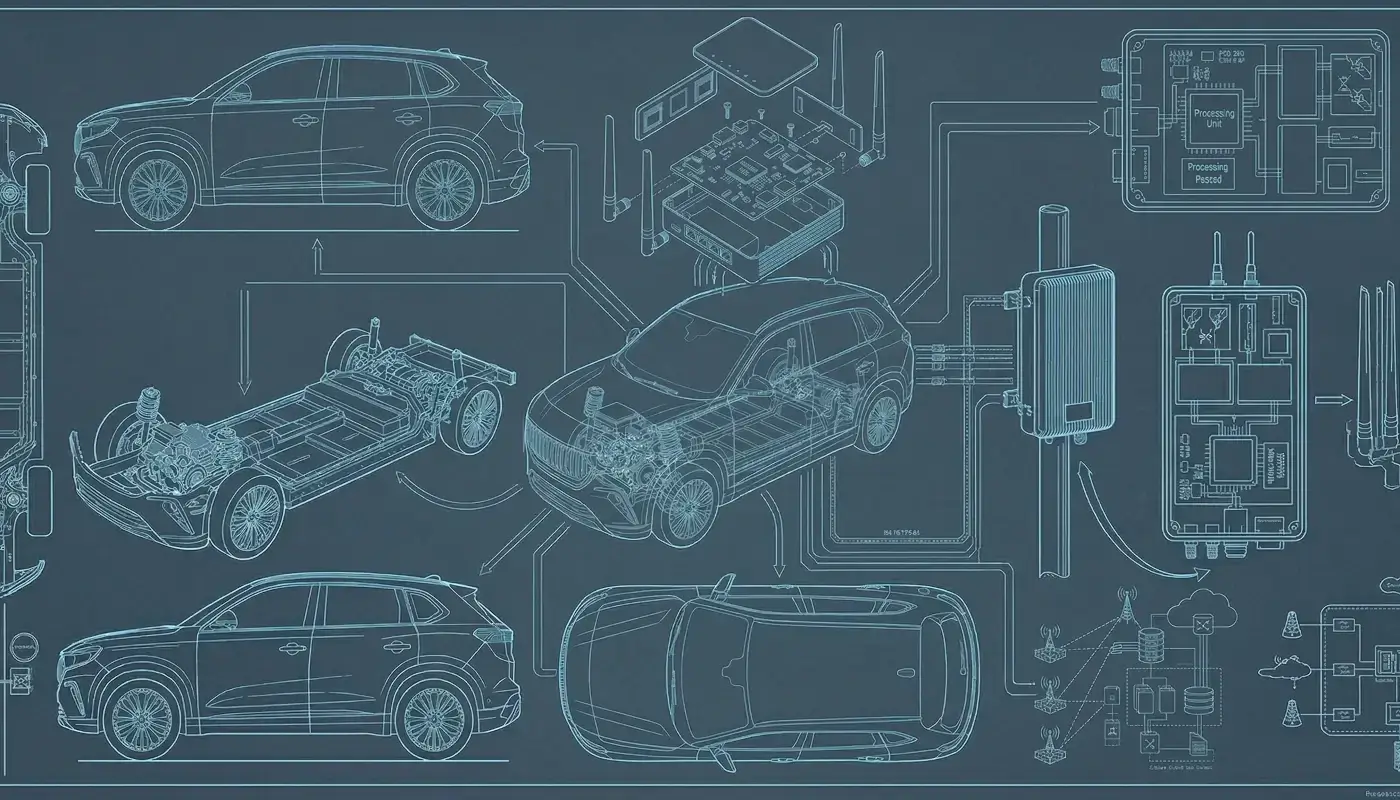
Türkiye's technology development capacity reached an all-time high in 2025. Minister of Industry and Technology Mehmet Fatih Kacır shared the 2025 domestic patent and utility model statistics with the public, based on TÜRKPATENT data. According to the official figures released, domestic patent applications increased by 12 percent compared to the previous year, reaching 11,394. This growth, led by telecommunications and automotive giants, proves Türkiye's vision of value-added production with concrete data.
The fundamental condition for surviving in global competition is no longer just producing, but owning the intellectual property rights of the technology produced. In line with the National Technology Move vision, Türkiye continues to accelerate its efforts in this field. The 2025 data announced by Minister Mehmet Fatih Kacır reveals the maturity level reached by the country's innovation ecosystem. The 10 percent increase in registrations (3,738 registrations), not just applications, documents that ideas are successfully transforming into concrete and protectable technologies.
Corporate Leaders: Telecommunications and Automotive Stand Out
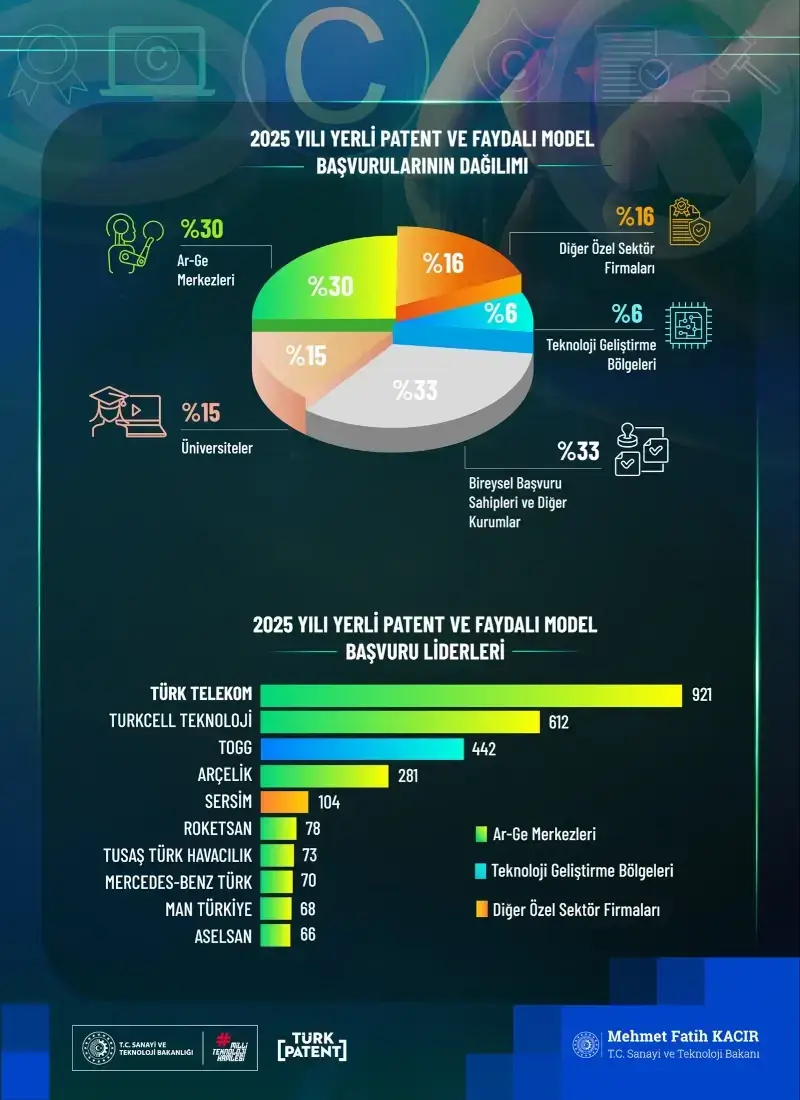
Technology, communication, and mobility companies did not relinquish the top spots in the list of patent and utility model application leaders. Türk Telekom became the absolute leader of 2025 with 921 applications. It was followed by Turkcell Teknoloji with 612 applications. Türkiye's domestic car, Togg, ranked third with 442 patent applications. This performance by Togg clearly demonstrates that the modern automotive sector has transformed from mechanical production into a vast software and technology ecosystem.
Furthermore, defence industry companies also made their weight felt in technology development on the list. Roketsan (78 applications), TUSAŞ (73 applications), and ASELSAN (66 applications) secured places in the top 10, securing intellectual property rights in critical defence technologies on a national scale.
According to official TÜRKPATENT data, the top 10 companies with the most domestic patent and utility model applications in 2025 are as follows:
- Türk Telekom: 921 Applications
- Turkcell Teknoloji: 612 Applications
- Togg: 442 Applications
- Arçelik: 281 Applications
- Sersim: 104 Applications
- Roketsan: 78 Applications
- TUSAŞ Türk Havacılık: 73 Applications
- Mercedes-Benz Türk: 70 Applications
- MAN Türkiye: 68 Applications
- ASELSAN: 66 Applications
The Difference Between Patent and Utility Model
What do these two concepts, frequently seen side by side in these statistics, actually mean for technology producers in the field?
A patent protects ground-breaking innovations that are completely new worldwide and involve an inventive step, meaning those that an expert in the field could not easily conceive, and generally grants the inventor a 20-year exclusive right.
A utility model, often known as a "small patent" in industry, covers functional improvements and practical design developments made to an existing product that are applicable to industry. The strict inventive step requirement is not sought for utility models. The utility model process is faster and less costly. With a 10-year protection period, it secures quick engineering solutions that are ready for immediate commercialisation. The simultaneous increase of these two mechanisms in the announced data shows that Turkish industry is exhibiting coordinated growth both in basic sciences (deep technologies) and in market-oriented rapid innovations.
Which Sectors are Growing?
The sectoral distribution of applications reveals Türkiye's technological transformation roadmap and future industrial targets. According to the statistics, the highest number of patent applications was in the field of Computer Technologies with 718 applications. This was followed by Digital Network Systems with 657 applications and the Transport and Logistics sector with 475 applications.
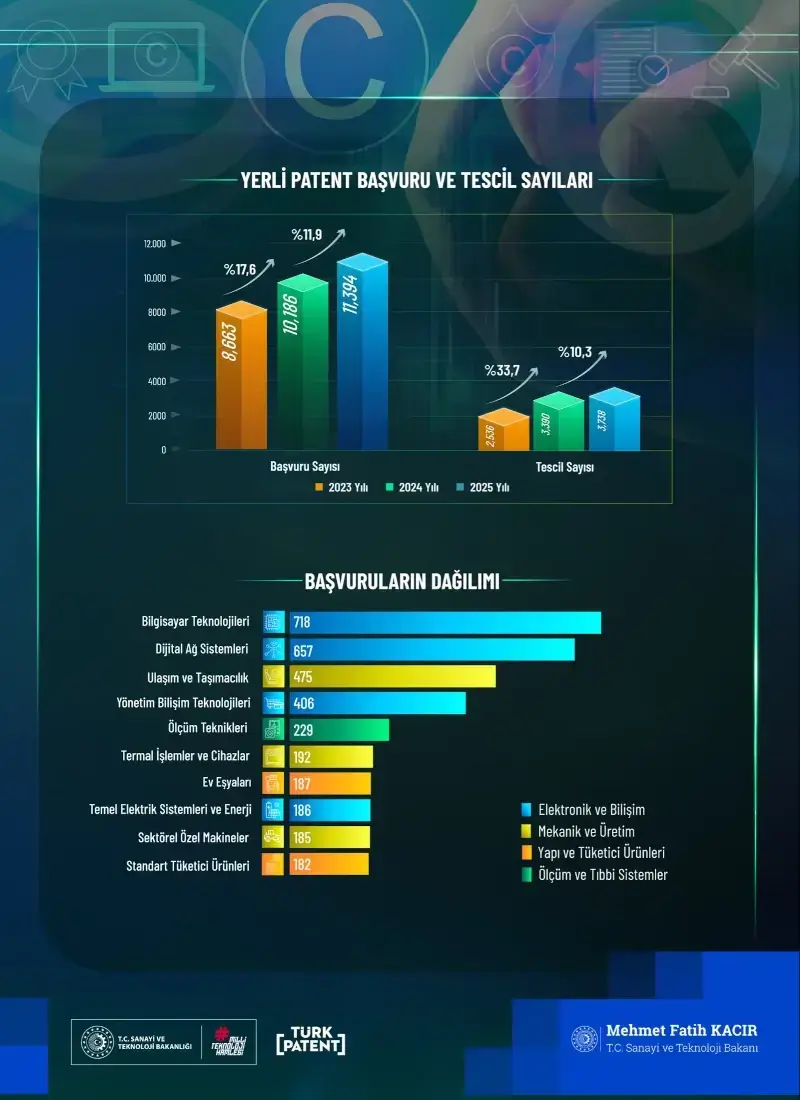
These sectoral figures prove that investments in artificial intelligence, the Internet of Things (IoT), and smart mobility networks are bearing fruit. Companies are investing in software architectures and communication network systems rather than traditional hardware to gain a competitive advantage in international markets.
The Strategic Role of R&D Centres and Universities
The synergy established between industry and academia in the patent production process is of great importance. According to the data, 30 percent of total applications came directly from the private sector's R&D centres. Universities played a critical role in transferring academic knowledge to industry, accounting for a 15 percent share. Additionally, Technology Development Zones (Technoparks) accounted for 6 percent of total applications. In short, this integrated structure documents that the speed at which innovative ideas move from the laboratory to commercial products is increasing.
Türkiye is rising to the position of a country that develops its own technology and registers the usage rights of this technology in its own name. As Minister of Industry and Technology Fatih Kacır emphasised, this steady rise in intellectual property applications directly adds strength to the country's economic independence. In the coming years, this vast intellectual property pool is expected to strongly reflect on high value-added export figures and competitive advantage in the global market.
