


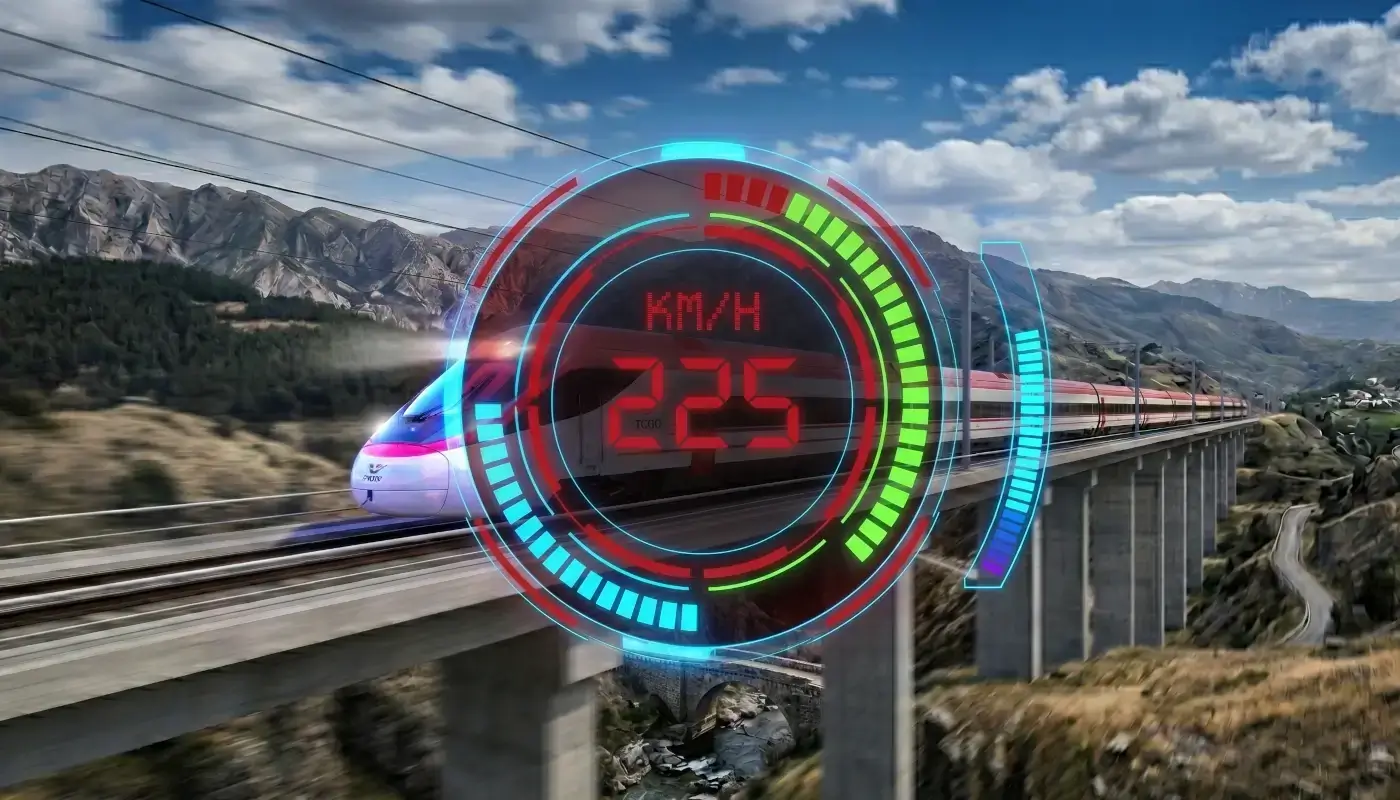
The Turkish transport industry has left behind another historic threshold on the path to full independence in railways. Minister of Transport and Infrastructure Abdulkadir Uraloğlu announced that the domestic and national first high-speed train successfully reached a speed of 225 kilometres per hour on the second day of its dynamic braking tests. This critical verification, conducted on the Mithatpaşa-Bilecik line, proved the train's ability to stop safely at high speeds in the field. Consequently, Türkiye has inscribed its name among the select few global actors capable of designing, producing, and testing such complex platforms under real track conditions.
Dynamic Braking and 225 km/h Speed
The most complex engineering process in high-speed trains is not accelerating the vehicle, but safely stopping a mass weighing hundreds of tonnes moving at 225 kilometres per hour without derailing or causing discomfort. Therefore, braking tests constitute the most vital safety phase in the international certification process of the vehicle.
The dynamic braking system uses the train's traction motors as generators, converting kinetic energy into electrical energy and slowing down the vehicle. Thanks to this technology, wear and overheating of mechanical brake pads are minimised. According to Minister Uraloğlu's statements, the domestic high-speed train successfully passed this complex and critical phase in just two days. Even at an extreme speed of 225 kilometres, the system managed to prevent jarring in the carriages and maintain the braking distance within international standards. This achieved speed limit also proves that the train's aerodynamic design and bogie (wheel assembly) architecture provide flawless stability against wind resistance at high speeds.
The Localisation Revolution in Railways
In its early years of high-speed train operation, Türkiye imported train sets from abroad. The software updates and heavy maintenance of these supplied sets created a significant cost burden on the country through foreign currency-based contracts. However, the national train projects initiated under TÜRASAŞ, coordinated by the Ministry of Transport and Infrastructure, have fundamentally ended this foreign dependency.
The Mithatpaşa-Bilecik line, where the tests are being conducted, is known for its sharp curves, challenging gradients, and long tunnel structures. It is of great importance that the domestic train reached its maximum operational speed and passed the braking tests not on a flat plain but in such a challenging geography. This success clearly demonstrates that the platform will operate flawlessly on all of Türkiye's high-speed train lines with different topographies, such as Ankara-Sivas or Ankara-Istanbul.
Mass Production and Export
The domestic high-speed train successfully completing its dynamic braking tests by reaching 225 kilometres per hour heralds the start of the countdown for passenger transport. In the coming period, with the completion of signalling, software optimisation, and passenger comfort tests, these sets will be directly included in the TCDD Taşımacılık inventory.
Türkiye is not only weaving its own railway network with national technologies but also preparing to export high value-added, safe, and competitive high-speed trains to the global rail systems market with this immense engineering experience gained at TÜRASAŞ facilities.
Note
If you have any photos or video footage to support our news story, please share them with us using the information provided on our contact us page.
