


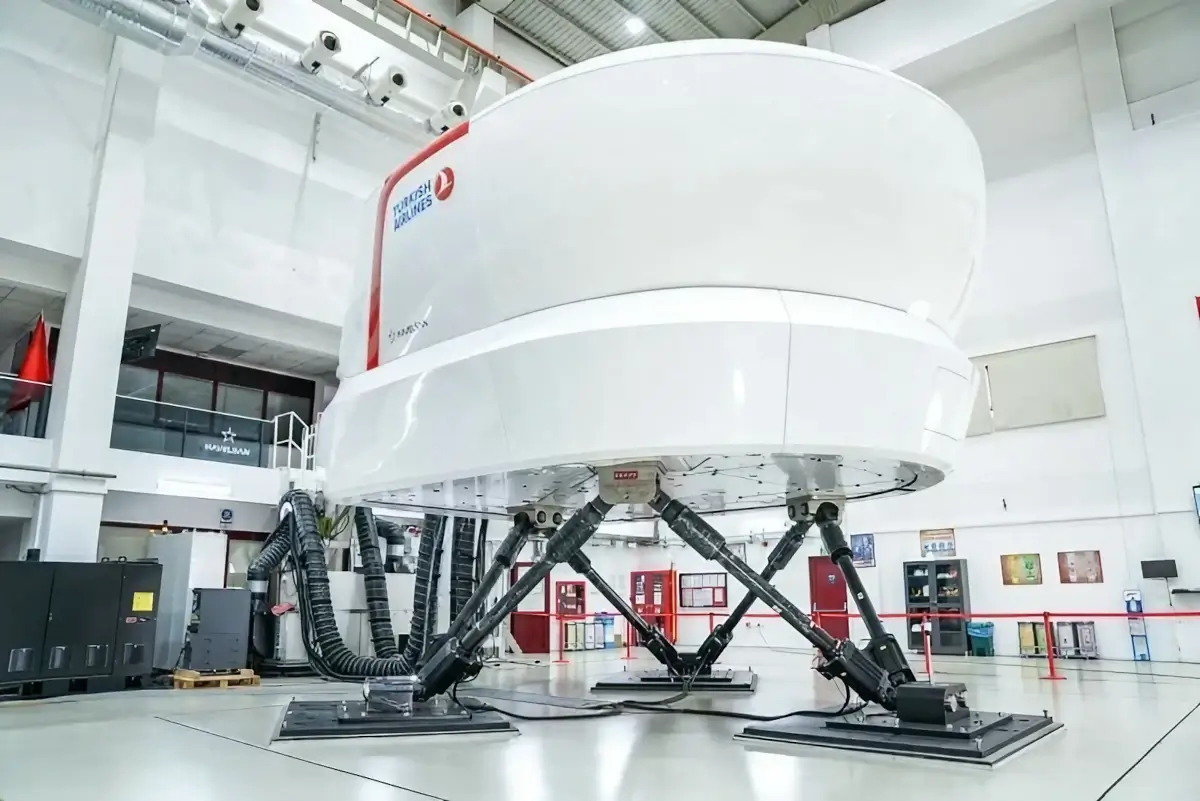
HAVELSAN, a leading company in the Turkish defense and IT industries, continues to prove its competence in civil aviation on a global scale. The company announced the addition of another B737 MAX-8 Full Flight Simulator (FFS) to its production line under a new agreement signed with global aviation giant Boeing. However, this agreement is more than just the production of a new device. The underlying technical details and strategic gains demonstrate that HAVELSAN has elevated its position in the simulator market from a manufacturer to a "global solution partner." Here are the details of this critical collaboration and its contributions to the domestic technology ecosystem.
Data Packet Obstacle in Simulator Production is Being Removed.
Aviation simulators must offer the most realistic flight experience possible. This realism is achieved through technical data and flight dynamics models provided by the aircraft manufacturer (OEM). Until now, HAVELSAN, in its B737 MAX simulators, generally obtained this critical "data package" from its client airlines. In other words, the process involved the airline receiving the data from Boeing and delivering it to HAVELSAN.
This new agreement fundamentally changes the process. HAVELSAN will now be able to obtain the data package for the simulators it develops for potential customers directly from Boeing. This will speed up bureaucratic processes and increase HAVELSAN's marketing capabilities. Therefore, the company will be able to present itself to potential customers much faster and in an integrated way with a ready-made solution.
Technical Specifications of B737 MAX-8 Full Flight Simulators
The B737 MAX-8 Full Flight Simulator, added to HAVELSAN's production line, represents the pinnacle of civil aviation training standards. These simulators allow pilots to experience all kinds of scenarios they might encounter in a real aircraft, in a safe environment on the ground.
Technological Infrastructure and Realism
These systems, developed by HAVELSAN engineers, are generally manufactured in accordance with EASA (European Aviation Safety Agency) or FAA (Federal Aviation Administration) Level D certification. Level D represents the highest level of fidelity a simulator can achieve. A pilot training on a simulator at this level can receive type training with "zero flight time" certification, without ever flying a real aircraft.
The basic components of a complete flight simulator system are as follows:
- High-Resolution Visual Systems: Wide-field, high-resolution projectors and image generators provide pilots with a realistic view of the outside world. Weather changes, day-night cycles, and runway details are simulated in detail.
- 6-Axis Motion System: The propulsion system, using electric or hydraulic actuators, physically transmits the aircraft's acceleration, turbulence, and maneuverability to the pilots.
- Cockpit Replication: All the avionics systems, buttons, displays, and flight control surfaces in the B737 MAX-8 cockpit are tactilely and functionally identical to their real-life counterparts.
Local Software and Engineering Capabilities
The most critical aspect of these simulators is the software running behind the hardware. HAVELSAN develops the software that models flight dynamics and acts as the brain of the simulator using domestic engineering expertise. Thanks to the agreement with Boeing, the aircraft's aerodynamic data will be directly integrated into the source code, maximizing the software's accuracy.
Competition and Strategic Importance in the Global Market
The civil aviation simulator market is dominated by giants like CAE and L3Harris worldwide. HAVELSAN's direct data supply agreement with an original manufacturer (OEM) like Boeing makes the Turkish company a respected player in this league of giants.
This strengthened collaboration with Boeing increases HAVELSAN's potential to export not only to local customers like Turkish Airlines, but also to international airlines. These systems, which create millions of dollars in added value per simulator, are one of the most important items that increase the export value per kilogram in Türkiye's technology exports.
Cost and Safety in Civil Aviation Training
The B737 MAX series is one of the most widely used narrow-body aircraft worldwide. The demand for pilots and consequently training for these aircraft is constantly increasing. Training with real aircraft is both very costly and risky. Furthermore, considering environmental factors and fuel consumption, simulators are indispensable.
The simulators produced by HAVELSAN provide airline companies with the following advantages:
- Low Operating Costs: It runs on electrical energy instead of real aircraft fuel.
- Risk Management: Emergency scenarios such as engine failure, fire, or severe weather conditions can be handled safely.
- Accessibility: It offers 24/7 training opportunities, unaffected by factors such as aircraft maintenance or unfavorable weather conditions.
This agreement signed between HAVELSAN and Boeing is not just a trade move, but also a declaration of confidence. A Turkish company's deepening presence in the "certified supplier" ecosystem of one of the world's largest aircraft manufacturers summarizes the level reached by domestic engineering.
Direct access to data packets will shorten production times and make HAVELSAN more agile in global tenders. This development makes a concrete contribution to Türkiye's goals of becoming a country that develops and exports high-tech products. With 100% domestic engineering and strategic international collaborations, Türkiye's name will continue to be heard more frequently in aviation training technologies.
Keywords: HAVELSAN, Boeing, B737 MAX-8, flight simulator, full flight simulator, domestic technology, defense industry, civil aviation, pilot training, technology export
