


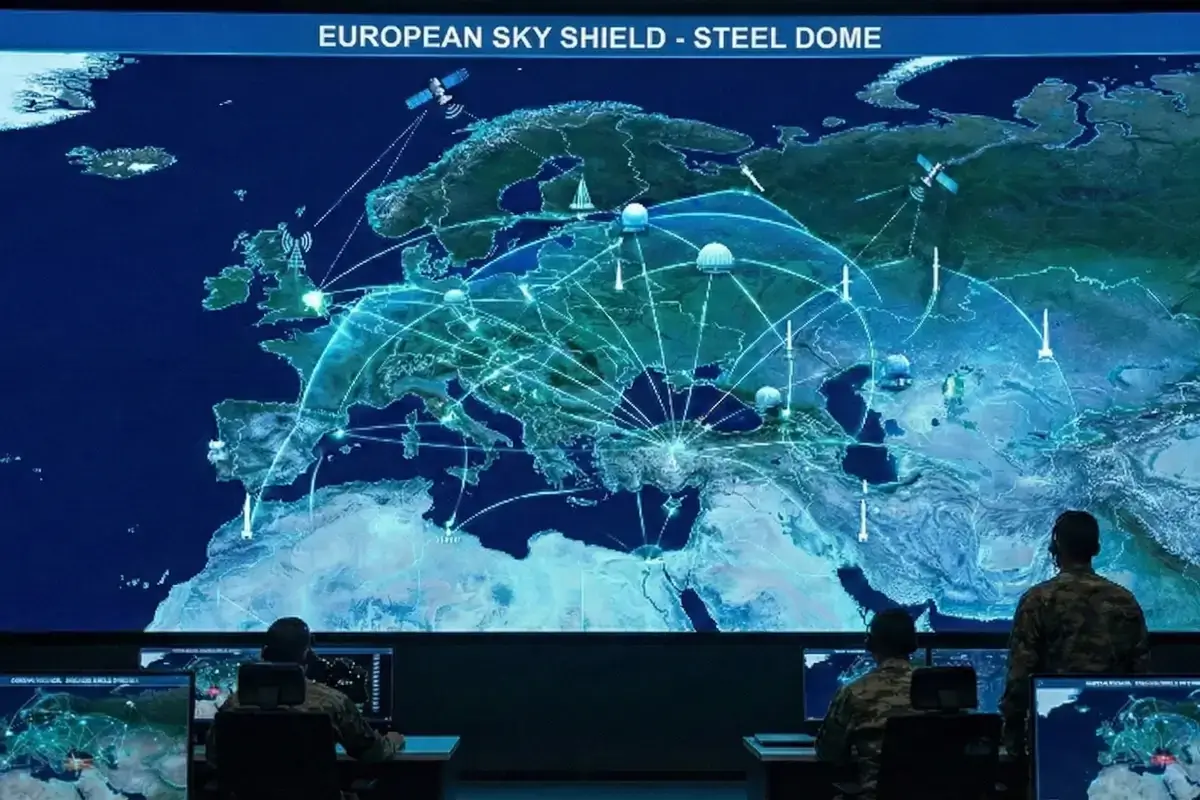
Türkiye's silent revolution in the field of air defense is now transforming into an academic and strategic doctrine. The Head of the Defense Industry, Prof. Dr. Haluk Görgün, drew attention to an article published in JDSI, the publication of the Defense Industry Academy, highlighting Türkiye's role in the European Sky Shield Initiative. This analysis, which reveals how the Steel Dome architecture and the HİSAR and SİPER systems can integrate into Europe's fragmented air defense map, showcases the Turkish defense industry's vision of being not just a producer, but a game-changer.
The war between Russia and Ukraine has revealed air and missile defense as Europe's biggest security vulnerability, triggering new efforts across the continent. The European Sky Shield Initiative (ESSI), launched under the leadership of Germany and including Türkiye, aims to create a common protective shield under the NATO umbrella.
At this point, the study titled “European Sky Shield Initiative (ESSI) and Türkiye’s Role in Integrated Air and Missile Defense Analysis,” shared by the Head of Defence Industry, Prof. Dr. Haluk Görgün, and published in the first issue of the Journal of Defence and Security Industries (JDSI), redefines Ankara’s place in this equation. The article presents a concrete roadmap on how Türkiye’s domestically developed systems (Steel Dome) can be integrated into European security.
What is ESSI? Why did Europe need a shield?
Before delving into the analysis, it's necessary to understand what ESSI is. In the post-Cold War era, European countries that cut defense budgets gradually diminished their conventional air defense capabilities. However, the rise of ballistic missiles and UAVs at the heart of modern warfare caught Europe unprepared.
ESSI was born as an initiative to close this gap, establishing interoperable air defense systems and shared procurement and logistics networks. The basic logic of the initiative is to integrate different systems (IRIS-T, Patriot, Arrow-3, etc.) in short, medium, and long ranges into a single command and control network. However, the study referenced by Haluk Görgün argues that this architecture would be incomplete without Turkey, and that its inclusion would give it strategic depth.
Steel Dome Architecture: The Journey of HİSAR and SİPER to Europe
The most crucial point of the article, highlighted by Haluk Görgün, is Türkiye's indigenous and national air defense architecture. Steel Dome‘The potential compatibility of the Steel Dome with ESSI. In the last 10 years, Turkey has successfully implemented a layered air defense doctrine, spearheaded by ASELSAN, ROKETSAN, and TÜBİTAK SAGE.
The analysis at JDSI examines the contributions that the following systems could make to European architecture:
- HİSAR Family (Medium Altitude): In many European countries, the systems used for medium-altitude air defense are either very old or have insufficient stocks. HİSAR-O+ and the HİSAR series missiles under development offer cost-effective and high-tech solutions that can fill the gaps in the middle layer of ESSI thanks to their fully compliant NATO standard data links.
- SİPER (High Altitude and Long Range): SİPER Product-1 and Product-2, which is currently undergoing testing, stand out as strong alternatives or complementary elements to Patriot and SAMP/T systems for the top layer of ESSI, representing Türkiye's strategic deterrence capability. The article states that SİPER is not just a missile system, but also a system capable of scanning a wide area with its search and fire control radars. system of systems He points out that this is the case.
Görgün's “"We are analyzing the potential contributions of our HİSAR and SİPER systems to the Steel Dome architecture."” This statement signals that Türkiye views these systems not only as an export and integration item for its own security, but also for the protection of allied airspace.
Geostrategic Location and Sensor Network Depth
Air defense is not just about launching missiles, but also about detection. The earlier you detect a threat, the greater your chances of destroying it. One of the most critical concepts highlighted in the study that Görgün points out is "Sensor Network Depth".
Turkey is located on NATO's southern flank, in a geographical area that dominates the Middle East and the Black Sea basin. EIRS (Early Warning Radar System), ALP Radars It possesses network-centric warfare capabilities. With these capabilities, it has the capacity to detect threats targeting Europe from thousands of kilometers away.
The article demonstrates, with scientific data, that integrating Türkiye into ESSI will expand Europe's radar horizon eastward. This means that data entering Türkiye's radar network can be instantly transmitted via Link-16 and NATO networks to a command center in Berlin or Paris. This depth of reach enhances Europe's ability to counter threats. warning and reaction time This can extend the response time from seconds to minutes. This additional time gained by detecting the threat much earlier is vital in ballistic missile defense.
Transitioning from Fragmented Supply to Interoperability
The biggest problem with the European defense industry is its fragmented structure. Each country uses its own system, and these systems cannot communicate with each other. This is what Haluk Görgün underlined in his message. “"Transition from fragmented supply to interoperability"” This vision is one of the greatest added values that Türkiye offers.
The Turkish defense industry, in all the air defense systems it has developed (from KORKUT to SİPER) NATO standards (STANAG) It is based on the principles developed by HAVELSAN. ADVENT War Management Systems and RADNET Such radar networks are already fully compatible with NATO architecture.
The study published in the JDSI journal argues that Türkiye's modular command and control capability can act as an adapter (glue) connecting the systems of different countries within ESSI. Turkey is not just a missile seller, but also a software and doctrine provider that integrates the systems.
Adding Vision to the Shared Security Architecture
Görgün's, “Integrating Türkiye’s expertise in defense technologies with allied structures is not only a strategic contribution but also brings a valuable vision to the shared security architecture.” This statement also summarizes Ankara's new defense diplomacy.
Turkey, which once requested systems from NATO, has now risen to a position where it proposes systems and visions to NATO. This article and Görgün's statements show that Türkiye's participation in ESSI is not just a political signature on paper. Turkey is bringing to the table its combat-proven technologies, scalable production infrastructure, and, most importantly, Integrated Air Defense He demonstrates his engineering skills in this area.
Industrial Infrastructure and Supply Security
Another important point analyzed in the article is... Supply Trends. While the European defense industry is struggling to increase its production capacity after the Ukraine war, the Turkish defense industry stands out with its flexible and rapid production capabilities. ROKETSAN and ASELSAN's production lines have the capacity to meet the urgent air defense ammunition needs not only of the Turkish Armed Forces but also of ESSI member countries.
This situation has the potential to transform Türkiye from a passive member within ESSI into an active logistics hub ensuring the security of the supply chain.
Türkiye is Now a Solution Partner
As Europe's air security is discussed, Turkey is no longer just a user at the table, but is positioned as a solution partner and technology provider. SİPER and HİSAR are very strong candidates to become part of the massive Steel Dome, which will soon encompass not only Türkiye's but also Europe's skies.
Sources
E. AKAGÜNDÜZ DEVECİ, K. KAZANCI, and Özge ÜREN, “An Analysis of The European Sky Shield Initiative (ESSI) and Turkey's Role in Integrated Air and Missile Defense”, JDSI, vol. 1, no. 1, pp. 27–56, Jan. 2026.
Prof. Dr. Haluk Görgün's NSocial post – https://nsosyal.com/post/109677918317228012
