


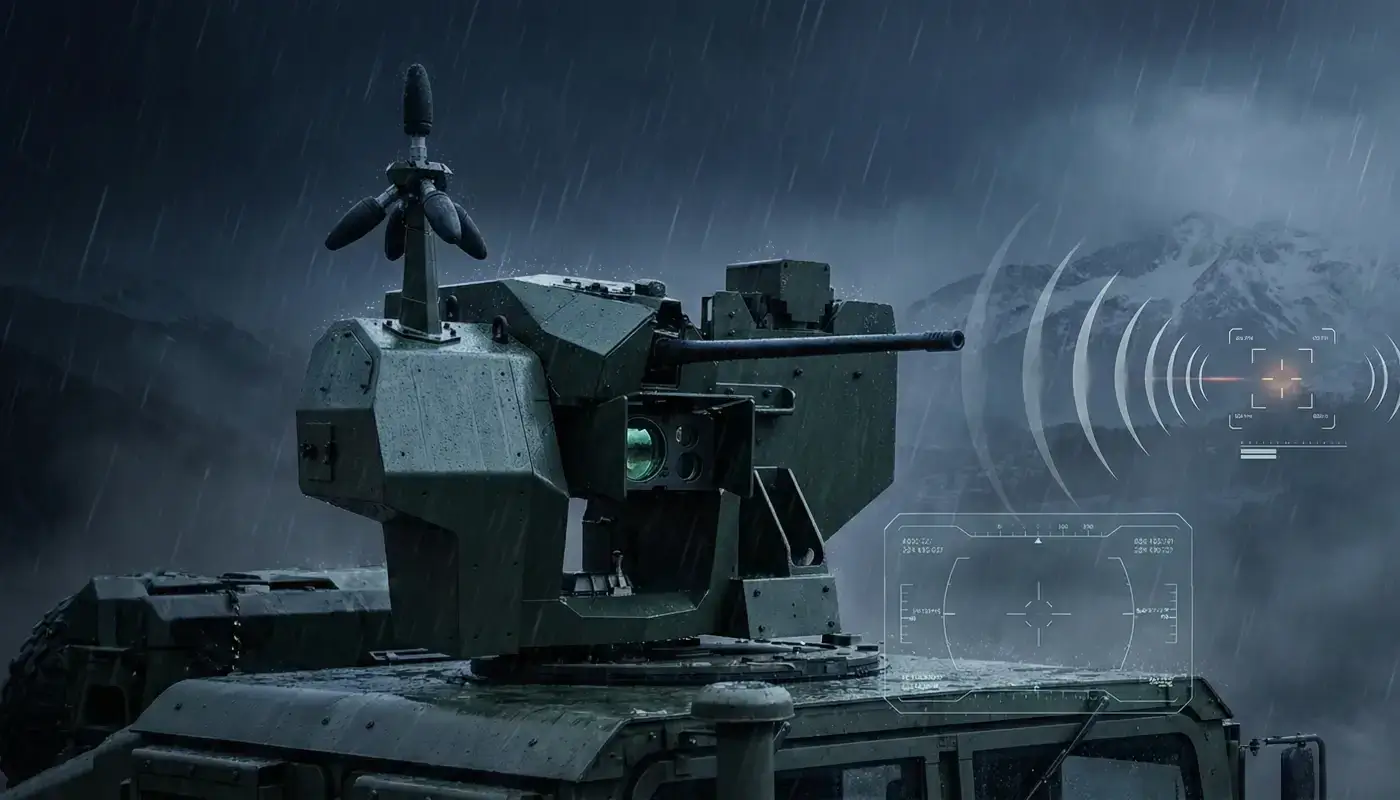
The strategic partnership between ASELSAN, the electronic systems manufacturer of the Turkish defense industry, and Hanwha Aerospace, the South Korean land systems giant, has borne its first tangible fruit. The Memorandum of Understanding (MoU), signed last year covering the integration of ASELSAN subsystems into Korean-origin armored vehicles, has been realized. The new generation Tigon 8x8 armored vehicle produced by Hanwha, exhibited at the World Defense Show (WDS) in Saudi Arabia, ensured its threat detection capability with the ASELSAN-produced SEDA 100 Acoustic Gunfire Detection System.
Two major players competing in the global defense market aim to increase their export potential to third countries by joining forces. The Tigon 8x8, located at the Hanwha stand at the WDS Exhibition, attracted attention with its onboard ASELSAN hardware. This integration is evaluated as the reflection of the agreement signed between the parties last year, which envisions offering ASELSAN's electronic warfare, electro-optic, and acoustic sensor solutions as standard equipment on Hanwha platforms.
The Signature Signed Last Year Hits the Field
The Memorandum of Understanding signed between ASELSAN and Hanwha Aerospace a year ago has gone beyond being just a declaration of goodwill and turned into a technical cooperation. Within the scope of the agreement, the aim was to integrate ASELSAN's proven avionics and sensor systems into Hanwha's globally ambitious platforms such as K9 Howitzers, Redback Armored Combat Vehicle, and Tigon.
The SEDA 100 integration on the Tigon 8x8 has become the first step of this roadmap. This cooperation combines South Korea's success in platform production with Türkiye's competence in subsystem and sensor technologies, enabling the provision of "full package" solutions to customers, particularly in the Middle East and Asian markets.
SEDA 100: Supersonic Shockwave Analysis
SEDA 100, exhibited on the Tigon 8x8, is a high-tech acoustic detection system that uses the laws of atmospheric physics to detect sniper or machine gun fire. Beyond a metaphorical "listening," the system analyzes the physical changes created by the projectile in the air.
The working principle of the system is based on a three-stage technical analysis:
- Shockwave Detection: As the bullet travels at supersonic speed (exceeding the speed of sound) after leaving the barrel, it creates a conical shockwave in the air.
- Muzzle Blast: A spherical sound wave formed by the explosion of gunpowder at the moment of firing spreads out.
- Precise Microphone Array: Sensitive microphone arrays placed on the vehicle, which filter out aerodynamic noise, measure the millisecond differences (TDOA - Time Difference of Arrival) between the arrival times of these two different sound waves at the sensors.
Coordinate, Range, and Elevation Data
Signal processing algorithms developed by ASELSAN process this data instantaneously to calculate the coordinates of the firing point, its distance to the vehicle, and the direction of arrival (azimuth/elevation).
These data are displayed to the operator on the Digital Map within the vehicle. More importantly, the system works integrated with the Remote Controlled Weapon System (RCWS) on the vehicle, ensuring that the gun turret automatically turns to the point where the shot came from (Slew-to-Cue). Thus, even in cases where there is no visual contact, the threat source can be engaged within seconds.
Turkish Technology in the Global Market
The presence of ASELSAN SEDA 100 on an international platform like Hanwha Tigon demonstrates that the Turkish defense industry has risen to a position of not only meeting its own needs but also supplying technology to global giants. This integration increases export potential by proving that the system can operate under different geographical conditions and on different vehicle architectures.
