


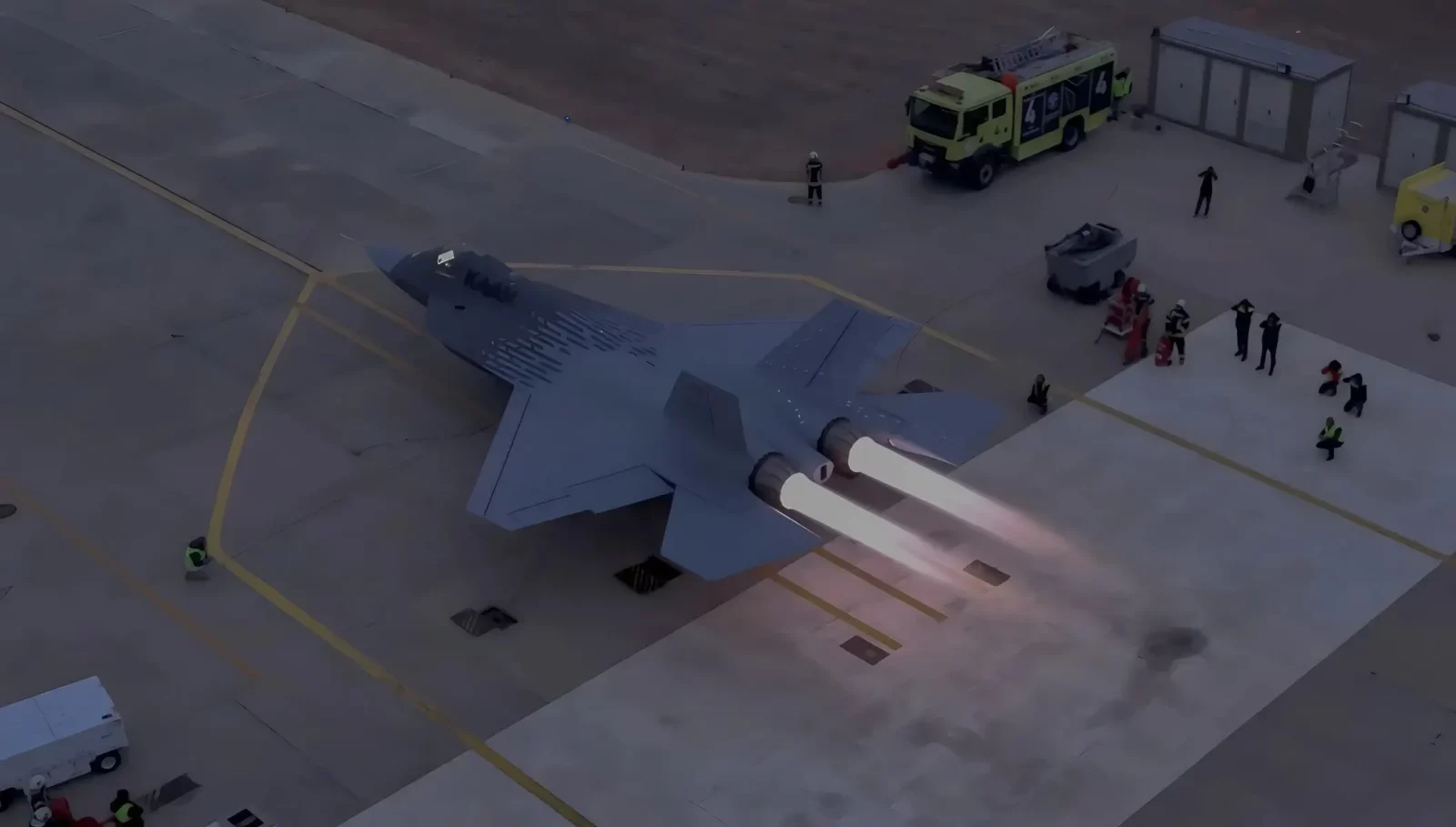
The Spanish defense analysis platform Defensa y Seguridad, scrutinized engine technology in the second part of its National Combat Aircraft KAAN analysis. In the article series titled "KAAN: Turkish Passion or the New Dark Horse of the Aviation Table," the potential cooperation between Spanish engine giant ITP Aero and Turkish engine giant TEI was characterized as "the shrewdest and quietest industrial move that could be cooked up in the European defense sector." According to the analysis, this partnership could transform KAAN into a supercruise beast superior to the F-35.
Following the airframe and avionics success of the National Combat Aircraft KAAN, eyes have turned to the domestic engine TF35000, which will be the heart of the aircraft. The Spanish defense press wrote that this engine, which entered the Critical Design Review (CDR) phase as of February 2026, could be a strategic exit door not only for Türkiye but also for Spain, which has not found what it was looking for in the FCAS project.
ITP and TEI: A Perfect Technical Marriage
In the article, while the European joint fighter jet project FCAS is likened to a marriage of convenience full of fights due to disagreements between France and Germany, the potential cooperation between Türkiye (TEI) and Spain (ITP Aero) is defined as a technical partnership for survival.
According to the author, the two companies complement each other's deficiencies perfectly:
- TEI (Muscle and Infrastructure): A power possessing high-precision manufacturing capabilities and massive infrastructure, currently producing over 1,500 parts for General Electric and Rolls-Royce. However, it is in the process of gaining experience in designing the "hot section" of a 5th-generation engine from scratch.
- ITP Aero (The Brain of the Turbine): A world leader known for its success in the Eurofighter Typhoon's EJ200 engine, particularly in the "Low-Pressure Turbine" (LPT). The author draws attention to the catalytic effect of Spanish engineering with the determination, "Without ITP, the Turkish engine could take another decade to become efficient."
Win-Win Strategy: Liberation from French Dictate
The analysis lists the political advantages of this cooperation as well as the technical ones. For Spain, this partnership means liberation from the dictate of French engine manufacturer Safran in the FCAS project and keeping its own R&D centers (Basque Country and Madrid) active.
For Türkiye (TEI), the biggest gain is the European Seal. A joint design with ITP Aero will facilitate the TF35000 engine's compliance with European Union Aviation Safety Agency (EASA) standards. This is seen as a vital key to removing the certification barrier in KAAN's export to countries like Saudi Arabia, Indonesia, and even Spain.
The Big Trump Card Against F-35: Supercruise and Thermal Invisibility
One of the most striking parts of the article is the technical analysis section where the targeted Turkish-Spanish engine (TF35000) is compared with the American F-35 engine (F135).
- The Supercruise Difference: It is stated that due to the F-35's single-engine and heavy structure, it cannot exceed the speed of sound without using an afterburner (cannot Supercruise). However, it is emphasized that KAAN, which will have twin engines and 70,000 lbs of total thrust, could perform supercruise at speeds of Mach 1.4 - 1.6 without guzzling fuel, thanks to the ITP-TEI design.
- Thermal Stealth: In 5th-generation aircraft, not only radar signature but also heat signature is important. Thanks to ITP Aero's expertise in single-crystal alloys, it is stated that KAAN's engine nozzles will disperse heat much more aggressively than the Eurofighter, increasing the chance of evading infrared missiles.
The Roadmap: Full Independence in 2032
In the analysis, the engine development schedule spans between the years 2026-2032:
- 2026: Commencement of ground tests for the first prototype.
- 2029 (Hybrid Flight): Conducting test flights where one of KAAN's engines is the American F110 and the other is the indigenous TF35000.
- 2032: 2032: Full integration of the engine and KAAN becoming 100% independent of US export restrictions (ITAR).
Plan B for Spain: Hürjet Was a Start
Author Roberto Escamez reminds readers that this scenario is not science fiction, noting that the first step was taken in December 2025 when Spain purchased 30 Hürjet training aircraft from Türkiye. The Hürjet agreement is interpreted as a preliminary preparation that allows engineers and military personnel from both countries to become familiar with each other's technology.
The analysis concludes with this striking result:
"Spain is in a toxic relationship (FCAS) where one partner (France) won't let you grow, and the other (Germany) goes its own way. Türkiye is that new partner, perhaps a bit controversial, but one who offers you the keys to the house and 50% of the business from day one."
