


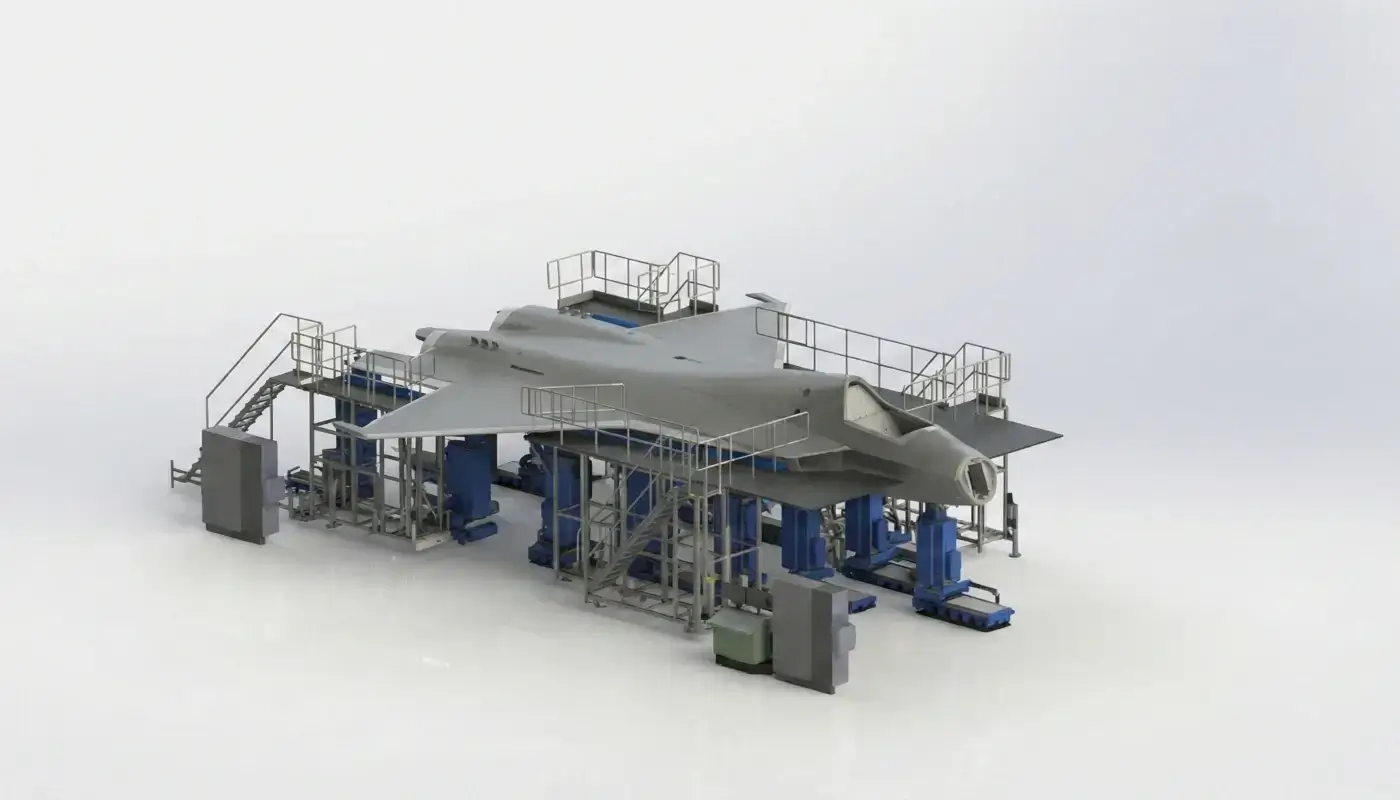
The National Combat Aircraft KAAN is redefining the 5th generation standards not only with its capabilities in the sky, but also with the digital assembly revolution on the production line. The Automatic Positioning and Alignment Fixture (APAJ), the details of which were shared in TAI's publication Gökvatan, eliminates human error from micron-level surface precision, which is vital for the aircraft's radar invisibility (Stealth).
Producing a fifth-generation fighter aircraft is not just about designing an aerodynamic fuselage. It is the art of combining the thousands of parts that make up that fuselage with a precision of one tenth of a millimetre. In the KAAN project, TAI launched the Digital Assembly era by shelving classical production methods. At the heart of the system is an autonomous assembly technology called APAJ (Automated Positioning and Alignment Jig), which is being used for the first time in Turkiye's aviation history.
What is APAJ? Smart Mould Technology
In traditional aircraft production, parts were placed in fixed moulds (fixtures) and aligned by operators. However, this method is insufficient in projects such as KAAN, where hybrid materials are used and geometric precision is critical for stealth.
APAJ comes into play at this point. The system consists of multi-axis servo motors, laser tracking sensors (Laser Tracker) and closed-loop control algorithms. It holds the part, instantly compares it with CAD (Computer Aided Design) data and automatically places it in place with an accuracy of +/- 0.1 millimetre (one tenth of a millimetre).
Why is it so important? Radar Stealth and Mounting
The Low Radar Cross Section (RCS), which is the most important feature of KAAN, requires the surface of the aircraft to be smooth and the joints of the parts to be perfect. A micron slip in the assembly may cause an increase in the radar cross-sectional area of the aircraft.
According to the information shared by TAI, the APAJ system:
- Alignment in Micron Band: It provides micron-level accuracy by analysing part positioning errors with the root mean square (RMS) method.
- No More Human Error: It eliminates assembly differences by eliminating operator initiative. In this way, each KAAN is produced in exactly the same standards as the previous one.
From Prototype to Mass Production: Digital Twin Integration
The APAJ system also speeds up the development process of the KAAN. In the traditional method, a new mould (fixture) had to be produced for each change in the design of the aircraft, and this was time consuming. However, thanks to the adjustable and flexible structure of APAJ, design revisions are digitally uploaded to the system and robots adapt to the new design instantly.
The system is also integrated with Product Lifecycle Management (PLM) and Manufacturing Execution Systems (MES) as part of the Industry 4.0 vision. The data generated during assembly is transferred to the aircraft's digital twin, digitising quality control processes.
Strategic Advantage
As highlighted in the article in Gökvatan magazine, the APAJ system is the first automation system in Turkish aviation history to be commissioned on the assembly line of indigenous projects. This technology proves that TAI has transformed into a technology base that not only designs aircraft, but also manufactures them with the world's most advanced techniques.
