


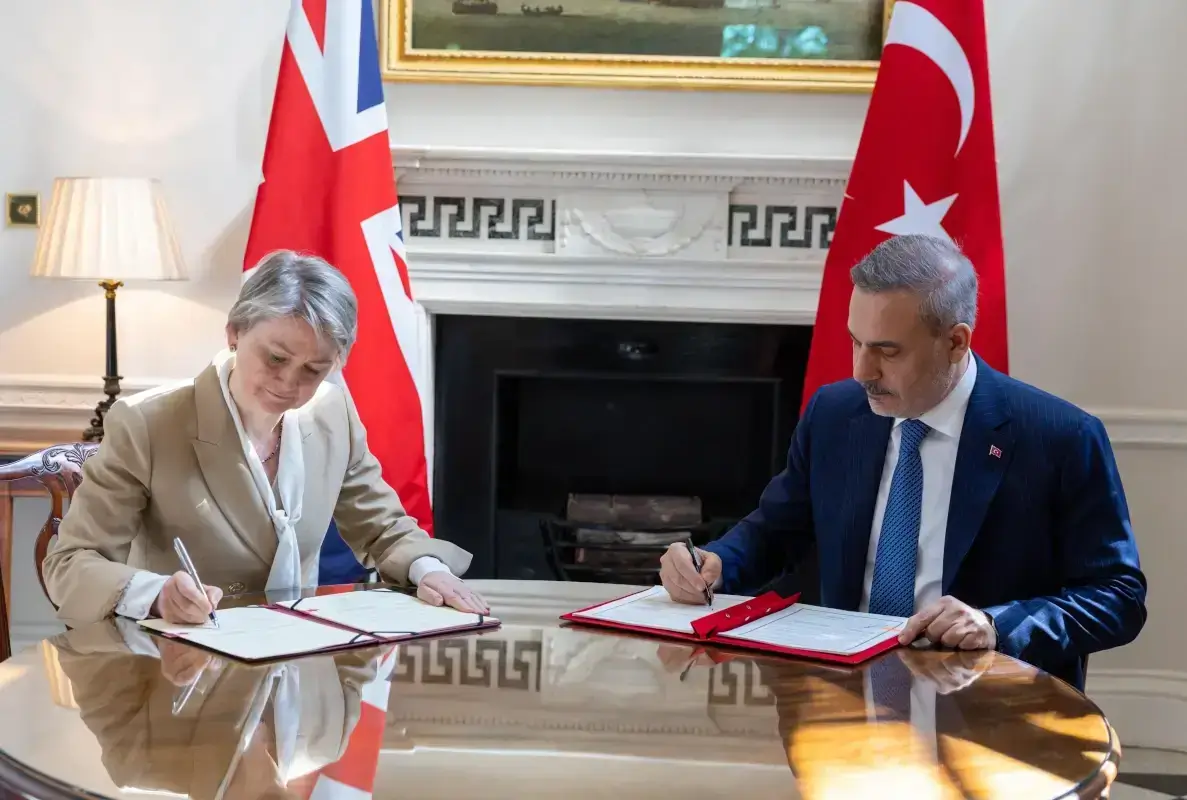
As the cards are rapidly reshuffled in the global security architecture, Türkiye and the United Kingdom have made a historic move that will directly affect Euro-Atlantic security. Foreign Minister Hakan Fidan met with UK Foreign Secretary Yvette Cooper in London on April 23, 2026, and officially signed the "Strategic Partnership Framework Document." With this historic declaration, the two countries decided to act jointly in the fields of defence industry, NATO military coordination, free trade, and advanced technology. The two strongest armies in NATO's Europe have formed an unshakeable bilateral security axis in the new, multipolar, and uncertainty-ridden world order.
What Does the Strategic Framework Document Cover?
To simplify the dense and complex language of diplomatic texts, this major memorandum of understanding signed between Ankara and London essentially rests on the following four strategic pillars:
- NATO and Joint Defence: Strengthening the European wing of the Alliance, increasing defence industry cooperation, and jointly developing military capabilities.
- Modernised Free Trade: Accelerating negotiations for a new, modernised Free Trade Agreement (FTA) that will support the strong economic growth of both countries, easing customs barriers.
- Advanced Technology, Energy, and Climate: Producing joint projects not only in conventional industry but also in science, innovation, technology development, combating climate change, and energy security.
- Joint Fight Against Terrorism: Conducting joint intelligence with zero tolerance against terrorist organisations threatening global security and regional stability, as well as cross-border organised crime networks.
Deepening Cooperation in the Defence Industry
Undoubtedly, defence industry and military cooperation comes at the forefront of the most critical and striking articles of the joint declaration. The goal clearly emphasised in the agreement of "enhancing defence capability and industry co-operation" indicates that joint projects between the two countries will be accelerated massively in the coming period.
As is known, the United Kingdom is among Turkey's most important European partners in aviation and space projects (especially in engine technologies and sub-system supply). Thanks to the new framework agreement, Turkish and British defence companies will work much more integrated in technology transfer and joint R&D activities. Furthermore, the two countries aim to directly strengthen the European pillar by increasing cooperation within NATO. Türkiye and the United Kingdom, two heavyweight countries of NATO that are not members of the European Union, are largely shouldering the continent's defence burden with this bilateral mechanism they have established.
Increasing Risks in a Multipolar World
The joint text published on April 23, 2026, contains a very sharp analysis of the current geopolitical situation. In the text, leaders clearly state that "the accelerating global transition towards a multipolar and fragmented international order is putting Türkiye and the United Kingdom into an era of increasing risks."
This strategic reading explains very well why the two countries did not settle for mere NATO alliance but elevated their ties to the level of a Strategic Partnership. Conflict risks in the Middle East and instabilities in eastern Europe compel Ankara and London to conduct joint intelligence and diplomacy in regional crises. Indeed, the emphasis in the declaration on the joint fight against terrorism and organised crime proves that security bureaucracies will work in fully integrated fashion in the field.
Modernised Free Trade and Technology Partnership
In this era where global supply chains have become fragile, strengthening economic ties with next-generation technologies is a vital necessity. Minister Fidan and his counterpart Cooper officially confirmed the goal of modernising the existing Free Trade Agreement (FTA) during their meetings in London.
Türkiye and the United Kingdom are moving far beyond traditional goods trade that transcends customs barriers. The parties will make joint investments in energy security, combating climate change, science, technology, and innovation. It appears highly likely that Turkish and British technology start-ups will develop joint products, especially in fields such as artificial intelligence, cybersecurity, and clean energy technologies. This economic deepening opens the doors of a brand new multi-billion dollar market for the industrialists of both countries.
A New Centre of Stability
Foreign Minister Hakan Fidan's engagements in London and this historic signature demonstrate that Türkiye has moved its strategic ties with the West to a new dimension based on pragmatism and mutual benefit. Seeing Türkiye's rise in the defence industry and its regional power, the United Kingdom prefers to design the future security architecture together with Ankara.
In the coming period, expected major contracts in the defence industry are expected to accelerate, free trade negotiations to conclude, and technology transfers to increase. Ultimately, Türkiye and the United Kingdom, with their diplomatic vision, strong armies, and technological production capacities, are building an unshakeable power centre in the increasingly uncertain global system.
Note
If you have any photos or video footage to support our news story, please share them with us using the information provided on our contact us page.
