


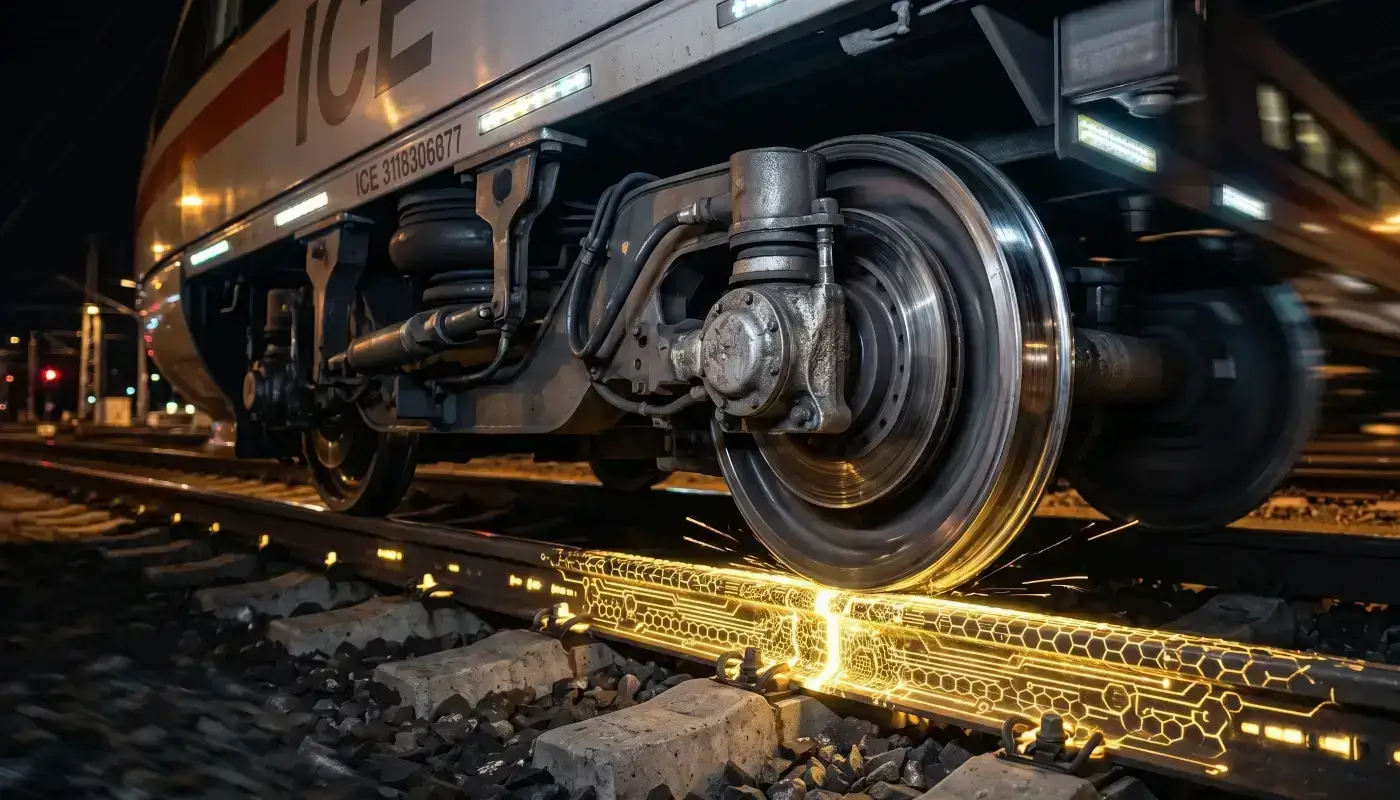
Turkish scientists continue to transform the country's vast boron reserves into high-tech strategic products. The Boron Research Institute of the Turkish Energy, Nuclear and Mineral Research Agency (TENMAK BOREN) and Gazi University are signing a historic project to prevent rail wear on railways. The project titled "Increasing the Wear Resistance of R260 Rail Steel through Boron-Based Surface Modifications" has been granted full support by UDHAM, affiliated with the Ministry of Transport and Infrastructure. This R&D move, funded 100 percent with a budget of 12.4 million TL, will radically reduce maintenance costs on Türkiye's high-speed train lines while maximising driving safety.
Metallurgical Transformation: R260 Rail Steel and Boron Integration
High-speed trains (YHT) and heavy freight trains generate immense kinetic energy and friction as they move on the rails. This enormous frictional force causes wear, micro-cracks, and metal fatigue over time in the standard R260 grade rail steel. Frequent replacement of rails means billions of liras in maintenance costs and long-term line closures.
TENMAK BOREN and Gazi University engineers are employing boron-based surface modification technology to overcome this physical problem. This process involves the penetration of boron atoms into the steel surface at high temperatures. Boron forms a brand new layer of ceramic hardness on the steel surface. Thus, while the inner part of the rail maintains its flexibility to prevent fractures, the outer surface gains exceptional armour against friction. The substantial budget of 12,448,088 TL allocated to the project within the scope of the UDHAM-RS-2025-01 "Rail System Technologies" call will enable these laboratory studies to rapidly turn into field tests.
The World's Largest Reserve Comes to the Field
Approximately 73 percent of the world's boron reserves are located in Türkiye. However, exporting boron ore only as a raw material prevented sufficient added value from being derived from this strategic resource. In recent years, institutions acting with the vision of the National Technology Move have started using boron in armour systems, batteries, fuel cells, and metallurgy.
This partnership between TENMAK and Gazi University represents a paradigm shift in the transportation industry. Türkiye is rapidly expanding its own railway network and building thousands of kilometres of new high-speed train lines. Extending the life of the rails to be used on these lines creates billions of liras in direct savings for the state budget. Furthermore, the meeting of the Ministry of Transport (UDHAM) and the Ministry of Energy (TENMAK) in this shared vision clearly proves how integrated and flawlessly the state's technology development ecosystem operates.
Export Potential and Full Independence
The R260 Rail Steel project is an innovative and completely domestic engineering solution that reduces foreign dependency in transportation infrastructure. Following laboratory tests, once the rails are laid on actual tracks, Türkiye will have one of the world's most durable infrastructures on its railways.
In the coming period, this technology will not only meet Türkiye's needs. Türkiye will be able to export the boron-reinforced rail technology it develops, or the directly produced reinforced rails, to European and Asian countries that have vast railway networks.
Note
If you have any photos or video footage to support our news story, please share them with us using the information provided on our contact us page.
