


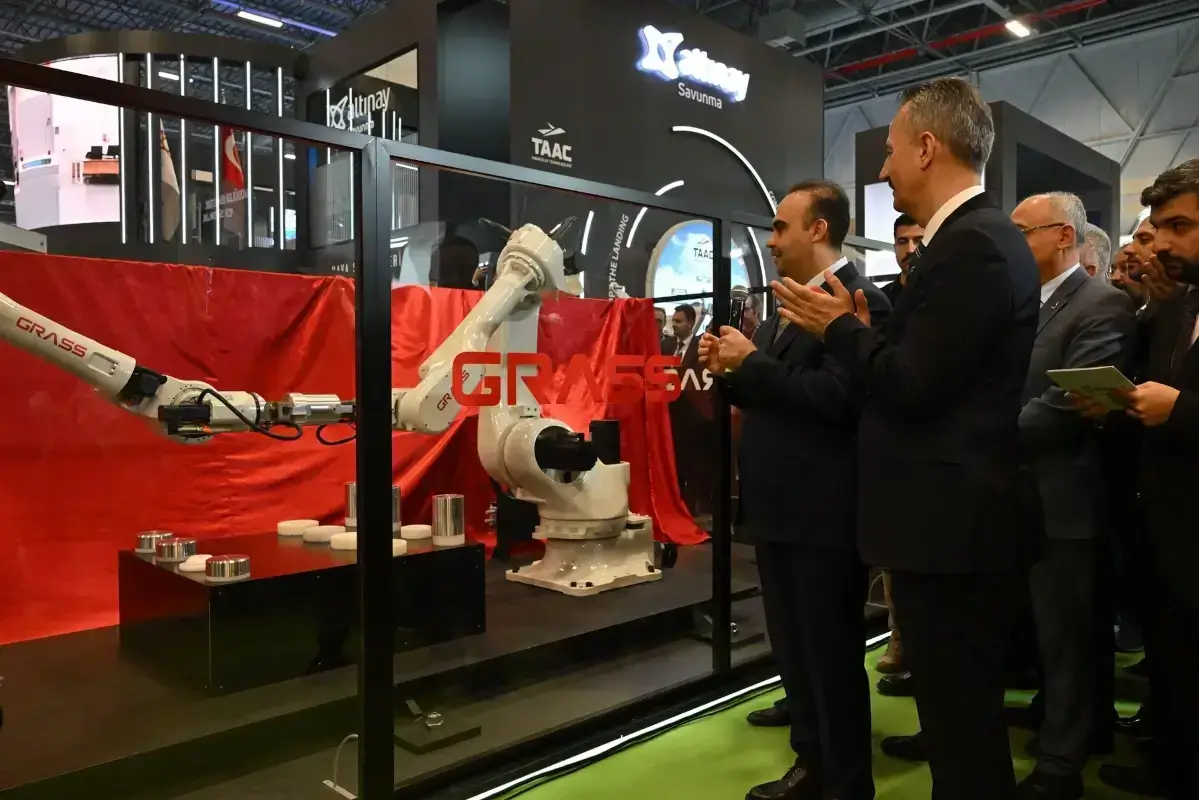
The Turkish industry has left behind a massive technological threshold that will fundamentally end the long-standing foreign dependency on factory automation lines. Altınay Robot Group, a long-established institution in Turkish robotics technology, officially introduced the SR40 and SR80 model domestic industrial robots, developed under the GRASS (Advanced Robot and Smart Industrial Systems) brand, at the SAHA EXPO 2026 fair. These new-generation robots, launched with the personal attendance of Minister of Industry and Technology Mehmet Fatih Kacır, stand out as being entirely a product of Turkish engineering, from their motors and software to their driver cards and mechanical architecture.
Vertical Integration: National Transformation in Motor, Driver, and Software
Industrial robotic systems, though appearing merely as moving metal arms from the outside, actually harbour immense technological depth behind them. For a robot to lift a heavy automotive part and weld it with millimetric precision, it requires precise servo motors, driver cards that manage these motors instantaneously, and kinematic software that coordinates the entire system. In past years, Turkish industrialists had to import these hardware components and black-box software from abroad, paying billions of dollars.
The SR40 (with 40 kg payload capacity) and SR80 (with 80 kg payload capacity) models introduced by Altınay Robot Group at SAHA EXPO 2026 break this import chain with full vertical integration. The systems constitute a rational and powerful alternative to their global competitors with their optimised motion control architectures, wide working spaces, and millimetric repeatability precision. Alongside the hardware, Turkish engineers also coded the software, the brain of the system, entirely domestically. This prevents production data in factories from going to foreign servers and provides strategic protection in terms of cybersecurity.
A 30-Year Engineering Journey
Turkey's industrial robot journey is not actually new. Behind this historic step lies immense engineering persistence and memory spanning over 30 years. Hakan Altınay, Chairman of the Board of Altınay Technology Group, had sparked this vision by producing HSR-4, Turkey's first industrial robot, in 1993.
Evaluating this challenging process from past to present at the launch, Hakan Altınay summarised the industrial maturity reached by Turkish engineering with these words: *"In 1993, we had a dream: for Turkey to be able to make its own robots. With the level of vertical integration we have reached today, we design and produce all critical sub-systems that constitute a robot within our own organisation. We are ending foreign dependency in our country's production lines and offering our industrialists a completely domestic solution partnership at international standards."*
Government Support and the National Technology Move
State-supported industrial policies play a significant role in the success of such deep and high-cost R&D projects. The SR40 and SR80 robots were brought to life with the support of the "Hamle Programme" conducted by the Ministry of Industry and Technology. Speaking at the launch ceremony, Minister Mehmet Fatih Kacır stated that the systems represent the self-confidence of Turkish engineering and the will for full independence. Minister Kacır emphasised that there is now a Türkiye that exports technology to the world by producing its own motors and software, indicating that the competitiveness of domestic industry has moved to the next league.
Global Goals for 2030
These new-generation robots launched under the GRASS brand by Altınay Robot Group signal a historic turning point for Turkish manufacturing industry. Many sectors, from automotive to food, metal processing to defence industry, will now be able to procure their own robotic systems directly from domestic sources with local support guarantee, instead of importing them.
Altınay Robot Group CEO Ömer Eren, explaining the future vision with targets for 2030, stated that they aim to become a global technology brand competing internationally with this fully vertically integrated ecosystem.
Note
If you have any photos or video footage to support our news story, please share them with us using the information provided on our contact us page.
