


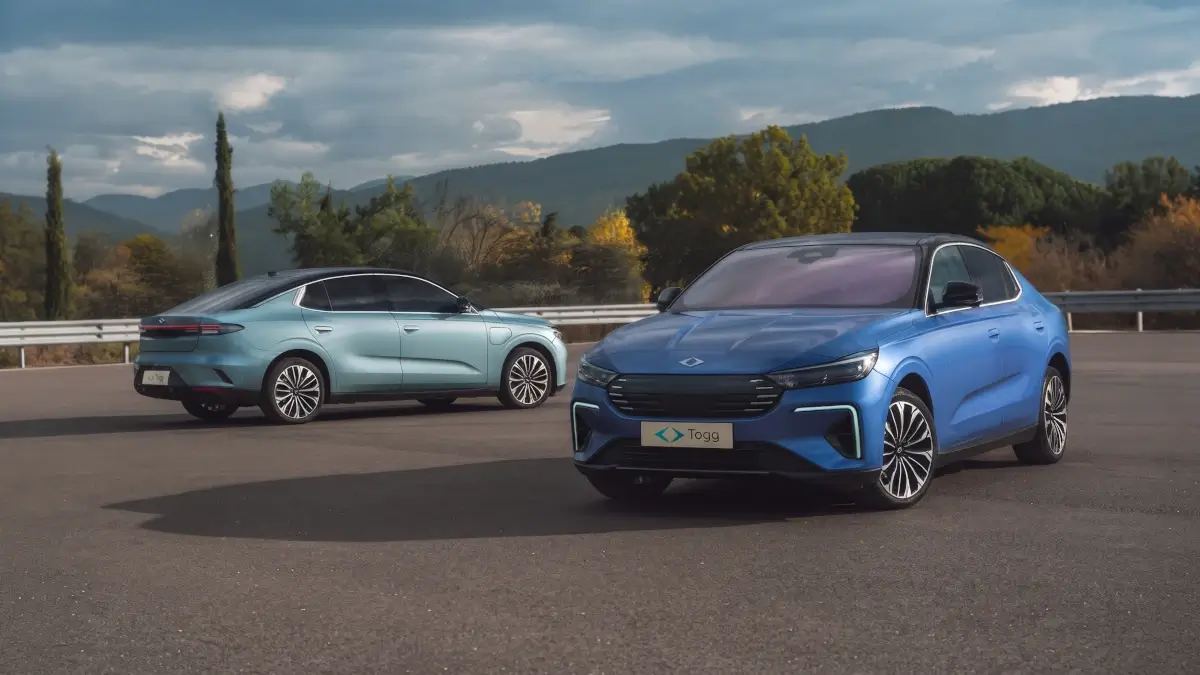
The question that arose in the minds of electric vehicle enthusiasts after Togg's switch to LFP batteries — what happened to this battery's effect on range — appears to have been answered by a range test. The new LFP-battery Togg T10F completed a 204-kilometre journey with 61 per cent charge in a comparative drive carried out between Kayseri and Sivas. The remaining charge of the NMC-battery T10F used on the same route was 56 per cent, while the LFP version succeeded in placing second among 14 cars in terms of remaining battery percentage.
The range test drive organised by the Otomobil Günlüklerim channel was attended by T10F models with two different battery technologies and one T10X. The fact that all three Togg models completed their journeys preserving more than half of their battery was one of the notable aspects of the test, while the LFP-battery T10F placed ahead of the other two NMC-battery Toggs in both remaining charge percentage and the consumption figures calculated by the channel.
LFP-Battery T10F Came Second Among 14 Vehicles in Remaining Charge
Starting the journey at 100 per cent charge, the LFP-battery T10F used 39 per cent of its charge level after 204 kilometres. The Kia EV3 Long Range, which preserved 64 per cent of its charge after 200 kilometres, took first place in remaining battery percentage. It was followed by the BYD Seal U EV with 57 per cent, then the T10F.
The NMC-battery Togg T10F completed its 205-kilometre drive with 56 per cent charge. The Togg T10X, meanwhile, completed its 200 kilometres with 54 per cent charge. Togg's three cars thus placed within the top six in the remaining battery ranking.
According to the results table shared by the channel, the battery levels of the vehicles at the moment they reached the charging station were as follows:
| Model | Remaining Charge | Distance |
|---|---|---|
| Kia EV3 Long Range | %64 | 200 km |
| Togg T10F LFP | %61 | 204 km |
| BYD Seal U EV | %57 | 197 km |
| Togg T10F NMC | %56 | 205 km |
| MINI Countryman | %55 | 205 km |
| Togg T10X NMC | %54 | 200 km |
| Tesla Model Y Premium | %53 | 203 km |
| Volvo EX30 | %52 | 204 km |
| Hyundai IONIQ 6 SR | %52 | 205 km |
| Volkswagen ID. Buzz | %49 | 208 km |
| KGM Torres EVX | %48 | 204 km |
| MG4 Luxury | %48 | 195 km |
| Peugeot E-3008 Allure | %48 | 205 km |
| Opel Frontera | %26 | 205 km |
The Peugeot E-3008 started its journey at 96 per cent charge, while the other cars started at 100 per cent. Since the vehicles' battery capacities and the loads they carried were different, the remaining charge percentage alone does not clearly show energy efficiency, but it is important that the test reflects real-world usage conditions. Because the study was not continued until the batteries were depleted, a definitive maximum range figure cannot be derived from these results.
A Consumption Difference Was Seen Between the Two T10Fs
In the first table, prepared on the basis of energy drawn from the charger and distance covered, consumption was calculated as 18.1 kWh/100 km for the LFP-battery T10F and 19 kWh/100 km for the NMC-battery T10F. The T10X's figure was 20 kWh/100 km.
37 kWh of energy was transferred from the charger to the LFP-battery T10F, and 39 kWh to the NMC-battery T10F. Both vehicles were driven with one person each, and there was only a one-kilometre difference between them. While the LFP version showing lower consumption on this drive is an important observation, it would not be correct to attribute the difference solely to battery chemistry. Wheels, tyres and driving conditions were not entirely equalised.
These consumption figures were not taken from the vehicles' trip computers. Because they are calculated on the basis of energy transferred from the charger, they may also include charging losses and the consumption of auxiliary systems running during charging.
How Was the Drive Carried Out?
On the route extending from Kayseri to Sivas, the aim was to travel at approximately 110 km/h on open-road sections. However, this figure was not the average speed of the journey. On the route, which included traffic lights and slow-downs, the average speed was seen as 73 km/h on the Peugeot E-3008's arrival screen.
At the outset, agreement was reached on a climate control setting of 21.5 degrees. An effort was made to avoid the vehicles continuously following one another in the same order. Because the cars were directed to different charging points after the journey, the distances covered up to arrival at the station were taken as the basis in the results table.
During the drive, a freeze occurred on the LFP-battery T10F's front screen. The vehicle owner stated that the screen worked again after a restart.
Consumption Ranking According to the Weight Calculation
According to the channel's own calculation, which Otomobil Günlüklerim determined specifically for the channel and prepared taking vehicle and passenger weights into account, the ranking was as follows.
- Hyundai IONIQ 6
- Tesla Model Y
- MINI Countryman
- MG4 Luxury
- Kia EV3 Long Range
- Volvo EX30
- Opel Frontera
- Peugeot E-3008
- Togg T10F LFP
- Volkswagen ID. Buzz
- Togg T10F NMC
- Togg T10X NMC
- BYD Seal U EV
- KGM Torres EVX
Source: Otomobil Günlüklerim — 14 Farklı Elektrikliyle Menzil Testi / Youtube
Note
If you have any photos or video footage to support our news story, please share them with us using the information provided on our contact us page.
