



Türkiye's first domestically produced communications satellite, Türksat 6A, began its mission in space today with a magnificent ceremony attended by the President. This historic moment showcased the level Türkiye has reached in space technologies and reinforced confidence in the country's engineering capabilities.
The Name of National Success: Türksat 6A's Domestic Roots and Architects
Türksat 6A is not just a technological product, but also the embodiment of national will and collective achievement. From the conceptual stage to the design, production, integration, and testing processes, it was entirely realized using domestic resources and with the signature of Turkish engineers and technicians. This is the clearest indication of how close Türkiye is to reducing its dependence on foreign countries and achieving self-sufficiency in strategically important space technologies.
In this prestigious project, under the visionary leadership of the Ministry of Transport and Infrastructure and TÜBİTAK, the giants of our country's technology and defense industry joined forces. ASELSAN's expertise in critical communication and payload components, TUSAŞ's (Turkish Aerospace Industries) engineering strength in structural, thermal control, and cabling systems, TÜBİTAK Space's experience in systems engineering, software development, and integration, and the contributions of domestic companies such as CTECH formed the cornerstones that ensured Türksat 6A's flawless operation. This successful collaboration model also serves as an important reference for more complex space missions in the future.
Türksat 6A's Technical Capabilities and Service Area
Having successfully launched and settled into its geostationary (GEO) orbit at 42 degrees East longitude, Türksat 6A, with its mass of approximately 4 tons and 250 kilograms, is noteworthy for successfully passing all functional tests. This strategic orbital position allows the satellite to rotate synchronously with the Earth, providing continuous service to a stable coverage area.
Türksat 6A's operational service area not only covers all of Türkiye but also extends to a vast geographical region encompassing Europe, North Africa, the Middle East, and a significant portion of Asia. Thanks to Türksat satellites, Turkey has the capacity to provide high-quality communication services to a region potentially with a population of over 5 billion. In particular, new regions such as India, Thailand, Malaysia, and Indonesia, which are outside the coverage area of existing satellites or receive inadequate service, have been included in the Türksat 6A service network.
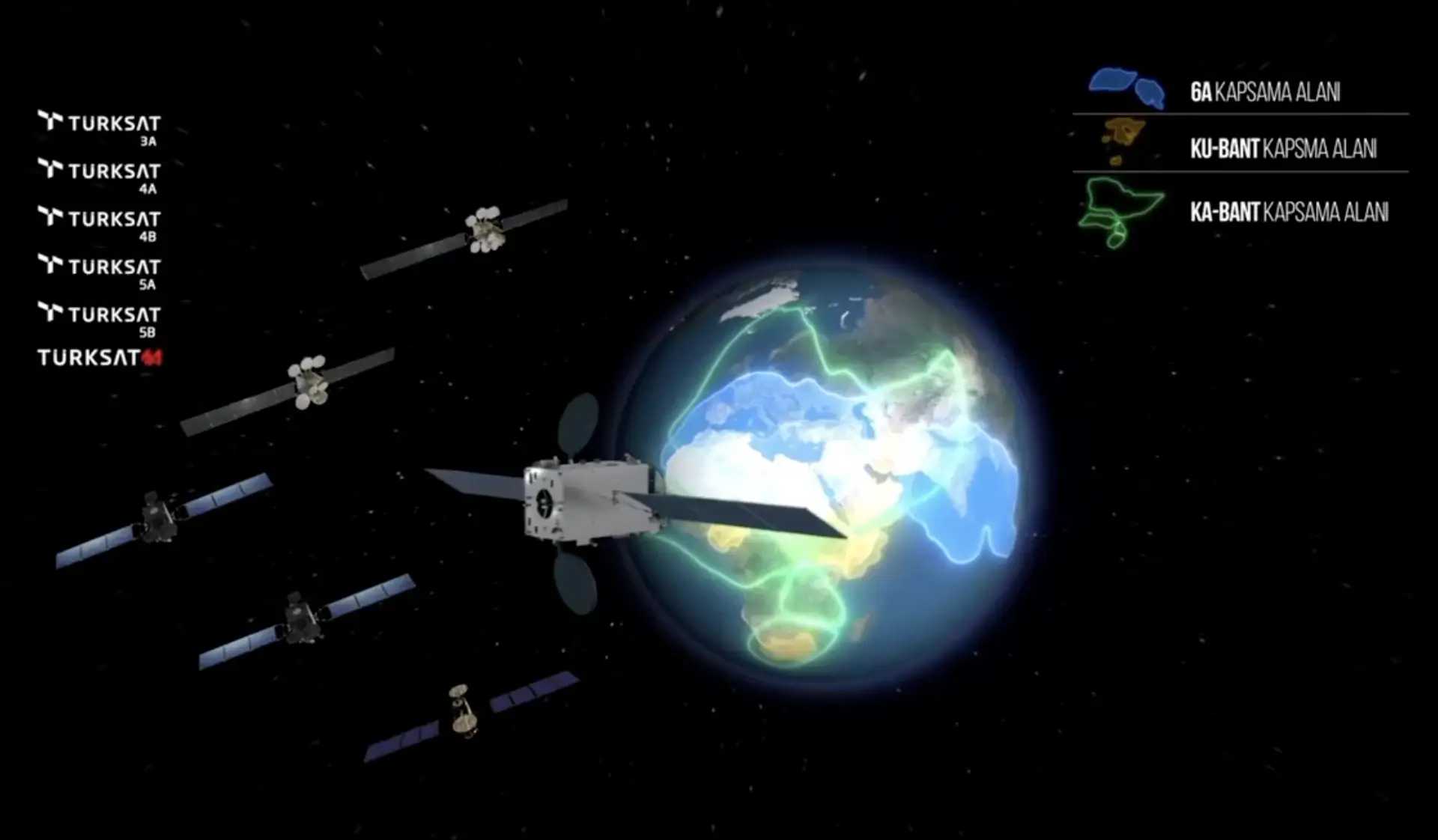
Thanks to its advanced solar panels generating approximately 8.4 kilowatts of power and its efficient power management system, Türksat 6A is expected to provide uninterrupted service for over 15 years. The high-efficiency Ku-band transponders at the heart of the satellite significantly increase Türkiye's satellite communications capacity. The tangible benefits offered by Türksat 6A upon its commissioning are as follows:
- Advanced Television Broadcasting: It is now possible to transmit a greater number of TV channels seamlessly to a wider geographical area in high-definition standards such as HD and 4K. This offers broadcasters a more flexible and powerful platform.
- The Widespread Adoption of Broadband Internet: High-speed, reliable satellite internet access is becoming increasingly available to individual and corporate users, particularly in rural and hard-to-reach areas where terrestrial infrastructure is inadequate. This contributes to accelerating digital transformation and democratizing access to information.
- Secure Data Communication: The system increases capacity and security in secure data flow and enterprise network (VSAT) services, which are critical for sectors such as banking, public administration, and energy. It also strengthens the communication infrastructure by providing support to mobile operators' base stations.
- Strategic Public Communications: The communication needs of state institutions and security units are being met more effectively through an uninterrupted, secure, and national infrastructure.
What is the difference between KU-band and KA-band?
Ku-band and Ka-band are two commonly used frequency bands in satellite communication, and their fundamental differences lie in their intended use and technical specifications. Ku-band operates in the 10.7–14.5 GHz frequency range and is particularly preferred for satellite television broadcasting, VSAT systems, and mobile communication applications. It offers a moderate bandwidth and is less affected by weather conditions compared to Ka-band. Ka-band, on the other hand, operates at higher frequencies (17.7–31 GHz) and is used in broadband internet services, high-speed data transmission, and next-generation communication systems. Its ability to achieve high speeds with smaller antennas is a significant advantage; however, it is more susceptible to weather conditions such as rain. It also provides higher capacity and efficiency thanks to spot beam technology. Therefore, Ku-band is preferred in applications requiring more stable connections, while Ka-band stands out in modern communication solutions that require high speed and capacity.
From a Challenging Process to Operational Success: The Story of Türksat 6A
The commissioning of Türksat 6A is the product of years of dedicated work and determination. The project began with the goal of achieving complete independence for Türkiye in satellite technologies. Following comprehensive feasibility studies, R&D activities, and detailed design processes, the production phase commenced. Components developed with the contributions of domestic subcontractors were meticulously assembled at the Space Systems Integration and Test (USET) Center in Ankara.
At the USET Center, the satellite underwent international standard tests simulating the harsh conditions of space (extreme temperature differences, vacuum, vibration and noise during launch, radiation, etc.). The successful completion of these tests guaranteed that the satellite could perform its mission in space without problems. The orbital insertion maneuvers and comprehensive system checks performed after the launch were also successful, and the satellite was made ready for service as planned.
Türkiye's Future Steps in Space
The commissioning of Türksat 6A represents a significant achievement and serves as an important source of motivation and capability for Türkiye in reaching its National Space Program goals. The work, coordinated by the Turkish Space Agency (TUA), encompasses a wide range of areas, from lunar access and next-generation earth observation and communication satellites to regional positioning systems and a spaceport project.
The operational success of Türksat 6A demonstrates that these ambitious goals are now more achievable. Officials state that the experience and technological expertise gained from this project will be used in the development of more advanced domestic communications satellites (such as Türksat 7A, 8A, etc.) to replace satellites like Türksat 3A, which are nearing the end of their lifespan. The aim is to continuously renew and increase the capacity of Türkiye's satellite fleet in orbit. Furthermore, it is expected that domestic satellite projects in imaging, scientific research, and other fields will gain momentum.
Türkiye Proved Its Strength in the Space League
The official launch of Türksat 6A is not only a technological advancement but also a strategic achievement for our country. This satellite represents the level of Turkish engineering, the determination of our nation, and its resolve to achieve great goals. Having a communications satellite that we designed, manufactured, tested, and are now successfully operating ourselves reinforces our hopes and confidence for the future.
Türksat 6A will strengthen Türkiye's communications infrastructure throughout its active service, provide better service to millions of people, and contribute to our country's regional and global influence. This operational success is the strongest expression of "we are also here" in the space race. We wholeheartedly congratulate all the institutions, engineers, technicians, and supporters who contributed to this historic project. With the commissioning of Türksat 6A, Türkiye has further solidified its rightful place in space.
Key words: Türksat 6A, domestic satellite, national communications satellite, Türksat 6A entered service, Turkish space technologies, national satellite project, Türksat, TÜBİTAK Space, TUSAŞ, ASELSAN, CTECH, USET, 42 East orbit, satellite communications, Ku-Band, satellite internet, TV broadcasting, domestically produced satellite, Turkish Space Agency, national space program, communications satellite, Türksat 6A coverage area, satellite operations, Turkish space industry
Note
If you have any photos or video footage to support our news story, please share them with us using the information provided on our contact us page.
