


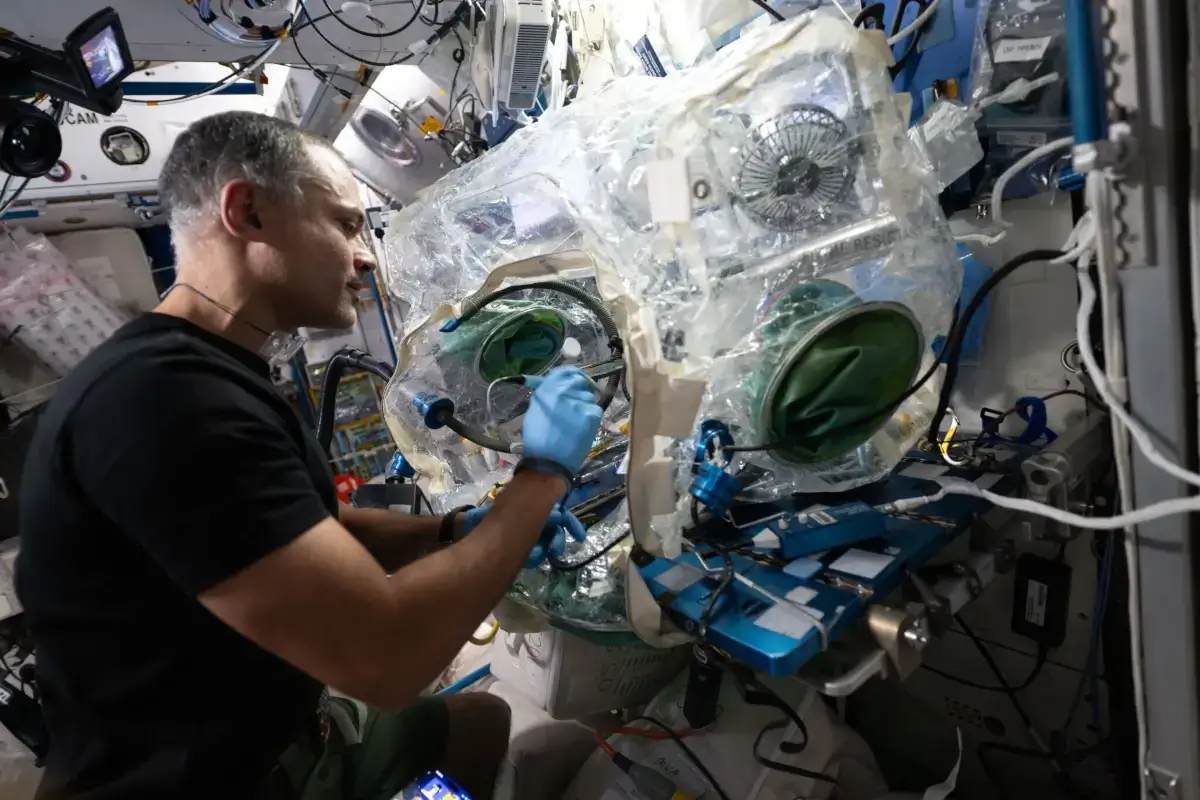
The second phase of the Microgravity Lead-Free Soldering Research (MİYOKA) experiment, developed by TÜBİTAK UZAY and implemented within the scope of the Turkish Astronaut and Science Mission (TABM), has been successfully completed. The second phase work of the MİYOKA experiment, initiated by Türkiye's first astronaut Alper Gezeravcı, was completed following operations conducted by NASA Flight Engineer Dr. Anil Menon aboard the International Space Station (ISS – Expedition 75) between 14 and 18 September 2026. The experiment module is now ready for its return journey to Earth.
A Critical Threshold for Safe Manufacturing and Repair in Space
The final procedures on the experiment module, delivered to the ISS aboard the SpaceX SpX-34 mission on 5 May 2026, were carried out in the station's Harmony module. The precision applications performed on a circuit board using lead-free soldering technique under microgravity conditions are of critical importance for the future of space technologies. The ability to safely manufacture electronic components and repair potential faults on site during long-duration deep space missions to the Moon, Mars and beyond will become possible through the infrastructure provided by the MİYOKA experiment. Thanks to the data obtained, future space crews' dependence on costly and time-consuming resupply missions from Earth will be significantly reduced.
Comparative Analysis with Earth-Based Samples
Within the scope of the experiment, the scientific data obtained on precision bonding performance in the space environment will be brought to Earth aboard the SpaceX CRS-35 mission to be compared with control samples produced under identical conditions on Earth. The analyses to be conducted under the leadership of TÜBİTAK UZAY are intended to guide future deep space missions and the development of in-space manufacturing technologies.
Türkiye's Microgravity Environment Capability
The MİYOKA experiment stands out as a concrete step proving Türkiye's manufacturing and repair capability in a microgravity environment. The experiment provides reference data and a validated technological infrastructure for lunar, Martian and other deep space missions. The reliable application of lead-free soldering technique in the space environment carries importance from both environmental and operational standpoints. Lead-free solder alloys enable the electronic systems used in spacecraft to be manufactured and repaired without containing toxic substances.
Note
If you have any photos or video footage to support our news story, please share them with us using the information provided on our contact us page.
