


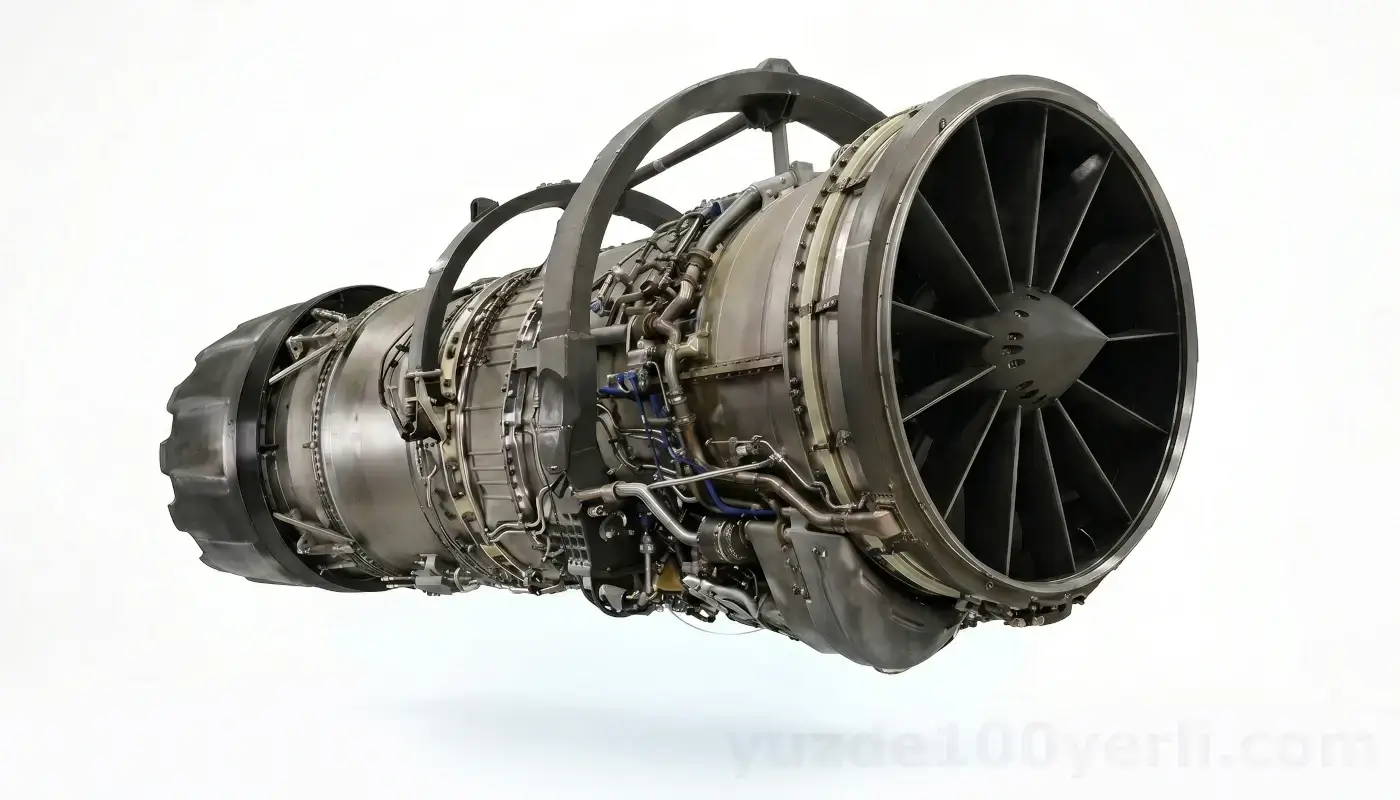
The secrets of the massive GÜÇHAN turbofan jet engine with 42,000 lbf thrust, the most discussed and curious project of the Turkish defence industry at the SAHA EXPO 2026 fair, are being revealed. Nilüfer Kuzulu, Director of the Ministry of National Defence (MoND) R&D Centre, made groundbreaking statements about Türkiye's first domestic and national jet engine project. Putting an end to claims that the massive engine exhibited at the fair was merely a concept or mock-up, Kuzulu officially announced that the engine was developed entirely with domestic resources, that 6 units have been produced so far, and that qualification tests will begin this year (2026). Türkiye has officially announced that it has taken this strategic heart, which will power fifth-generation fighter jets, off the drawing board and directly onto laboratory tests.
The Holy Grail of Aviation: Single Crystal Blades Produced
The biggest engineering barrier where many countries trying to develop jet engines get stuck is metallurgy science. The thousands of degrees of heat generated in the combustion chamber and turbine of a jet engine would melt standard metals within seconds. The only technology that can withstand this heat is single crystal turbine blades with perfect atomic arrangement.
The biggest engineering revolution in Nilüfer Kuzulu's statements lies right here. Kuzulu announced that the single crystal blades used in the GÜÇHAN engine were cast and produced entirely in Türkiye, with our own resources. Furthermore, instead of copying existing engines like the F110 or F135, the MoND R&D Centre designed the system from scratch. The compressor architecture providing the engine's air intake and the compression ratios were shaped entirely by the original calculations of Turkish engineers. Although similar in external dimensions to its global counterparts, GÜÇHAN carries a unique technological DNA, belonging entirely to Türkiye in terms of thermodynamics and internal architecture.
The Process Extending from Helicopters to Fighter Jets
It cannot be expected for a monster like GÜÇHAN, with 42,000 lbf thrust, to appear overnight. MoND R&D teams started this massive project years ago with a solid strategy. As Kuzulu stated, the ministry first studied the combustion dynamics of rocket engines, then gained experience in turbine technologies in helicopter engines, and finally transferred this accumulation to jet engines (turbofan).
The answer to the most curious question in the sector, "Where are these engines?", proves the maturity of the project. The MoND has succeeded in producing 6 units of this engine, developed entirely with domestic resources, at the prototype stage. These 6 produced engines show that the system has long passed the design phase in engineering and has now reached the physical validation phase.
Qualification Tests Begin This Year
Nilüfer Kuzulu's statements have also clarified the historic schedule that will fundamentally eliminate the risk of engine embargoes in the Turkish aviation industry. Qualification tests for the 6 GÜÇHAN engines produced so far will begin this year. In these tests, the engines will be run at maximum speed for thousands of hours, subjected to extreme hot and cold tests, and will prove their durability in extreme scenarios like bird strikes they might encounter in the air.
In the coming period, these engines, having successfully completed ground tests (test rigs), are expected to be tested in the air on modified aircraft called "Flying Test Beds". With this development, Türkiye is not only designing its own National Combat Aircraft (KAAN). By producing the massive 42,000 lbf heart that will fly KAAN supersonically entirely with its own resources, down to the single crystal blades inside it, Türkiye is inscribing its name at the very top of the aviation league.
Note
If you have any photos or video footage to support our news story, please share them with us using the information provided on our contact us page.
