


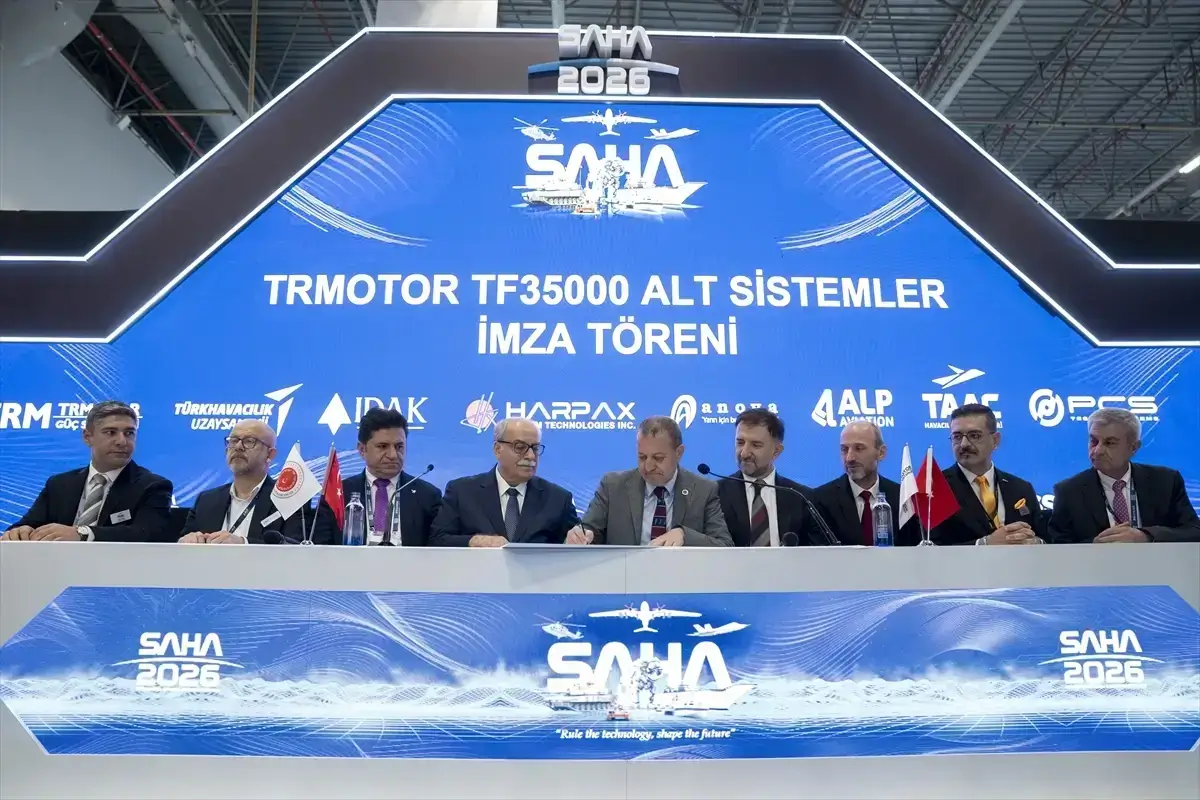
The Turkish defence and aviation industry has passed a historic threshold in the indigenous turbofan engine project aimed at powering the National Combat Aircraft KAAN. TRMOTOR, carrying out its work under the auspices of the Presidency of Defence Industries (SSB), signed development and procurement agreements worth approximately $70 million for the sub-systems of the TF35000 turbofan engine. At the ceremony, leading domestic engineering companies such as TUSAŞ, TAAC, ALP Havacılık, ANOVA, HARPAX, IDAK, and PCS came to the table. Türkiye has taken a strong step towards producing the most critical and complex components of a turbofan engine entirely with its domestic ecosystem.
Gearbox, Lubrication, and Fuel Systems
It would be wrong to define a modern turbofan engine merely as a metal cylinder that compresses and combusts air. The operational reliability of the engine is determined by its high-pressure fuel systems, lubrication units operating at thousands of degrees, and accessory gearboxes that transfer immense power to other systems.
TRMOTOR is precisely nationalising these complex systems within the scope of the TF35000 project. The signed agreements, totalling $70 million, cover the gearbox, fuel control units, lubrication systems, activation equipment, and the test benches where these systems will be tested on the ground. When a fighter jet exceeds the speed of sound or performs sharp manoeuvres, each of these sub-systems must operate with millisecond response times and zero error tolerance. Therefore, an extraordinary engineering burden falls on the shoulders of the seven different domestic companies with which agreements have been reached.
Nationalising Ecosystem and Embargo Shield
In aviation history, the number of countries capable of producing jet engines does not exceed the fingers of one hand. Moreover, even if these countries sell the engine itself, they subject critical sub-components like fuel pumps or activation systems to very strict export controls. The Turkish defence industry has experienced schedule delays in many strategic projects due to such sub-systems procured from abroad.
This signing ceremony, attended by Deputy President of Defence Industries Gökhan Uçar, actually represents a massive national shield established against covert embargoes. Instead of doing all the design and production of the engine alone, TRMOTOR is involving companies specialised in their own fields, such as TUSAŞ, TAAC, ALP Havacılık, and ANOVA, in the process. Thanks to this strategic approach, Türkiye is building an unshakeable, broadly distributed aviation engine ecosystem without being dependent on a single institution.
35,000 lbf Thrust and a Fully Independent Sky
In conclusion, this major $70 million sub-system investment shows that the TF35000 turbofan engine is rapidly progressing from a concept on paper towards the physical production line. This massive engine, which takes its name from its targeted thrust of 35,000 pounds-force (lbf), will form the ultimate and most powerful component of the National Combat Aircraft KAAN.
In the coming period, we will see prototypes of these sub-systems, for which contracts have been signed, rapidly produced and operated on ground test rigs. Turkish engineering is completely breaking the chains in the aviation engine sector, where foreign dependency has been most intense.
Note
If you have any photos or video footage to support our news story, please share them with us using the information provided on our contact us page.
