


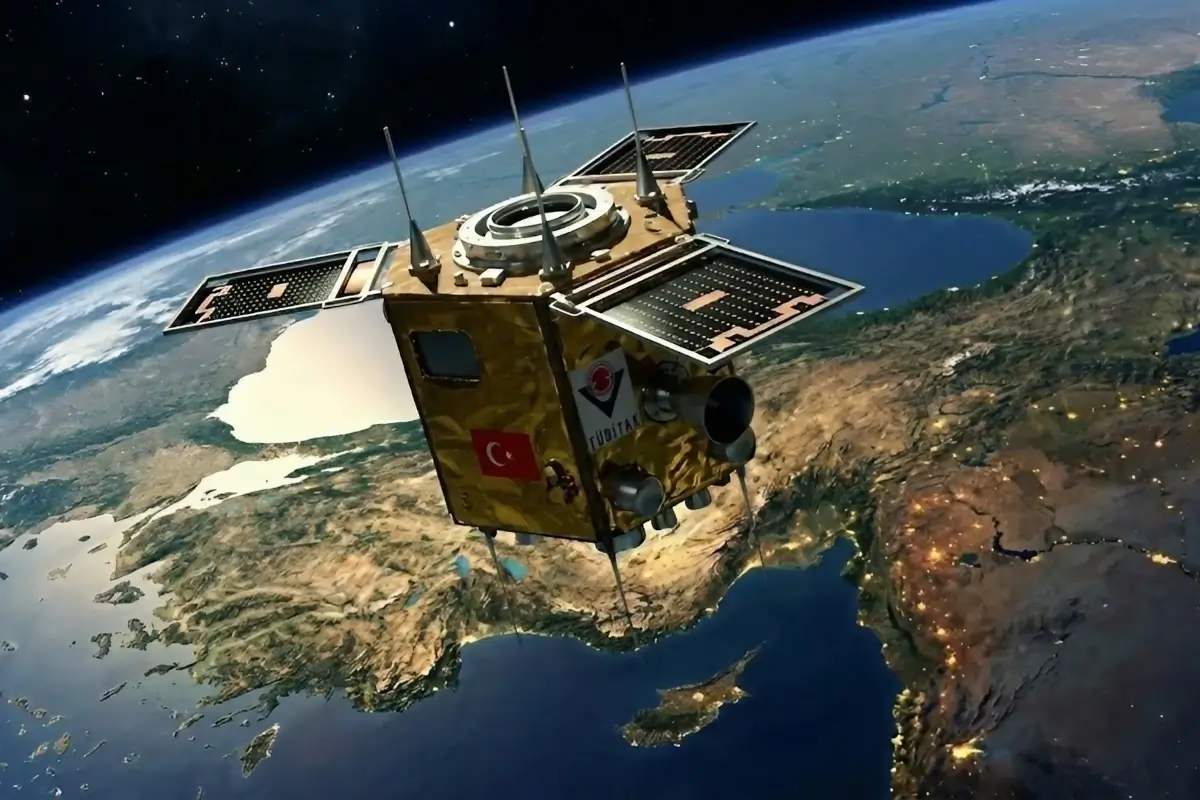
Considered a milestone in Türkiye's space program and developed using national resources, the GÖKTÜRK-2 Earth observation satellite has passed another significant milestone in its mission in space. According to a statement by TÜBİTAK (The Scientific and Technological Research Council of Turkey), the satellite, launched on December 18, 2012, has successfully completed its 13th year in orbit.
Although its design life was planned for 5 years, GÖKTÜRK-2, thanks to its robust infrastructure and domestic engineering success, exceeded this period by more than 2.5 times and is completing its active duty in the Turkish Armed Forces (TSK) and taking on a new role.
The Göktürk-2 Earth Observation Satellite has been transferred from the Turkish Armed Forces to TÜBİTAK Space.
The satellite, which has met the intelligence and earth observation needs of the Turkish Armed Forces since its launch, has been transferred to TÜBİTAK UZAY after 13 years of operation. A statement from the institution indicated that the satellite will now serve as a data source for next-generation satellites with the accumulated knowledge it has gained, and will also be used in the training of young researchers.
This change of mission means the satellite will continue to serve as a "space laboratory" rather than being retired. Telemetry data obtained from the satellite is critical for studying long-term space environmental effects such as battery aging and solar panel efficiency.
The most important feature of GÖKTÜRK-2 is its high domestic content ratio.
GÖKTÜRK-2’nin fırlatıldığı 2012 yılında yapılan resmi açıklamalarda, projenin en stratejik başarısının yüksek yerlilik oranı olduğuna dikkat çekilmişti. Dönemin TÜBİTAK Başkanı Prof. Dr. Yücel Altunbaşak’ın ifadelerine göre; Türk mühendisleri tarafından geliştirilen uydunun yazılımında %100, donanımında ise %80 oranında yerlilik başarısı yakalandı. TSK’nın operasyonel ihtiyaçlarını karşılamak üzere tasarlanan ve 15 gigabyte görüntü depolama kapasitesine sahip olan uydu, dünyayı günde yaklaşık 15 kez turlayarak geniş bir kapsama alanı sunuyor. Türkiye’yi kendi uydusunu üretebilen sayılı ülkeler ligine taşıyan bu proje, o dönemde yerli uydu teknolojisinin DNA’sının çözüldüğünün ve sistemin ana mekanizmasının millileştirildiğinin en somut kanıtı olarak kayıtlara geçmişti.
Durability Test of Domestic Engineering
Developed through a collaboration between TUSAŞ and TÜBİTAK UZAY, GÖKTÜRK-2 is Türkiye's first high-resolution national Earth observation satellite. Launched into space from the Jiuquan Launch Center in China in 2012, the satellite operates in a sun-synchronous orbit at an altitude of approximately 686 kilometers.
The satellite's most remarkable technical achievement was exceeding its expected lifespan. Designed to withstand the high radiation, extreme temperature differences, and vacuum conditions of space for 5 years, the satellite's subsystems have been operating continuously for 13 years. This demonstrates that Türkiye's engineering capabilities in satellite power systems, thermal control structures, and attitude determination algorithms are above international standards.
GÖKTÜRK-2 laid the technological foundation for subsequent projects such as GÖKTÜRK-1, İMECE, and TÜRKSAT 6A. The veteran satellite, orbiting the Earth approximately 14 times a day, continues to undertake one of the longest-running missions in Turkish space history.
Keywords: GÖKTÜRK-2, TÜBİTAK SPACE, domestic observation satellite, Turkish space studies, TUSAŞ satellite, GÖKTÜRK-2 specifications, December 18, 2012
Note
If you have any photos or video footage to support our news story, please share them with us using the information provided on our contact us page.
