


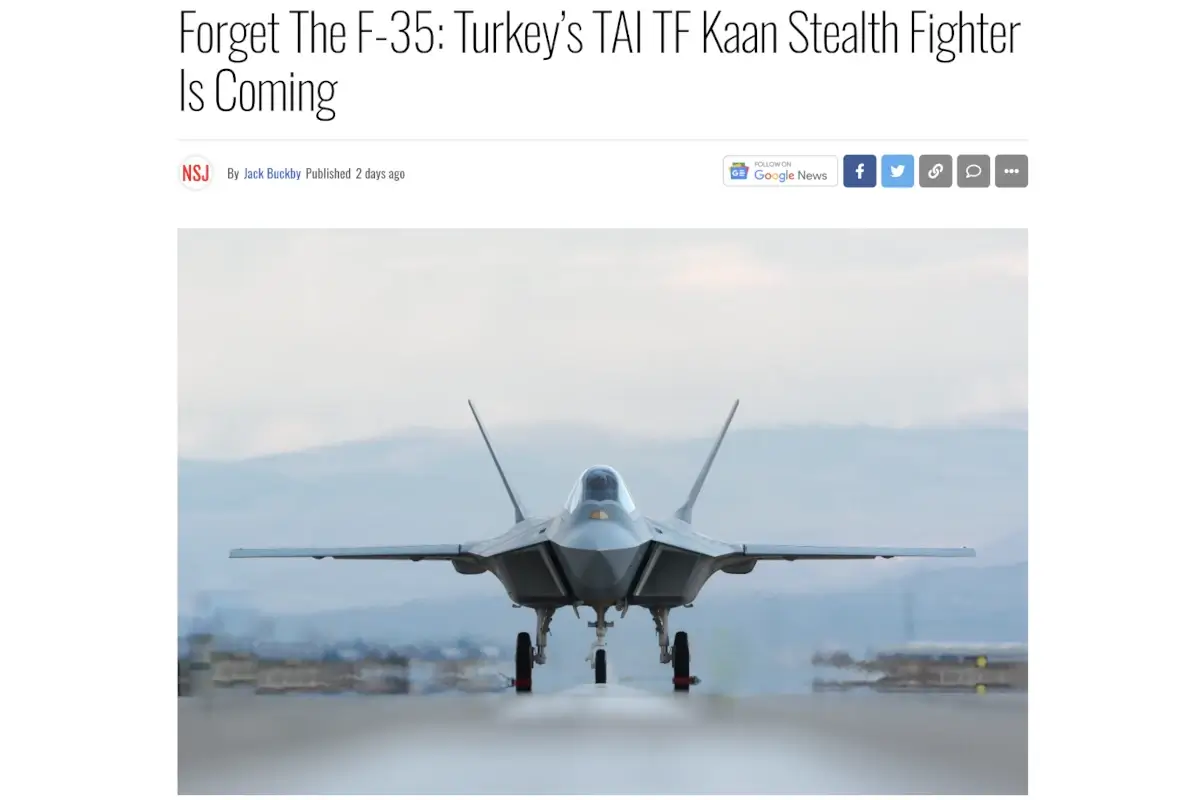
Global defense industry balances have undergone an unprecedentedly rapid and drastic transformation in recent years. In particular, air dominance doctrines, the integration of manned and unmanned platforms, and the strategic importance of fifth-generation fighter jets have become fundamental elements determining the fate of nations. In this context, Türkiye's National Combat Aircraft project, KAAN, is positioned not only as a local success story but also as a strategic actor shifting the balance of power on the international stage. A recent analysis published by the National Security Journal (NSJ), a respected US-based defense publication, announced this fact to the world public with a striking headline: "Forget the F-35, Türkiye's TAI TF KAAN Invisible Warrior is Coming."“
This article, drawing on a notable analysis from the National Security Journal, will examine KAAN's technical specifications, the paradoxical advantage created by Türkiye's removal from the F-35 program, and the level of maturity reached by the Turkish defense industry from a strategic perspective.
Strategic Autonomy Arising from Necessity: The F-35 Crisis and the Turning Point
Türkiye's removal from the F-35 Joint Strike Fighter program was interpreted at the time as a serious risk of air power weakness for Ankara. The F-35 was considered one of the world's most advanced platforms, with its network-centric warfare capabilities and sensor fusion. However, as the National Security Journal also emphasized, this separation was not an end for Turkey, but rather a critical starting point on the path to strategic autonomy.
A point often overlooked by Western military analysts is the Turkish engineering ecosystem's ability to react to crises. The industrial gains and production experience acquired from the F-35 program were channeled into the KAAN project by TUSAŞ (Turkish Aerospace Industries) engineers. This accelerated Türkiye's rise from being merely a "parts manufacturer" to a major platform integrator and designer.
The phrase "Forget the F-35," highlighted in the NSJ analysis, symbolizes not just a change of aircraft, but a paradigm shift. Turkey has reached the point of preferring a national platform, in which it has complete control over every screw, every line of code, and every mission concept, over an imported platform whose source code it may not fully master and which could be subject to logistical and operational restrictions.
KAAN: Technical Excellence and the Depth of its Design Philosophy
An examination of KAAN's design philosophy reveals that it exhibits a hybrid character between the F-35 and the F-22 Raptor. While the F-35 primarily serves as a "ground attack" and "information gathering" (ISR) platform, KAAN has a fuselage structure more suited to air superiority missions.
Its twin-engine structure gives the KAAN some kinematic advantages that the F-35 lacks. A higher thrust-to-weight ratio, a higher altitude ceiling, and potentially higher speed make the KAAN a formidable opponent in air-to-air combat. The "stealth" capability highlighted by the NSJ is not limited to fuselage geometry alone, but is also supported by radar-absorbing paint technologies and internal weapon bays.
Aviation experts state that KAAN's design details, particularly those aimed at reducing radar cross-section (RCS) (sawtooth covers, air intake geometry, wing-fuselage connection), are world-class. This is concrete evidence of the level reached by the Turkish defense industry in aerodynamic and electromagnetic analysis capabilities.
Sensor Fusion and Avionics Independence
The key element that transforms a fifth-generation fighter jet from a mere "flying mass of metal" is its electronic systems and software. KAAN is equipped with advanced systems including the AESA (Active Array Scanning) radar developed by ASELSAN, as well as the Integrated Radio Frequency System (BÜRFİS), IRST (Infrared Search and Tracking), and helmet-mounted sighting systems.
The article in the National Security Journal underlines Türkiye's ability to produce these subsystems domestically. The sovereignty restrictions imposed by centralized control mechanisms like ALIS (Autonomous Logistics Information System), a major concern for F-35 users, are not an issue with KAAN (Turkish Air Force's National Combat Aircraft). The Turkish Air Force can integrate any ammunition it wants into the aircraft's mission computer, update threat libraries as it wishes, and not have to share operational data with third countries. This is more than a technical detail; it is the digital equivalent of complete independence.
Integration of National Combat Aircraft and Unmanned Systems: The Superpower Doctrine
One of the biggest innovations in Türkiye's air warfare doctrine is that KAAN will not fight alone. Within the framework of the "Loyal Wingman" concept, unmanned combat aircraft such as BAYKAR's KIZILELMA and TUSAŞ's ANKA-3 are being designed to fly in formation with KAAN.
KAAN will be able to act like an "orchestra conductor," staying behind to identify targets while directing unmanned systems to risky areas. This is one of the aspects that has attracted the most attention from Western sources such as the National Security Journal. Turkey is not just building an aircraft; it is establishing a new generation air warfare ecosystem where manned and unmanned systems are intertwined. While this concept has not yet become fully operational in the F-35 program, Türkiye is expected to achieve this integration much faster with the UAV/UAS experience it has gained in the field.
Economic Sustainability and Export Potential
The success of defense projects is measured not only by technical excellence but also by economic sustainability. The unit costs of the F-35, and especially its flight hour costs, represent a significant budget burden for many user countries. Türkiye's KAAN project has the potential to offer a cost-effective alternative.
As implied in the NSJ analysis, for non-Western countries, a fifth-generation fighter jet that can be procured without being subject to strict US export restrictions and political blackmail is invaluable. The interest of many countries, particularly Azerbaijan, Pakistan, and the Gulf states, in the KAAN project is no coincidence. With KAAN, Turkey will not only protect its own airspace but will also become a new player in the global fighter jet market, breaking the monopoly of the US, Russia, and China.
Engine Technology and Future Vision
The American-made F110 engines used in KAAN prototypes provided a reliable power source in the early stages of the project. However, the ultimate goal is the completion of domestic engine development efforts undertaken by TEI (TUSAŞ Engine Industry). While acknowledging the difficulty of the engine issue, the National Security Journal predicts that this obstacle will be overcome in the medium term, taking into account Türkiye's progress in gas turbine technology (TS1400, TEI-TF6000/10000 projects).
With the integration of the domestically produced engine, KAAN will fully achieve supercruise capability and maximize its stealth capacity with reduced infrared signature nozzle designs.
Geopolitical Influences: From Regional Power to Global Actor
Türkiye's commitment to the KAAN project is influencing geopolitical balances across a vast geographical area stretching from the Eastern Mediterranean to Central Asia. Greece's dreams of establishing air superiority in the Aegean Sea, relying on its F-35 purchase, have been dashed by KAAN's deployment much faster than expected.
The headline in the NSJ, "Forget the F-35," is actually a message to the Western world: "You cannot weaken Türkiye by excluding it; on the contrary, you will create a stronger competitor that produces its own solutions." KAAN is Türkiye's most sophisticated and vocal response to technological embargoes.
About the National Security Journal
The source of the analysis we are discussing is the National Security Journal (NSJ), a digital platform focused on analysis in the fields of international security, defense technologies, and geostrategy. While it generally addresses issues from an American and Western perspective, it has recently been featuring reports that objectively evaluate the defense industry advancements of rising powers like Turkey. The platform's inclusion of KAAN under the title "Forget the F-35" is a testament to the global brand value of the Turkish Aerospace Industries.
KeywordsKAAN, National Combat Aircraft, TUSAŞ, National Security Journal, F-35, Turkish defense industry, 5th generation fighter jet, air superiority, strategic autonomy, ASELSAN, TEI
Note
If you have any photos or video footage to support our news story, please share them with us using the information provided on our contact us page.
