


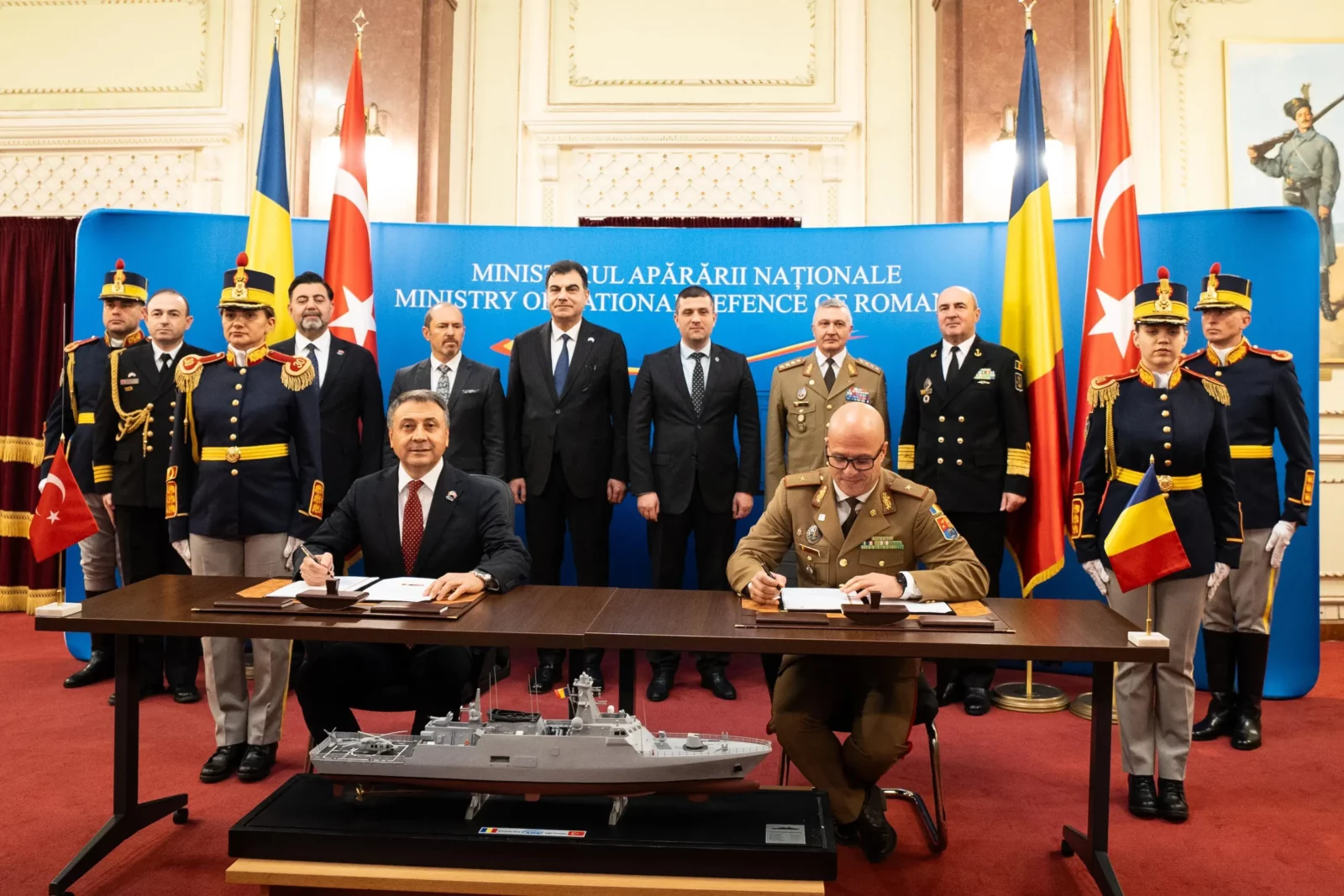
The Turkish defense industry continues to achieve the seemingly impossible, open closed doors, and become a game-changer on the global stage. Another success story has been added to the culmination of national engineering and strategic vision. ASFAT (Military Factory and Shipyard Management Inc.) has made history in the Turkish defense industry by exporting a warship to a NATO and European Union member country for the first time. This agreement, signed with the Romanian Ministry of Defense and covering the purchase of one light corvette, is not only a commercial success but also a diplomatic triumph for Türkiye's naval deterrence and engineering capabilities.
This historic agreement reinforces Türkiye's role in Black Sea security, proving that our domestic and national solutions are on par with, or even beyond, Western standards. So, which ship, described as a "light corvette" but towering in capabilities, was chosen by Romania? Here's the story behind this great success and the details of that mysterious ship.
HİSAR Class: Giants with the Look of Light Corvettes
The "Light Corvette" mentioned in the agreement between ASFAT and the Romanian Ministry of Defence refers to the same type of corvette built for the Turkish Navy, known as the new guardians of the Blue Homeland. HİSAR Class is an Offshore Patrol Vessel (ADKG).
Although generally classified as "Offshore Patrol Vessels" (OPVs) in the public eye, HİSAR-class vessels far surpass standard OPVs in the literature with their weaponry, sensor systems, and survivability capabilities. Therefore, their classification as "Light Corvettes" in the international arena and in the Romanian tender is entirely appropriate. Carrying the genes of the MİLGEM project (ADA-class Corvettes), the HİSAR class has emerged as a cost-effective and versatile solution built upon the success of the ADA-class corvettes.
Why was the HİSAR Class chosen?
Given Romania's strategic location on NATO's eastern flank and the increasing security risks in the Black Sea, the chosen vessel needed to have both a deterrent and flexible mission structure. The HİSAR Class surpassed its competitors precisely in this respect.
- Modular Design (Fitted for but not with): HİSAR-class ships can perform patrol duties with a light weapons payload in peacetime, but have an infrastructure that allows for the rapid integration of heavy weapon systems such as guided missiles and torpedoes in conflict or crisis situations. This “ready-to-use” concept offered Romania a budget-friendly yet combat-ready platform.
- A Local Engineering Marvel: The ship's design is entirely the work of Turkish engineers. The Combat Management System (CMS) on board is ADVENT, developed by HAVELSAN, which has network-centric warfare capabilities. The fact that a NATO country chose Turkish software as the brain of the ship is a critical milestone for our software exports.
- The MİLGEM Legacy: Built on the hull design of the world-renowned ADA Class Corvette, the ship's seaworthiness, durability, and performance are guaranteed.
Technical Specifications and Operational Capabilities
This ship, which will join the Romanian navy, will be approximately 99.5 meters long and have a displacement of 2300 tons. The prominent technical details of the HİSAR class are as follows:
- Drive System: Instead of combinations of diesel and gas turbines, more economical and mission-suitable diesel propulsion systems (CODELOD or CODAD) have been preferred. This provides the ship with the advantage of extended sea endurance and a wide operational radius.
- Weapon Systems: The ship is equipped with a 76mm main gun, close-in air defense systems (Gökdeniz or equivalent), heavy machine gun platforms, and anti-ship missile launch capability. According to Romania's request, a vertical launch system (VLS) can be integrated into the ship to enhance its air defense capabilities.
- Aviation Capacity: The ship has a platform capable of handling the take-off and landing of 10-ton class general-purpose helicopters, as well as a hangar to accommodate them. It also offers operational capabilities for unmanned aerial vehicles (UAVs).
The Ice Breaks in the NATO Market
The long-held perception that "NATO countries buy from established Western manufacturers" has been shattered by this agreement. In a market dominated by countries with well-established shipbuilding industries like France, Germany, and Italy, a NATO member choosing Türkiye and ASFAT is proof that the Turkish defense industry is aiming for the top in the world in terms of quality/cost balance.
This sale should not be read as merely the sale of a single ship. It has provided Türkiye with a huge reference for future frigate, patrol boat, and support vessel tenders. Romania's choice will also set a precedent for other countries in the region, such as Bulgaria and Poland.
ASFAT's Role and Strategic Vision
ASFAT, operating under the Ministry of National Defence, has combined public and private sector dynamics to undertake massive projects in recent years, such as the Pakistan MİLGEM project. The Romania project, however, has become ASFAT's ticket to enter the European market. The fact that production will take place in Turkish shipyards will increase the capacity utilization rate of our shipyards and provide a boost to the supporting industries.
In conclusion, those to be exported to Romania HİSAR Class Light Corvette, It is an engineering marvel that will fly the Turkish flag on the opposite shore of the Black Sea. On this path taken with the "Yüzde 100 Yerli" vision, we are not only protecting our own borders, but also leaving a Turkish mark on the security of friendly and allied countries.
Key words: ASFAT, Romania, corvette exports, HİSAR class, offshore patrol vessel, light corvette, Turkish defense industry, Blue Homeland, NATO exports, warship
Note
If you have any photos or video footage to support our news story, please share them with us using the information provided on our contact us page.
