


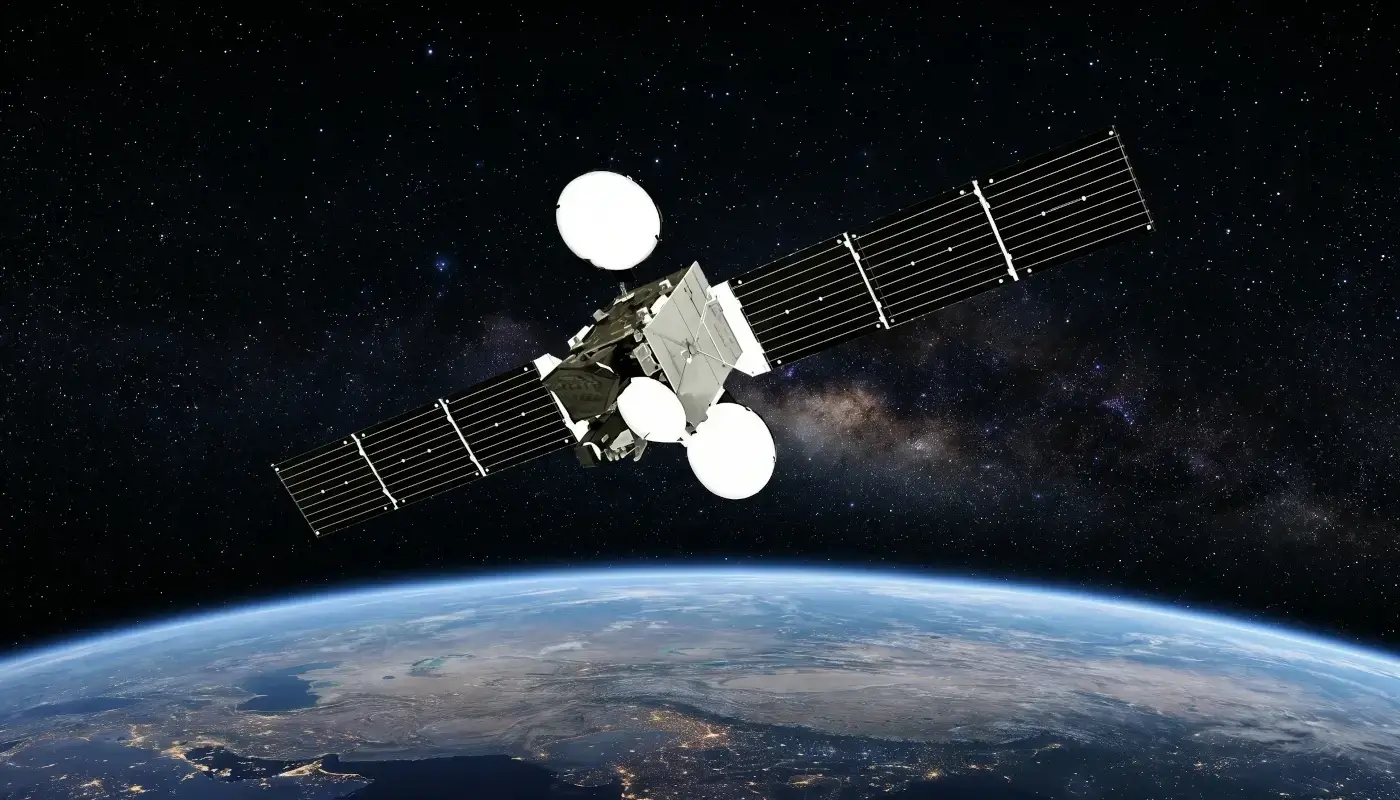
TÜRKSAT 6A, one of the significant milestones in Türkiye's space technologies, has completed its first year of operational journey in space. Launched on July 8, 2024, aboard a SpaceX Falcon 9 rocket, the satellite officially entered service on April 21, 2025, ushering in a new era in Türkiye's communication infrastructure. This development concretely demonstrates how domestic engineering and production capacity has become competitive at international standards.
TÜRKSAT 6A holds the title of Türkiye's first fully domestic and national communications satellite. The project was carried out in collaboration with TÜBİTAK UZAY, TUSAŞ, ASELSAN, and CTECH. Positioned at 42.0° East orbit, the satellite settled into geostationary orbit and aims to provide long-term service with an expected manoeuvre life of approximately 16 years. Following launch, the satellite reached its target orbit using its chemical propulsion system; it reached its final position on December 28, 2024, performed its first test broadcast on February 17, 2025, and became fully operational in April 2025.
Türksat 6A: Technical Specifications and Design Details
The technical infrastructure of TÜRKSAT 6A was designed to meet modern communication needs. The satellite offers Ku-Band & Ku-BSS Band, Ka-Band, and Q/V Band support for both uplink and downlink frequencies. This multi-band structure provides high data rates, wide bandwidth, and low latency performance. While the Ku-BSS band is optimised for television and radio broadcasting, the Ka and Q/V bands offer high capacity for data communication.
The satellite expanded its coverage area to include Western and Eastern regions as well as Türkiye. Thus, it provides reliable communication capability across a geography extending to Asian countries such as India, Thailand, Malaysia, and Indonesia. Covering an area with approximately 4.5 billion people, this wide coverage makes TÜRKSAT 6A a regional communications hub. Thanks to its power capacity and orbital position, the satellite is expected to maintain stable performance until the end of its life.
The project's localisation rate was kept at a high level. Developed under the coordination of the TÜBİTAK UZAY Institute, the satellite was completed with TUSAŞ's production and integration capabilities, ASELSAN's electronic systems, and CTECH's communication technologies. This cooperation model proves Türkiye's independent design and production capability in the space sector.
Operational Impacts and Global Communication
With TÜRKSAT 6A entering service, Türkiye's existing satellite fleet has been strengthened. This new satellite, surpassing the capacity limitations of previous generation satellites, provides significant improvements in broadband internet, corporate data communication, emergency communication, and broadcasting services. The importance of domestic satellite infrastructure becomes particularly evident during disasters such as earthquakes and floods.
On a global scale, TÜRKSAT 6A places Türkiye among the limited number of countries that produce communications satellites. Technology has been attained at a level capable of competing with actors like the USA, Europe, China, and Japan, which carry out similar projects. Although the satellite was launched with SpaceX's Falcon 9 rocket, all production and testing processes were carried out with domestic resources. This also demonstrates the success of strategically managing international collaborations.
In its first year in space, TÜRKSAT 6A has successfully completed all planned tests and exhibited stable operational performance. According to data shared by the Ministry of Transport and Infrastructure, the satellite is providing uninterrupted service at 42° East orbit. In the future, with the Q/V band technology becoming fully operational, it is aimed to reach even higher levels of data transmission speeds.
Future Perspective Shaped by TÜRKSAT 6A
TÜRKSAT 6A is just one part of Türkiye's space vision. The project is building experience in domestic satellite technologies, paving the way for next-generation satellites. Industry experts state that this success will make Türkiye a more active player in the space economy. It has also become an inspiration encouraging young engineers to pursue careers in space technologies.
In summary, TÜRKSAT 6A's first year in space draws attention with its technical infrastructure, wide coverage area, and domestic production model. Recorded in history with its launch on July 8, 2024, and service entry on April 21, 2025, the satellite strengthens Türkiye's communication independence while contributing to the global connectivity infrastructure. This development once again emphasises how strategic domestic production in space technologies is.
Note
If you have any photos or video footage to support our news story, please share them with us using the information provided on our contact us page.
