


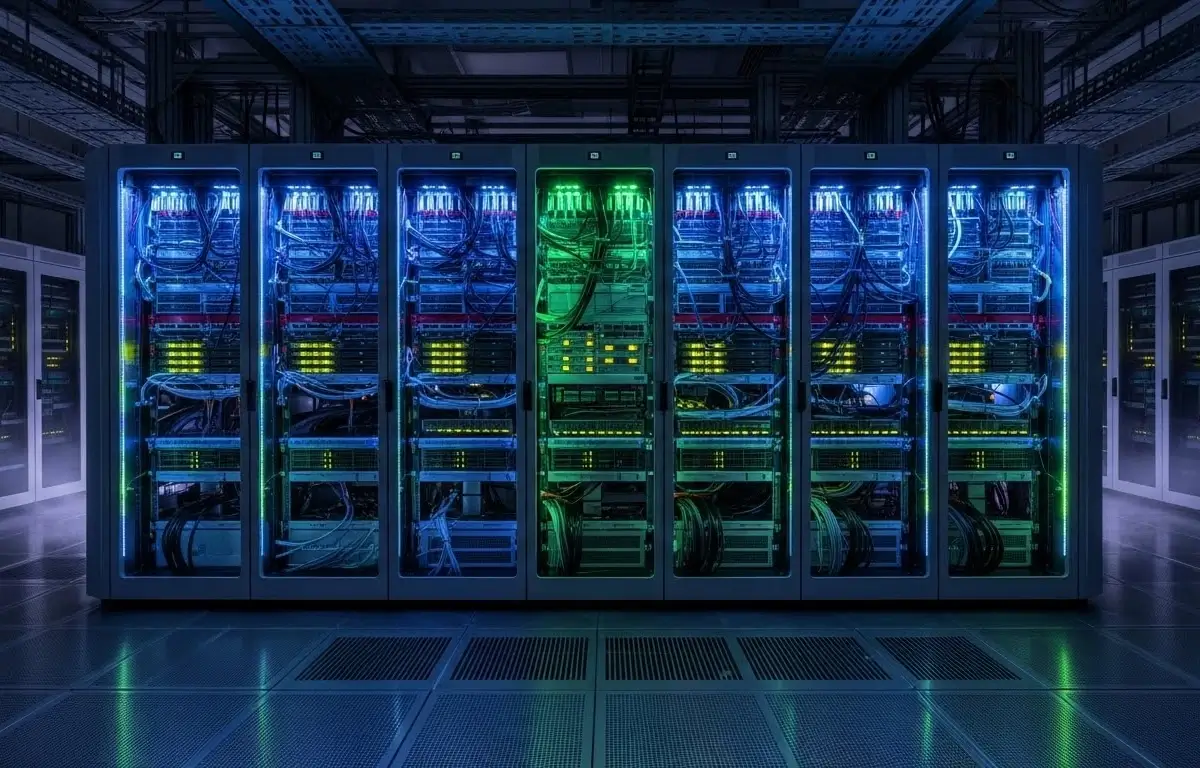
In the data age, a nation's technological independence is measured not only by its ability to produce software or hardware, but also by its "computational power" to process massive datasets. Türkiye's flagship in this field, TRUBA (Turkish National Science e-Infrastructure), operating under TÜBİTAK ULAKBİM, has shifted gears in the global arena with its ARF-ACC supercomputer. Rising 121 places to 145th in the TOP500 list of the world's most powerful supercomputers (based on November 2025 data), the system represents not just a ranking success, but also a strategic increase in capacity.
Hardware Update and H200 Impact
The performance of supercomputers is not static; it requires continuous investment and updates. The leap of the ARF-ACC system from 266th place in June 2025 to 145th place in November, just five months later, is based on a strategic hardware investment. The 192 NVIDIA H200 GPUs integrated into the system are the main architects of this performance increase.
The H200 series is hardware designed for artificial intelligence and high-performance computing (HPC) workloads, boasting significantly superior memory bandwidth and capacity compared to its predecessors. This new power, added on top of the H100 GPUs integrated into the system in 2024, has dramatically increased Türkiye's speed in training AI models and solving complex simulations. This technical upgrade has brought the system's theoretical processing capacity (Rpeak) and sustainable processing capacity (Rmax) to the upper segment of global standards.
Real-World Performance: HPCG Ranking
The TOP500 list is generally based on a test called "Linpack," which measures the system's raw mathematical processing power. However, what truly matters to scientists and engineers is the system's performance in solving complex real-world physics problems. This is where HPCG (High Performance Conjugate Gradients) tests come into play, evaluating a supercomputer's data access patterns and communication speed.
ARF-ACC has achieved an even more remarkable success in this field. Ranked 118th in June 2025, the system climbed 48 places to become the 70th most efficient system in the world by November 2025. This data proves that ARF-ACC is not only ’theoretically fast“ but also highly efficient in real scientific applications such as fluid dynamics, weather forecasting, or materials science simulations.
Giants at the Top: Leaders of the "Exascale" Era
The top of the November 2025 TOP500 list is dominated by systems that have already surpassed the “PetaFLOPS” (quadrillion operations per second) barrier and reached the “ExaFLOPS” (quintillion operations per second) level. Here are the world’s three most powerful systems:
- El Capitan (USA): This system, located at Lawrence Livermore National Laboratory, is approximately 1.74 ExaFLOPS It is the undisputed leader on the list in terms of processing power. It is used for nuclear stockpile management and national security simulations.
- Frontier (USA): Oak Ridge National Laboratory's legendary system, 1.20 ExaFLOPS It delivers performance at various levels. After remaining at the top of the list for a long time, it was replaced by El Capitan.
- Aurora (USA): Aurora, developed at Argonne National Laboratory and built on Intel architecture, 1.01 ExaFLOPS Its processing power pushes the boundaries of scientific discovery.
Where does TÜBİTAK ARF-ACC stand?
While world leaders compete at the “Exascale” (10 to the power of 18) level, TÜBİTAK ARF-ACC and the vast majority of the other top 500 computers in the world compete in the “Petascale” (10 to the power of 15) league.
Rising to 145th place in the TOP500 list, ARF-ACC has significantly increased its processing power with the addition of NVIDIA H200 graphics cards. However, a mathematical comparison reveals the following:
- Power Difference: The leader of the list, El Capitan, has approximately the same processing capacity as ARF-ACC. It is 200 to 250 times more powerful.
- Analogy: If El Capitan is a supersonic fighter jet, then ARF-ACC is a state-of-the-art, very powerful cargo plane. Both fly, both are technologically advanced, but their scale and mission definitions differ.
While this difference may seem significant, the concept of "suitability for needs" is fundamental in the world of supercomputers. Systems like El Capitan are built with billion-dollar budgets to solve the world's most complex physics problems; ARF-ACC, on the other hand, is optimized to meet Türkiye's academic and industrial R&D needs (climate modeling, domestic UAV/UAS aerodynamics, Turkish-language artificial intelligence models) and offers a more than sufficient and powerful infrastructure for these tasks.
Energy Efficiency and Green500 Success
High processing power often means enormous energy consumption. However, in modern supercomputer architecture, success is measured by the processing power produced per watt (GFlops/Watts). ARF-ACC has demonstrated its engineering quality by ranking 45th on the Green500 list, which ranks the world's most environmentally friendly supercomputers.
This ranking demonstrates how optimized the system's cooling infrastructure and energy management have been. At a time when the global energy crisis and climate change are being discussed, the fact that Türkiye's most powerful computer is also one of the world's most efficient systems is part of a sustainable technology vision.
Strategic Contribution to the National R&D Ecosystem
This increase in ARF-ACC's technical capacity is directly reflected in the pace of scientific output in Türkiye. This immense power, offered free of charge or at low cost to researchers in academia, the public sector, and the private sector, serves as a critical leverage in the following areas:
- Large Language Models (LLM) and Generative Artificial Intelligence: The high memory capacity of H200 GPUs enables much faster training of Turkish language models and native artificial intelligence algorithms.
- Climate and Earth Sciences: Data-intensive processes, such as modeling climate change scenarios and earthquake simulations, can now be performed at much higher resolution.
- Defense and Aerospace: Aerodynamic analyses and material strength tests can be simulated in this digital environment in milliseconds, before physical prototypes are created.
In conclusion, ARF-ACC within TRUBA is more than just a computer; it is the driving force behind Türkiye's digital transformation. Its recent updates, placing it among the top 150 in the world and the top 70 in real-world performance, are one of the most tangible developments strengthening the hand of the domestic research ecosystem in global competition.
Keywords: TRUBA, ARF-ACC, supercomputer, TÜBİTAK ULAKBİM, NVIDIA H200, TOP500, artificial intelligence, HPCG, Green500, high-performance computing
Note
If you have any photos or video footage to support our news story, please share them with us using the information provided on our contact us page.
