


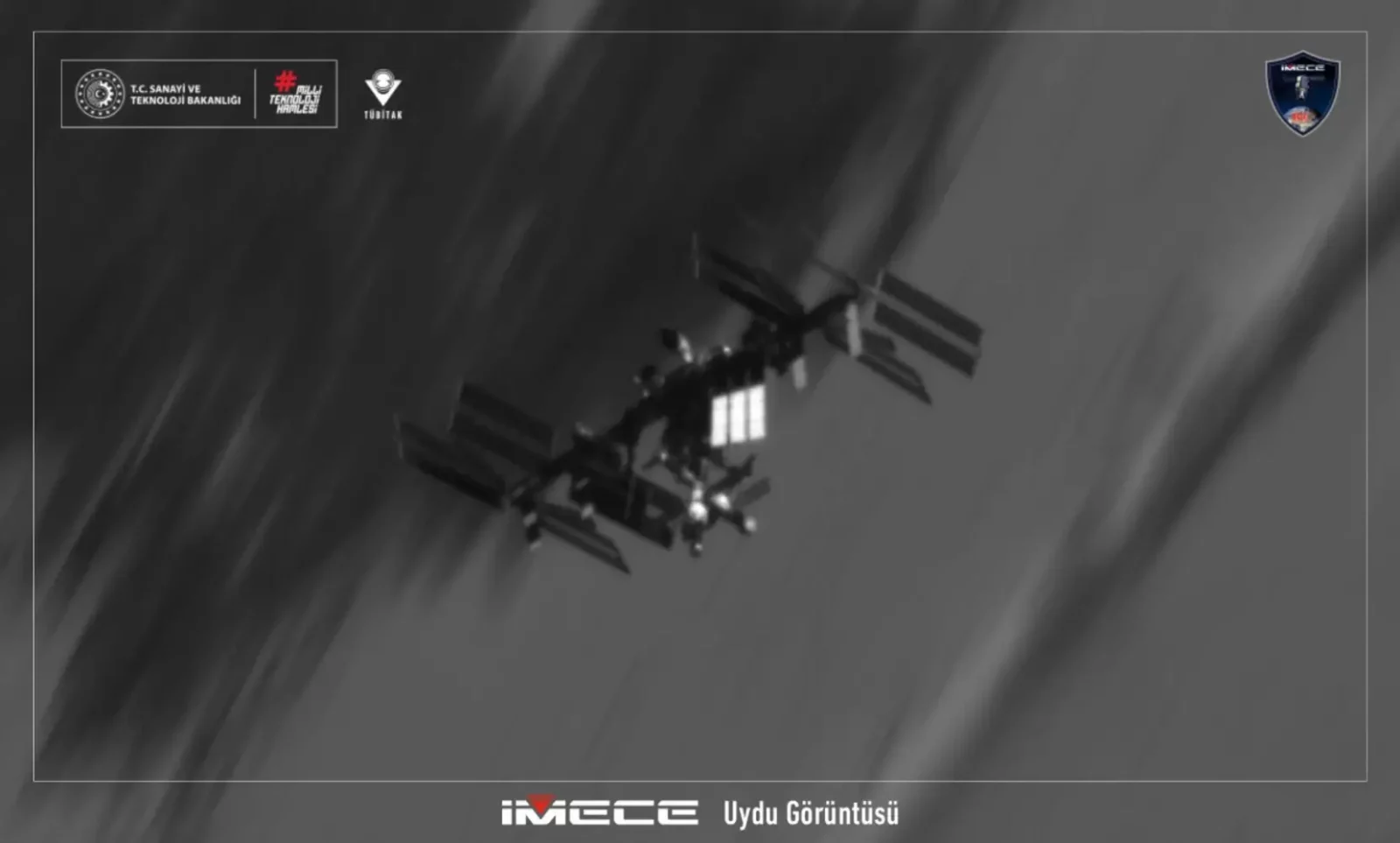
The İMECE satellite, showcasing Türkiye's capabilities in the space field, has achieved a new milestone by photographing the International Space Station (ISS).
İMECE, Türkiye's first sub-meter satellite, was given an unusual mission by TÜBİTAK (The Scientific and Technological Research Council of Turkey). İMECE captured images of the ISS, where Türkiye's first astronaut, Alper Gezeravcı, conducted various experiments for 21 days, and accomplished this mission using domestic and national technology.
The high-speed satellite successfully photographed another spacecraft in a different orbit and moving at a much higher speed. This mission demonstrates Türkiye's capacity to develop software, hardware, and algorithms.
Features and Project History of the İMECE Satellite
With the experience gained from BiLSAT, RASAT, and GÖKTÜRK-2, the "İMECE Satellite Subsystems Development Project," supported by the Investment Program, was launched to create the necessary infrastructure for the development of satellite subsystems that can be used in sub-meter satellites within the country.
The goal is to contribute to space history and transform it into economic value by developing a sub-meter resolution electro-optical satellite camera, communication system, star tracker, solar sensor, electric propulsion system, reaction wheel, payload data recording compression formatting unit, and next-generation flight computer, all of which will be used in high-resolution imaging satellites.
The İMECE Satellite Project, supported under the TÜBİTAK 1007 Program, began in 2017 and was launched into orbit on April 15, 2023. Thanks to the İMECE Satellite, Turkey can obtain sub-meter resolution images with its own electro-optical camera.
| Useful load | Camera |
| Resolution | PAN 0.99 m – MSI 3.96 m |
| Image Area (1 Frame) | 16km x 16km |
| Mass | ~700 kg |
| Orbit | ~700 km Synchronous with the Sun |
| Design Life | 5 Years |
Note
If you have any photos or video footage to support our news story, please share them with us using the information provided on our contact us page.
