


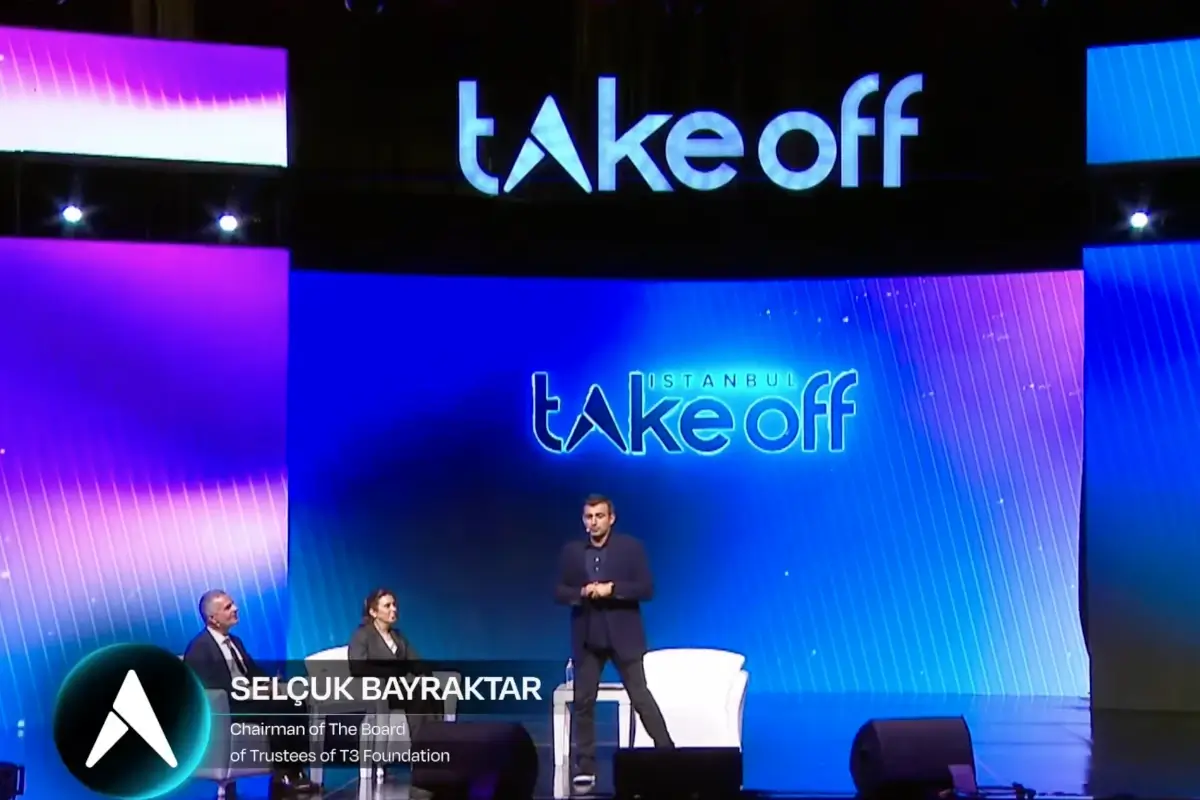
Türkiye's success story in the defense industry is not limited to its world leadership in unmanned aerial vehicles. Selçuk Bayraktar, Chairman and Technology Leader of Baykar, outlined a new roadmap for national technology with striking statements at the Take Off Entrepreneurship Summit held in Istanbul. This vision, which is not only an engineering achievement but also a manifesto of strategic independence, aims to position Türkiye as a game-changer in the space race and the next-generation energy league. Bayraktar's statements cover a wide range of projects that will shape Türkiye's future decades, from orbital transfer vehicles to a spaceport to be built in Somalia, from small modular nuclear reactors to the new location of TEKNOFEST in Anatolia.
From Unmanned Aerial Vehicles to Orbital Domination: The Fergani Initiative
Following platforms like the Bayraktar TB2 and Akıncı, which changed the course of Turkish aviation history, Baykar's vision extends beyond the atmosphere. Selçuk Bayraktar stated that the work in the space field is carried out under the umbrella of the "Fergani" initiative, and that a distinguished team of 130 engineers is working day and night in this field. The Fergani initiative is more than just a satellite project; it aims to enable Türkiye to achieve independence in global positioning systems (GPS) and attain interorbital logistics capabilities.
As the global space race shifts towards low Earth orbit (LEO) satellites, Turkey aims to be a "leader," not a "follower," in this field. Bayraktar emphasized that near-Earth internet and data networks, popularized by projects like Starlink, will shape the future, but the truly critical point lies in "orbital transfer vehicles." Developed by Fergani, these vehicles will act as a kind of "logistics courier" or "shuttle" in space, transporting payloads launched into space from one orbit to another. This capability will make Türkiye's presence in space sustainable and highly maneuverable.
Strategic Move: Turkish Spaceport in Somalia
One of the most striking moments of the summit was Selçuk Bayraktar's statements on launch technologies and spaceports. For a country to have independent access to space, it's not enough to just build satellites; it also needs the rocket technology to launch those satellites and a geographically advantageous launch base. Bayraktar stated that Türkiye's launch vehicle development efforts (for large rockets) are continuing with a 5-year projection.
However, the real strategic depth lay in the details of the spaceport's location. Proximity to the equator allows rockets to carry more payload with less fuel by taking advantage of the Earth's rotation speed. Combining this physical principle with strategic thinking, Turkey plans to build a spaceport and launch base in Somalia. Somalia, located in Türkiye's sphere of influence and with which it has strong strategic relations, will become Türkiye's gateway to space thanks to its proximity to the equator. This project has the potential to become a global hub where Türkiye can launch not only its own satellites but also international commercial satellites. This vision, stretching from Uzbekistan to the Fergana Valley and then to the Somali coast, is also a testament to the technological bridge being built with the Turkic world and friendly geographies.
A New Era in Energy: TMRS and Small Modular Reactors
For a country to be considered fully independent, energy independence is just as vital as its defense industry. Selçuk Bayraktar announced that they are focusing on the nuclear energy sector with the TMRS initiative established within Baykar. In an era where energy needs are increasing every day and technologies like artificial intelligence are leading to massive energy consumption, Turkey is turning to clean and intensive energy sources.
Bayraktar explained the power of nuclear energy with a simple but striking physics lesson: While energy obtained from chemical combustion (fossil fuels) relies on the bonds between electrons, nuclear energy relies on the release of the strong force in the atom's nucleus. This difference means that nuclear fuel contains millions of times more energy than chemical fuels. The TMRS initiative focuses on "Small Modular Reactors" (SMRs), which are safer, faster to install, and more cost-effective, instead of massive and time-consuming traditional nuclear power plants. This technology will directly contribute to Türkiye's energy supply security and its goals of reducing its carbon footprint.
Red Apple and the Future of Air Warfare: Manned Aircraft The era is coming to an end.
Selçuk Bayraktar, with his visionary perspective on the 5th generation manned fighter jet debates dominating the world agenda, once again highlighted the strategic importance of Bayraktar Kızılelma. Stating that comparing manned and unmanned fighter jets is like "comparing hand stitching with a sewing machine," Bayraktar emphasized that the future undeniably lies in unmanned and autonomous systems. He noted that 5th generation manned aircraft are the last of their kind, and predicted that platforms like Kızılelma, with their AI-powered decision-making mechanisms, will establish an overwhelming superiority over manned aircraft in air-to-air combat. Bayraktar stated that a manned aircraft is limited by the pilot's physiological limitations, but Kızılelma eliminates these limitations, defining unmanned fighter jets as "reusable, cost-effective, and much smarter missiles." He underlined that in the future of air warfare doctrine, these autonomous systems, which reduce the risk of pilot casualties to zero and can operate in swarms, will be the decisive force.
The Sociology of the National Technology Initiative and the Undercurrent
Technology is not just an engineering task; it is also a transformation of a society's mindset. Selçuk Bayraktar frequently emphasizes that the real power behind technical successes in the field is "human resources" and "belief." Highlighting the necessity of a multidisciplinary approach encompassing everything from law and sociology to engineering and fundamental sciences, Bayraktar stated that the National Technology Initiative has created an "undercurrent" spreading across all layers of society.
Bayraktar, stating that the entrepreneurial ecosystem is not limited to coding or designing circuits, emphasized the importance of law students studying space law and sociology students studying the societal impacts of technology. Organizations like the T3 Foundation and TEKNOFEST aim to cultivate a generation that not only builds airplanes but also shapes the world of the future, possesses ethical values, and is concerned with benefiting their country and humanity. Bayraktar's statement, "It's not what you do, but why and how you do it that matters," forms the moral foundation of this vision.
Where and when will TEKNOFEST 2026 be held?
TEKNOFEST, the world's largest aviation, space, and technology festival, continues to expand beyond Istanbul and Ankara, reaching out to the ancient cities of Anatolia. Selçuk Bayraktar announced that the next TEKNOFEST will be held in Şanlıurfa, the land where civilizations originated. This massive event, taking place between September 30th and October 4th, will ensure that the heart of technology beats in the heart of Mesopotamia. Şanlıurfa, home to Göbeklitepe, the zero point of history, will this time host the technologies of the future, thus building a magnificent bridge between the past and the future.
The Power of Teamwork and the Entrepreneurial Spirit
Bayraktar responded to young people who asked about the secret to success not with a single word, but with a culture: Teamwork. Whether in UAV/UAS production or in newly established ventures like Fergani and TMRS, the success is driven more by teams that "believe in each other, trust each other, and work together for a common goal," rather than individual genius. The harmony of the thousands-strong team at Baykar, and the synergy of the tens of thousands of volunteers at the T3 Foundation, are seen as Türkiye's greatest assets.
The vision outlined by Selçuk Bayraktar shows that Türkiye will not only be an influential force in regional crises, but will also have a say in every field concerning the future of humanity, from space mining to next-generation energy production. With the self-confidence gained from its success in the defense industry, Turkey is now pursuing what was once considered "impossible" in civilian technologies. Turkish rockets to be launched from the spaceport in Somalia and nuclear modules to be produced in Anatolia are poised to rise as concrete examples of this self-confidence.
Note
If you have any photos or video footage to support our news story, please share them with us using the information provided on our contact us page.
