


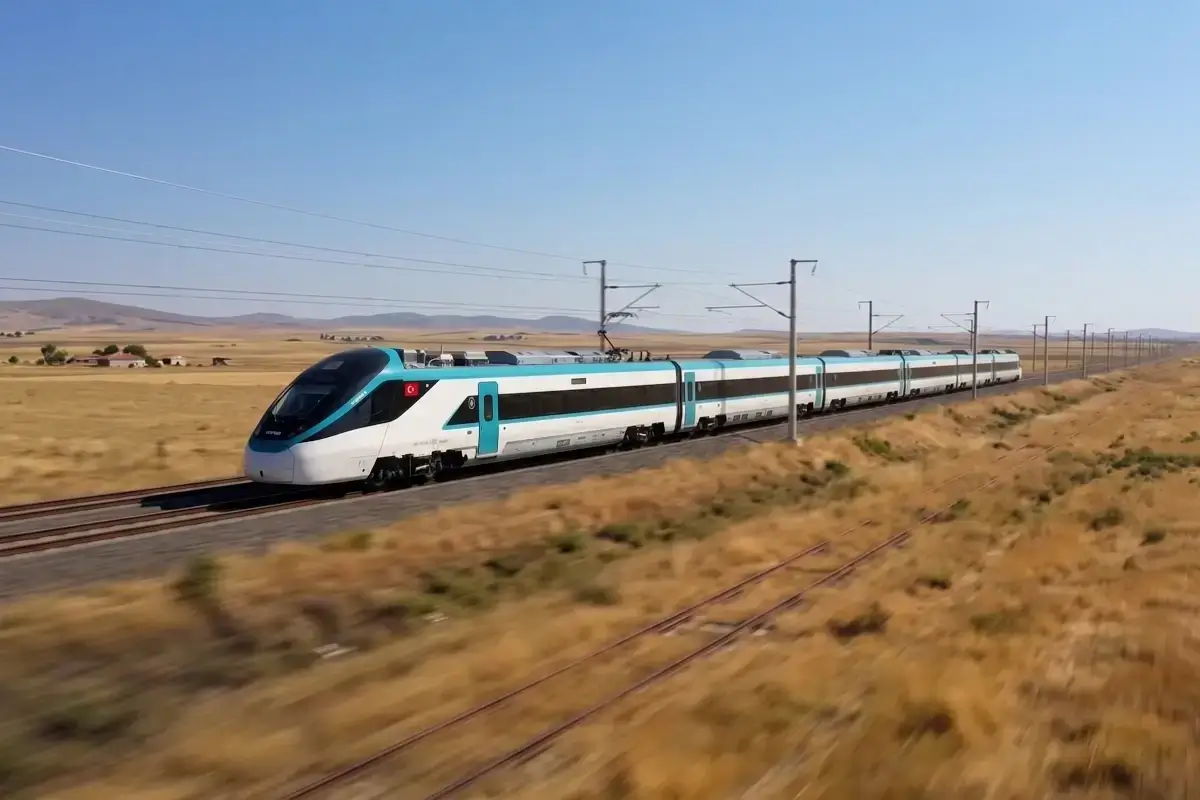
TÜRASAŞ has announced that serial production has begun on Türkiye's first indigenous and national high-speed train. According to a statement from the company's social media account, while testing of the first set continues successfully, production of the second set has commenced. TÜRASAŞ aims to produce a total of 14 sets, with seven sets each in 2027 and 2028.
Sets with 577-Passenger Capacity
The National High-Speed Train sets have a passenger capacity of 577. Production of the trains, developed entirely with indigenous and national capabilities, is being carried out at Türkiye's first high-speed train factory in Sakarya. It was announced that construction work at the factory has reached 90 per cent completion. TÜRASAŞ stated: "By bringing our trains, developed with our domestic engineering strength, onto the rails, we are carrying Türkiye's production power in railway technology even further forward."
Test Process and Targets
The first set of the National High-Speed Train had passed a significant threshold in recent months by reaching a speed of 250 kilometres per hour during testing. This speed indicates a performance above the train's target cruising speed of 225 km/h. With the transition to serial production, Türkiye aims to join the ranks of the few countries capable of producing their own high-speed trains. TÜRASAŞ's production plan will proceed in batches of seven sets each in 2027 and 2028.
With the National High-Speed Train entering the inventory, a domestic alternative is expected to emerge to the Siemens, CAF and Alstom-produced YHT sets currently in the TCDD fleet, imported from different countries. This will both save foreign currency and reduce external dependency in maintenance and repair processes.
Note
If you have any photos or video footage to support our news story, please share them with us using the information provided on our contact us page.
