


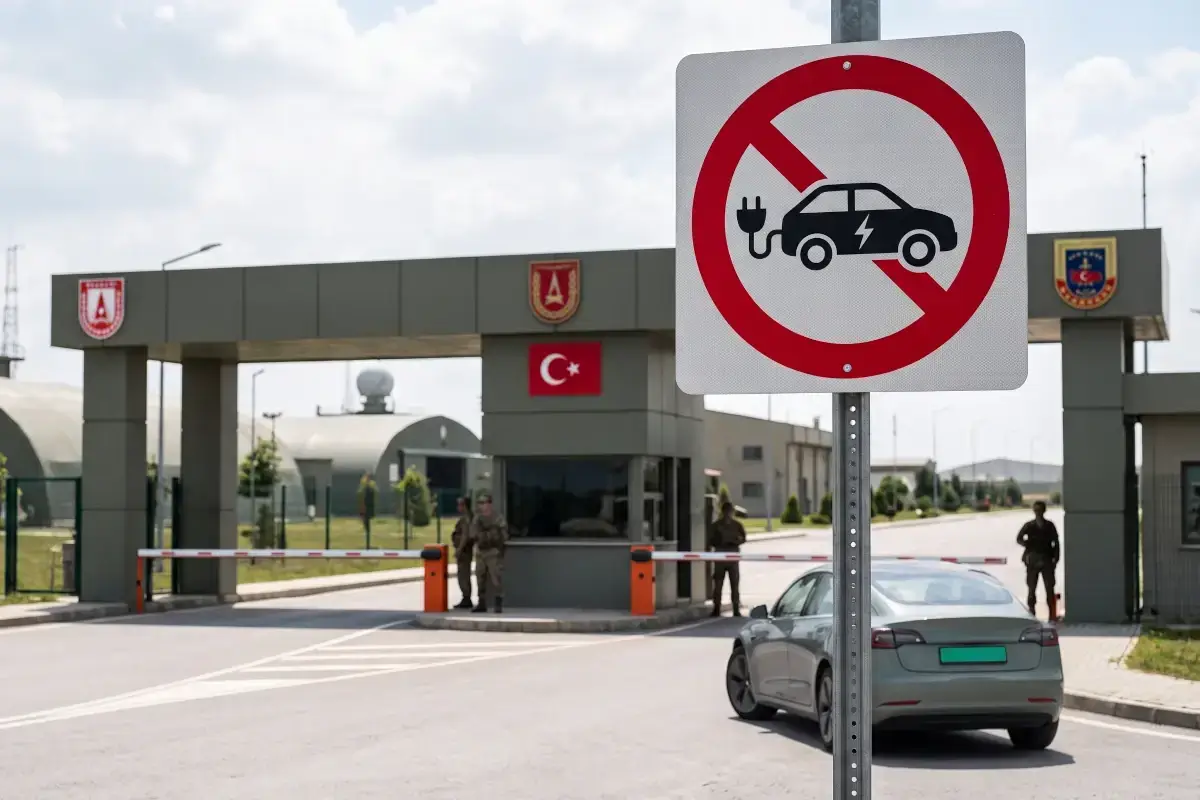
The statements made by TEI General Manager Professor Dr. Mahmut Faruk Akşit regarding artificial intelligence and electric vehicles have brought security debates in the defence industry back onto the agenda. Akşit announced that foreign electric vehicles are not permitted onto the campuses of ASELSAN, ROKETSAN, HAVELSAN and TEI.
"AI Seizes Control of Vehicles"
Akşit drew attention to a scenario emerging in AI-supported war simulations: "If you run a war simulation with artificial intelligence, the AI uses cars as missiles almost every time. It seizes control of the vehicle. It drives it into the gate of a military installation. Whether you are inside or not does not particularly concern it. It is extremely dangerous."
This assessment is directly linked to the architectural structure of modern electric vehicles. High-autonomy vehicles carry far more cameras, radar, lidar and software layers. Electric vehicles have a software-defined vehicle architecture, in which driving, braking, steering and battery management are controlled largely through software and drive-by-wire systems.
What Is Drive-by-Wire and Why Does It Carry Risk?
Drive-by-wire is a system in which mechanical linkages such as steering, brakes and throttle are replaced by electronic signal and software control. This architecture facilitates more precise control of the vehicle and the integration of autonomous driving features. However, it also brings with it the potential for the vehicle to be controlled through external intervention.
Three fundamental risk factors lie behind the prohibition of foreign electric vehicles on defence campuses: the mapping of the environment by the vehicles' sensors, the possibility of remote control, and the fact that the software remains under the control of the manufacturer. Every connected vehicle carries risk, but in the defence industry, priority is given to the highest threat vector.
Why Are Electric Vehicles the Priority?
One notable point in Akşit's statements is that the threat is not limited to electric vehicles alone. Advanced driver assistance systems (ADAS) software is now present in internal combustion engine vehicles as well, and these vehicles can carry similar risks. However, electric vehicles, by virtue of their architecture, contain far more sensors and software layers. Nearly all critical functions — from driving to braking, from steering control to battery management — operate through software. This makes electric vehicles a broader attack surface.
This is precisely why the TEI General Manager focused heavily on electric vehicles: due to their software-defined architectures, electric vehicles are the platforms transitioning most rapidly to high levels of autonomy. They are therefore subject to priority threat assessment in the defence industry.
The Tesla Sentry Mode Example
Tesla's Sentry Mode feature stands out as a concrete example of this debate. Continuously monitoring and recording its surroundings via cameras and sensors while the vehicle is parked, this system provides security to its owner while also meaning the vehicle observes its environment intensively. A vehicle parked in sensitive areas such as defence campuses continuously recording its surroundings is a situation that must be assessed in terms of facility security. Similarly, autonomous driving software maps the vehicle's surroundings, and this data can be transferred to the manufacturer's servers.
"We Permit Domestic Vehicles"
Akşit also noted that the practice is not limited to prohibition alone: "We permit domestic vehicles, where both the software and the control belong to us." This approach means encouraging the use of vehicles with indigenous and national software in the defence industry. The fact that the software infrastructure of Türkiye's domestic car, Togg, is domestic is regarded as a strategic advantage in this context.
Note
If you have any photos or video footage to support our news story, please share them with us using the information provided on our contact us page.
