


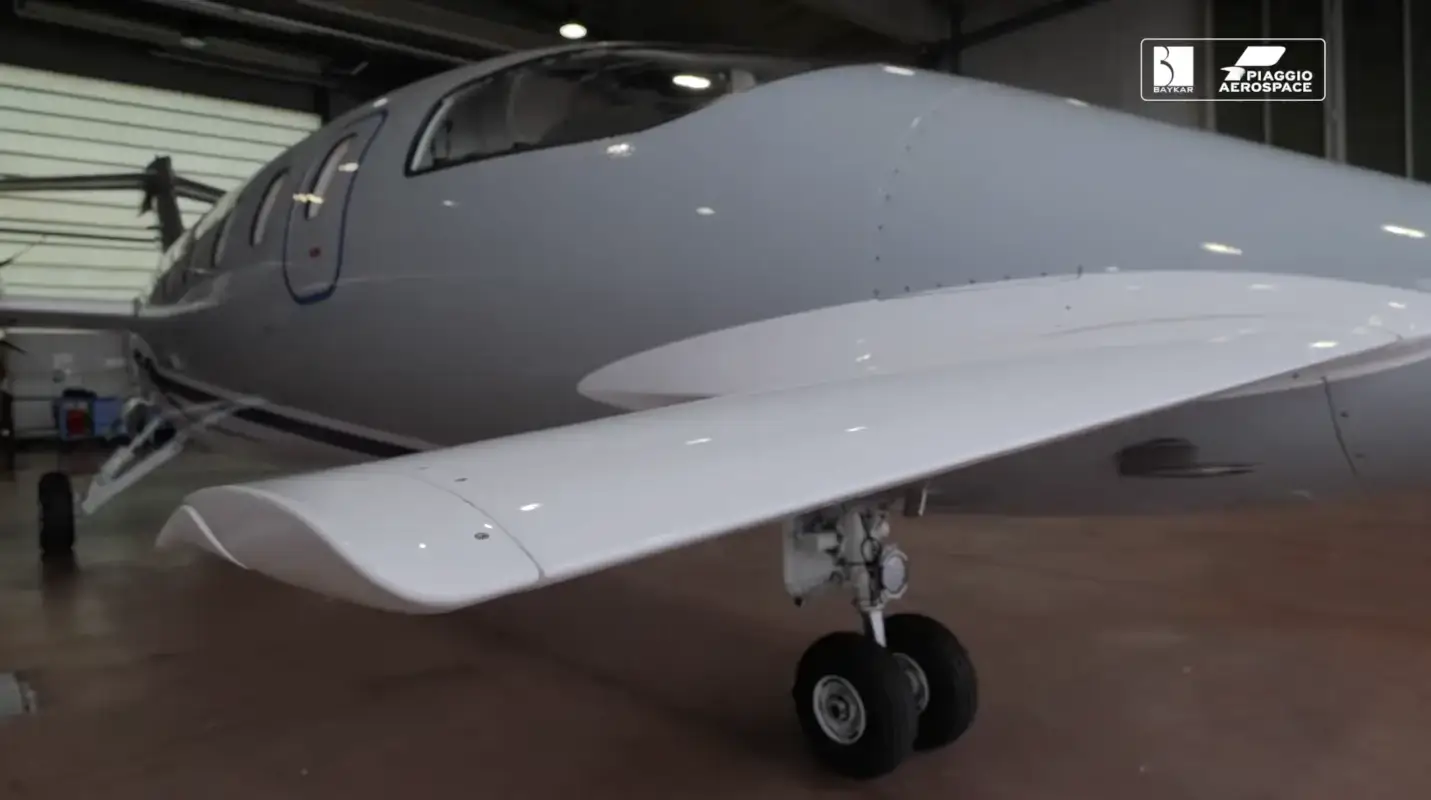
The legendary P.180 Avanti EVO, from Italian aircraft manufacturer Piaggio Aerospace, which has joined the Baykar group, is one of the most recognizable aircraft in the sky with its extraordinary design. But what exactly do those small winglets on the nose of the aircraft do? The company's test pilot, Lorenzo Villi, explained the difference between "canard" and "forewing," which are often confused by aviation enthusiasts, and the secret to the aircraft's efficiency.
Known in the aviation world as the "Ferrari of the Sky," and experiencing a resurgence thanks to Baykar's strategic investment, the Piaggio P.180 Avanti is famous for being the only turboprop aircraft to reach jet speeds. Behind this performance lies a patented and unique aerodynamic architecture: “"Three Lifting Surfaces" (3LS).
Piaggio Aerospace Test Pilot Lorenzo Villi, In the technical video released, they explained the physics of this design and why it is more efficient than other aircraft in detail.
It's not a "canard," it's a "forewing."“
The nose structure of the P.180 is often confused with the "canard" structure commonly seen on fighter jets (Eurofighter, Rafale, etc.). However, Villi points out that this is a common misconception.
Villi explains the difference as follows:
“This is a common misconception. A canard would be complex, mobile, and give the pilot different flying sensations. The one on the P.180 is a 'Forward Wing'. It's a very simple, robust, and extremely useful structure.’
So this part isn't a control surface that moves to steer the aircraft, but rather a fixed lifting component that contributes to keeping the aircraft airborne.
“Instead of "stepping on someone's tail," use "lifting them by the nose."”
So why does this "Front Wing" exist? The answer is..., “"Positive Buoyancy"” It is hidden in the principle.
In traditional aircraft designs, the laws of physics work as follows: For the aircraft to fly level, the main wings lift the aircraft upwards, while the tail (horizontal stabilizer) applies downward pressure (negative lift) to keep the nose of the aircraft in the air. Villi explained this situation as follows:, “Pushing on the tail is like carrying extra weight you don’t need, and this creates ‘induced drag’ due to negative lift.” He summarizes it with these words.
All 3 Surfaces Push Upwards: Here's the Productivity Formula
This is where the engineering genius of the Piaggio P.180 Avanti comes into play. The nose wing of the aircraft is designed to keep the nose elevated. positive lifting It generates power.
In this way;
- Forward Wing: He lifts his nose up.
- Main Wing: It supports the body.
- Tail (Stabilizer): Unlike traditional aircraft, it doesn't have to push down, which generates positive upward lift.
Lorenzo Villi, “In this case, the front wing, the main wing, and the stabilizer are all pushing upwards and generating positive lift. This, of course, increases efficiency.” He explains scientifically why the P.180 can fly faster with less fuel. These aircraft, which began to be produced within Baykar after Piaggio Aerospace was acquired by Baykar, continue to soar in the skies as a textbook example of aerodynamic efficiency.
Note
If you have any photos or video footage to support our news story, please share them with us using the information provided on our contact us page.
