


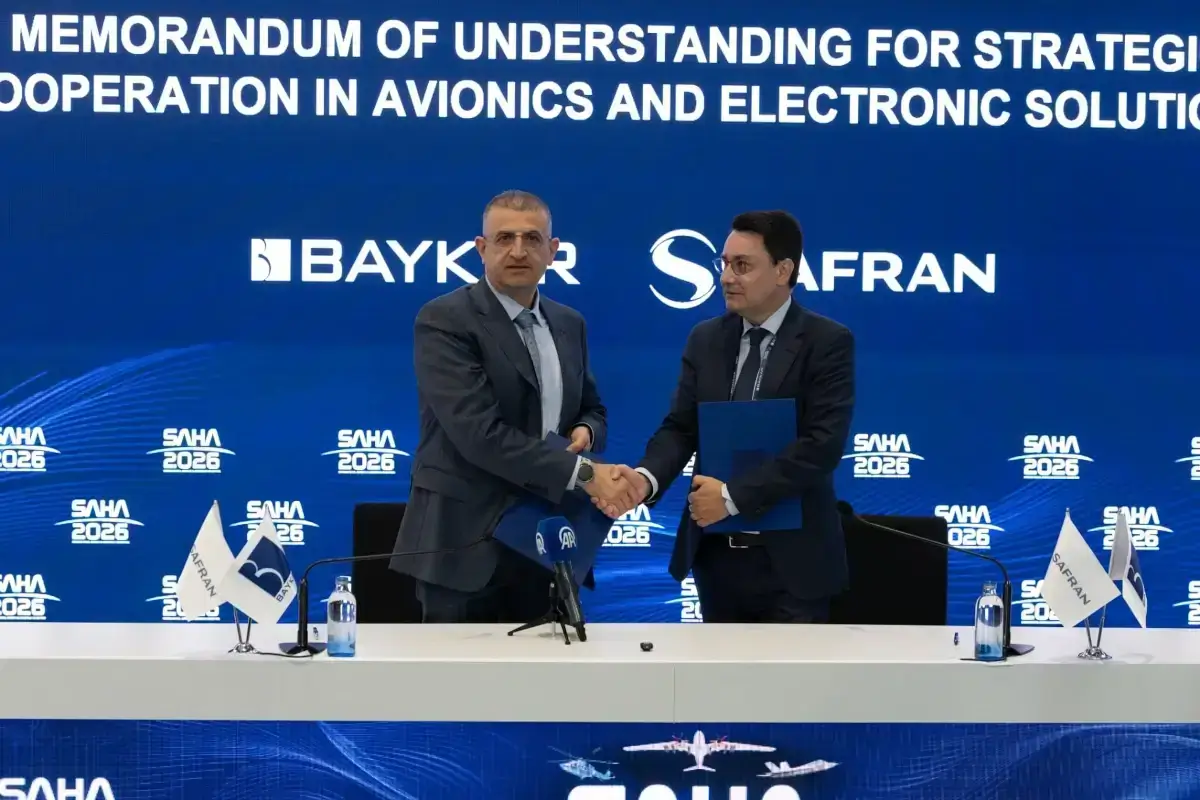
The strategic cooperation agreement signed between Baykar Technology and French defence giant Safran Electronics & Defense in Istanbul opens the door to a new era in drone and smart munition technologies. The partnership, officially announced on May 12, 2026, is seen not merely as a technical integration but as a strategic move with the potential to affect the balance of power in the European defence market.
Euroflir Integrated into TB2: Reducing Canadian Dependency
At the technical heart of the agreement lies the integration of Safran's Euroflir electro-optical system, currently used on the French Army's Tiger helicopters, into Baykar's TB2 platform. This integration aims to significantly enhance the TB2's surveillance, targeting, and reconnaissance performance. The two companies will also jointly develop integrated solutions combining electro-optical sensors, navigation systems, and guided munition capabilities.
Alexandre Ziegler, Head of the Defence Business Unit at Safran Electronics & Defense, evaluated the agreement with the following words:
"By integrating our advanced Euroflir electro-optical systems and our world-class positioning, navigation, and timing technologies into Baykar's TB2 drones, we are taking operational performance to the next level. Together with Baykar, we are proud to offer levels of precision and intelligence that will help improve tactical UAV missions across the defence sector."
Baykar General Manager Haluk Bayraktar used the following expressions:
"The Memorandum of Understanding we signed with Safran Electronics & Defense represents a significant milestone in advancing our strategic cooperation. Through this partnership, we aim to offer innovative solutions and create new opportunities in the market."
One of the striking strategic dimensions of the agreement is the diversification Baykar creates in its supply chain. With this integration, the company is replacing the previously used Canadian-made L3Harris Wescam electro-optical system on the TB2s with Safran technology. This transition is interpreted as a concrete step in Baykar's strategy to reduce its dependency on North American equipment.
OpexNews: "From Strategic Rivalry to Industrial Partnership"
The French defence news site OpexNews evaluated the agreement with a striking analysis. Using the headline "From strategic rival yesterday, industrial partner today," the site recalled that French Chief of Staff General Burkhard had included Türkiye on the list of strategic rivals in November 2024. Commenting on Safran Electronics & Defense signing a partnership with Turkish UAV manufacturer Baykar Technology a year and a half later, they stated, "Sometimes it takes a serious dose of pragmatism to swallow one's own words."
OpexNews highlighted that waiting for political decision-making in the defence industry means losing market share, emphasizing that Baykar is "literally signing contract after contract". The report also included a striking price comparison: while a similar American unmanned aerial vehicle carries a price tag of $30 million, the TB2 costs $10 million per unit and possesses an "operational track record that no one can dispute."
The French site wrote that Safran's technologies are "entering Baykar's unmanned aerial vehicle empire," stating that this partnership opens a new page in Türkiye-France defence relations.
Baykar-Safran Partnership Causes Intense Debate in Athens
The agreement also resonated widely in Greece. According to a report by the Greek newspaper Kathimerini, the Baykar-Safran partnership caused intense political and strategic debate in Athens. The newspaper quoted the following expressions:
"According to information obtained, the agreement for the development of UAVs and smart weapons envisages technology sharing and opens the door for Turkish giant Baykar to enter the European market."
Kathimerini also wrote that Baykar would gain access to electro-optical systems like the Euroflir targeting system and European-origin engines for its UAVs through this agreement. Another point the newspaper noted was that these UAVs "violate the Athens Flight Information Region (FIR) almost daily and occasionally Greece's national airspace."
Defence Index announced the development with the headline "European drone defence shift shocks Athens." The analysis stated that Greece's plans to procure Safran-linked surveillance UAVs faced reported delays and technical concerns, while France had already moved away from the Patroller programme. According to Defence Index, this development underscores the shifting alliances and rising competition in Europe's rapidly changing drone and defence technology sector.
The Cancellation of Patroller Explains the Timing of the Partnership
The timing of Safran's partnership with Baykar is no coincidence. The Euroflir electro-optical system developed by the company was originally designed for France's Patroller MALE-class unmanned aerial vehicle. However, despite a €330 million contract signed in 2016, the Patroller programme suffered chronic delays. Facing modern air defence threats revealed during the Ukraine war, it was assessed that the platform could be "detected and shot down within minutes," leading to its official cancellation by France in April 2026.
This cancellation left Safran with a proven electro-optical technology but without a platform to integrate it into. The partnership with Baykar is expected to fill precisely this gap. While Safran's technology finds a new home on the TB2, one of the world's most combat-proven UAVs, Baykar simultaneously deepens its presence in Europe by working with one of the continent's most established defence companies.
A Strategic Bridge to the European Market
For Baykar, this agreement could serve as a critical bridge for entering the European market. Safran's established position in Europe and the integration of a proven, NATO-standard system like the Euroflir into the TB2 could facilitate the platform's acceptance by European customers. The agreement may also open new doors regarding strategic supply issues, such as access to European-origin engines.
As OpexNews highlighted, waiting for political decisions in the defence industry means losing market share. Safran's pragmatic step reveals the French defence industry's strategic preference for doing business with Türkiye. Both companies plan to deepen this cooperation throughout technology, operations, and commercial activities. The agreement is expected to pave the way for new joint ventures and a stronger international presence in the defence market in the coming period.
Note
If you have any photos or video footage to support our news story, please share them with us using the information provided on our contact us page.
