


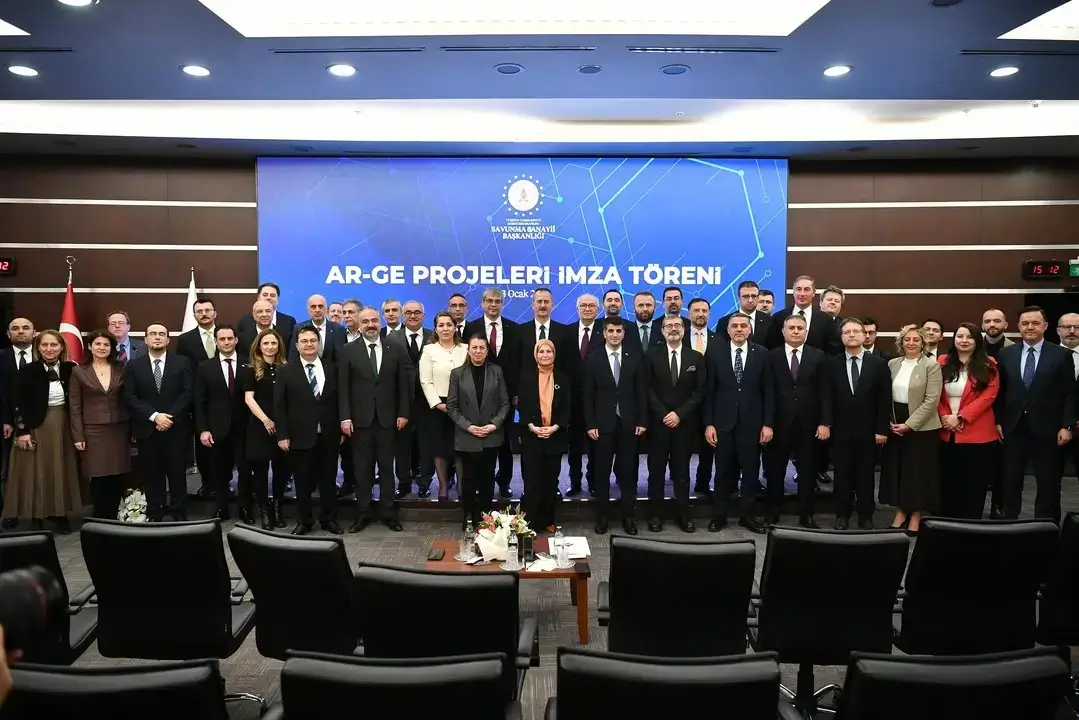
The Presidency of Defence Industries (SSB) has accelerated its transformation strategy from a structure that merely produces platforms to one that controls the critical technologies that bring those platforms to life. At a ceremony held in Ankara on January 13, 2026, agreements were signed for 14 new R&D projects, ranging from artificial intelligence and quantum technologies to hypersonic propulsion systems and superalloys. SSB President Prof. Dr. Haluk Görgün conveyed the message, "We are now present in the field not only with the number of platforms, but also with our dominance in critical technologies.".
Following the development of giant platforms such as KAAN, KIZILELMA, ALTAY, and TCG ANADOLU, the Turkish defense industry has shifted into high gear to achieve complete independence in the sub-technologies described as the "brain, heart, and nervous system" of these systems. 14 new R&D projects, coordinated by the Presidency of Defense Industries and launched within the scope of the 2025 vision, were inaugurated at a ceremony.
The ceremony was attended by the Head of the Defense Industry, Prof. Dr. Haluk Görgün, as well as representatives from 13 defense industry companies, 5 universities, and 5 research institutes that will be involved in the projects. These projects are the most concrete indication that Türkiye is preparing not only for today's combat environment but also for the future combat environment of 10-20 years from now.
“"The Platform Race is Over, the Technological Depths Begin"”
Making strategic statements at the signing ceremony, Prof. Dr. Haluk Görgün drew attention to the changing dimensions of competition in the global defense industry. "Deterrence on the battlefield and prestige at the negotiating table are no longer measured solely by the number of aircraft or tanks we produce," said Görgün, explaining the codes of this new era as follows:
“Our capacity to have a say in critical technologies, and the speed at which we transform new knowledge into products, and products into capabilities in the field, is the true source of our strength. Global competition has gone beyond platform racing. Beyond the products our companies develop with their own resources, we are investing in the technologies of the future with the wisdom and support of the state.”
Görgün stated that the R&D budget allocated within the SSB (Undersecretariat of Defense Industries) $3.34 billion, the number of projects Over 1,600 He stated that this was the case, emphasizing that R&D is not an expense item but a strategic investment.
Here are the 14 Strategic R&D Projects that were signed.
The projects signed at the ceremony target the cutting edge of the defense industry, from artificial intelligence and quantum technologies to engine materials and next-generation rocket fuels. Here are the details of those projects, which were added to the R&D portfolio in 2025 and will shape the future operational environment:
1. Artificial Intelligence and Autonomous Systems Group
- CENGIZ Project: This system, to be developed for Autonomous Unmanned Ground Vehicles (UGVs), will offer a "reinforcement learning" based control architecture. The most striking aspect of the project is the system it will bring to UGVs. “"AI-Based Voice Control"” He will have the talent.
- KIDA-PORT Project: Route tracking for Kamikaze Unmanned Surface Vehicles (USVs), the new striking force of the seas, is now entrusted to artificial intelligence. With reinforcement learning algorithms, USVs will reach their target via the most optimal route even in the most challenging sea conditions.
- ICON Project (Image Positioning Methods): A strategic navigation project that will enable aircraft to determine their own position by analyzing landforms and imagery in environments where GPS is unavailable or interfered with.
2. Advanced Materials and Engine Technologies Group
- EMERALD Project: For the turbine blades, the most critical link in Türkiye's jet engine journey (KAAN, TF6000), "Fourth Generation Single Crystal Material" and casting processes will be localized.
- DORUK Project (Phase 3): This is the third phase of a materials program developed for parts of aviation engines that are exposed to high temperatures and pressures. This project will directly improve engine life and performance.
3. Communications and Cyber Security Group
- MITHAT Project: This project, which will pave the way for 6G and beyond military communications, will develop communication technologies operating in the millimeter and terahertz bands that have high data transfer rates and are difficult to jam.
- AYAZ Project: Waveforms used in network-based military communications will be optimized using artificial intelligence algorithms. This will increase spectrum efficiency and security.
- Cyber Twin Project: By creating "Digital Twins" of critical military systems, cyberattacks will first be detected on this virtual twin, and defense mechanisms will be instantly activated using artificial intelligence.
4. Rocket, Fuel and Energy Group
- ALAZ Project: Using additive manufacturing (3D printing) methods, it will be possible to produce a new generation of highly efficient solid fuel blocks with complex geometries.
- DEFNE Project: Critical "maturation agents" that enhance the shelf life and combustion stability of solid fuels, which determine the performance of rocket engines, will be synthesized using domestic resources.
5. Sensor, CBRN and Advanced Physics Group
- MURAT Project: Platforms' electromagnetic signatures will be managed using "Adaptive MetaSurface" technologies, which are critical for radar invisibility and signal steering.
- Quantum Technologies Development Platform: A comprehensive project that will transform Türkiye's expertise in quantum sensors and encryption into tangible products.
- RIVER Project: The "Active System Chemical Agent Detection Technology," which can detect chemical threats remotely, will provide early warning against asymmetric attacks.
- BAHAR Project: MEMS (Micro Electro-Mechanical Systems) based, miniature and sensitive sensors will be developed to detect biological warfare agents.
Past R&D has become today's export record holder.
In his speech, Haluk Görgün proved with past examples that R&D projects are not just files shelved, but are transformed into tangible products in the field. Projects that were once at the "idea" stage;
- DUFAS (Low Frequency Active Sonar System),
- MESSENGER (National Base Station),
- MERCAN and MIRA (Unmanned Underwater Vehicles),
- LASSO (Data Link System)
He pointed out that projects like these are still in the inventory today and have even achieved export success by becoming companies.
"Complete Independence" Through Common Sense“
The ceremony was recorded as the tangible result of the "Technologies Shaping the Future Operational Environment (GOST)" workshop. This ecosystem, bringing together 13 companies, 5 universities, and 5 institutes, will accelerate Türkiye's march towards becoming a country that not only buys or produces weapons, but also "invents" technologies that will change war doctrines.
Note
If you have any photos or video footage to support our news story, please share them with us using the information provided on our contact us page.
