


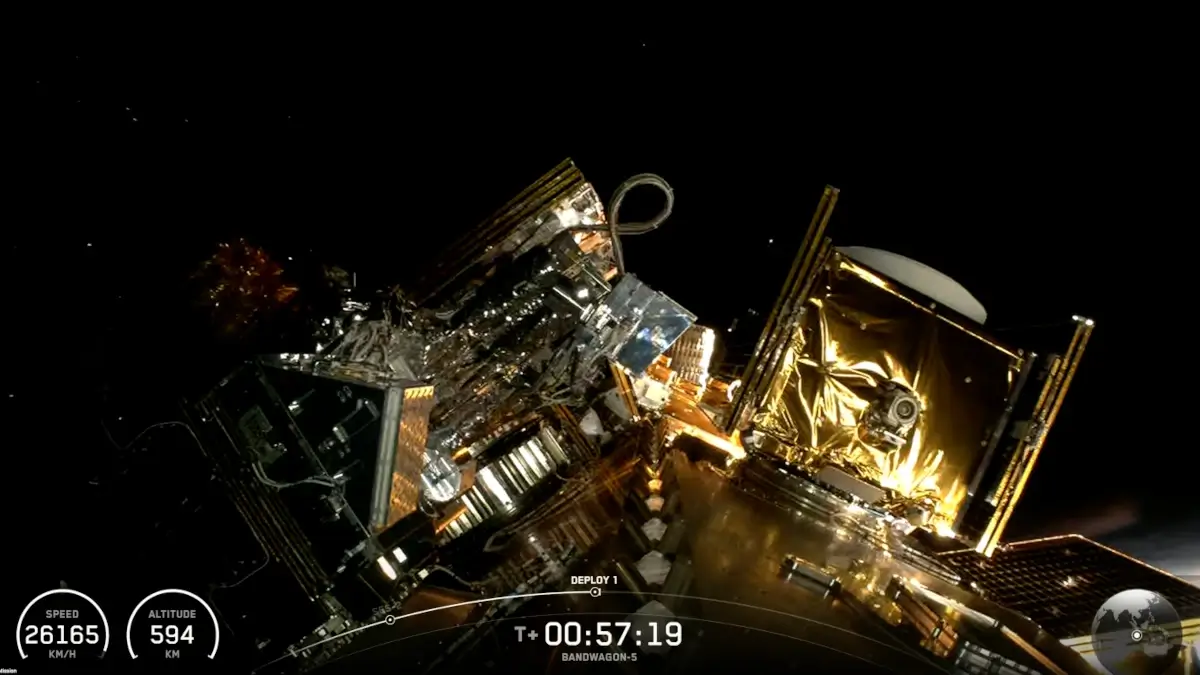
Fergani Space, one of the private-sector representatives in Türkiye's space technology field, has sent a new test satellite into orbit. FRG-100D4, launched within the scope of SpaceX's Bandwagon-5 mission, constitutes a new link in the company's satellite development process focused on communications and navigation. Although the satellite's specific mission has not yet been detailed on the company's official channels, its place in the launch manifest and the company's previous projects indicate that this satellite too may be part of the journey towards the Uluğ Bey global positioning system.
The Staged Test Process Continues
Fergani Space had previously demonstrated its competence in this field through the CubeSats and orbital transfer vehicles it developed. It is known that the company's long-term goal is to bring to life Uluğ Bey, Türkiye's own global positioning system. Each test satellite launched within this scope is assessed as enabling the verification in the space environment of critical technologies such as navigation signal generation, orbital dynamics and communications infrastructure. FRG-100D4 is also seen as a new link in this staged verification process.
Uluğ Bey: One of Türkiye's Most Ambitious Space Projects
Global positioning systems are today among the most critical dependencies of military and civilian infrastructure. Systems such as GPS (US), GLONASS (Russia), Galileo (EU) and BeiDou (China) are under the control of the countries that provide positioning data. Türkiye has long been dependent on these systems. The Uluğ Bey project aims to eliminate this dependency and to provide Türkiye with full sovereignty over its own positioning data.
Fergani Space's staged testing approach shows that it is pursuing a shrewd strategy on the path to this goal. Building a global positioning system is not something that can be done in one go. Dozens of satellites must operate in a specific orbital configuration, generate precise timing signals and communicate uninterrupted with ground stations. The CubeSats and orbital transfer vehicles Fergani has tested in the past constitute the building blocks of this grand system. FRG-100D4, as a continuation of this series, is expected to collect data for future positioning satellites.
However, there are serious challenges ahead for Uluğ Bey. Global positioning systems require tens of billions of dollars of investment and decades of development. It will take time for Türkiye to reach a final system in this field. Nevertheless, Fergani Space's taking steps in this field through a private-sector initiative shows that an ecosystem is forming beyond state-supported projects. When Uluğ Bey succeeds, Türkiye will gain strategic independence not only in the defence field but also in civilian areas such as autonomous vehicles, logistics and disaster management.
Note
If you have any photos or video footage to support our news story, please share them with us using the information provided on our contact us page.
