


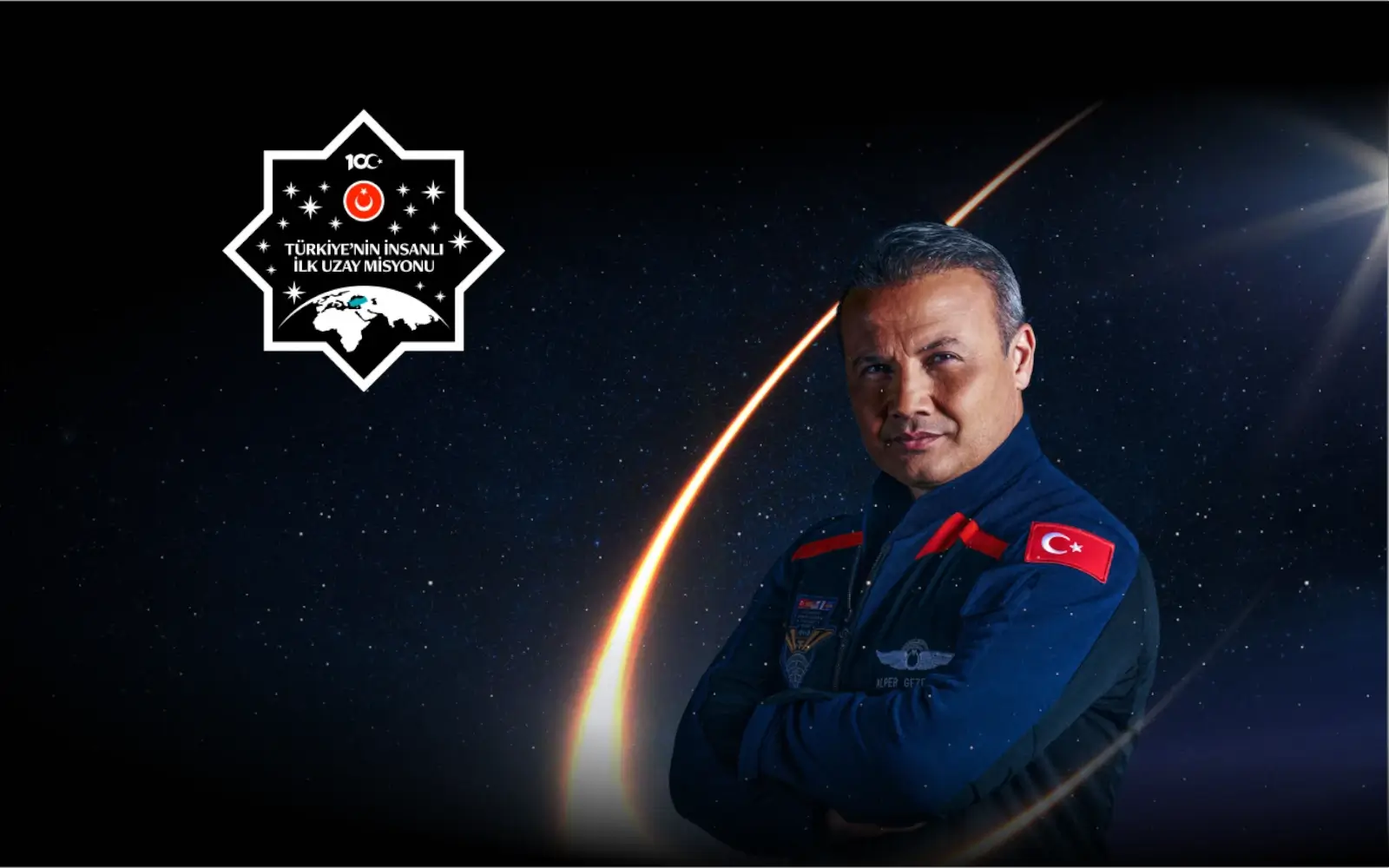
Alper Gezeravcı, Türkiye's first space traveler, will participate in the Axiom Mission 3 (Ax-3) private space flight scheduled for 2024.
Gezeravcı will be part of a four-person, multinational team traveling to the International Space Station (ISS) on January 9, 2024, aboard SpaceX's Crew Dragon capsule, operated by Axiom Space for Türkiye's first manned space mission.
Details of the emblem for Türkiye's first manned space mission have been revealed.
The emblem, specially designed for this historic mission, reflects the Turkish nation's fascination with space, its history, and its culture. The most striking feature of the emblem is the Turkish flag. Above the flag is the number 100, surrounded by stars symbolizing the 16 Turkish states. Below the emblem is a turquoise map of Turkey and an eight-pointed Seljuk star. The eight-pointed star represents the connection between earth and sky and the eight principles of Islam.

Who is Alper Gezeravcı?
Gezeravcı was born in Silifke in 1979. He completed his undergraduate studies in Electronic Engineering at the Air Force Academy in Istanbul. He also earned a master's degree from the Air Force Institute of Technology at Wright-Patterson Air Force Base. With 15 years of flight experience as a fighter pilot in the Turkish Air Force, Gezeravcı served on various aircraft including the T-41, SF-260, T-37, T-38, F-5, KC-135, and F-16. He also worked as a captain for Turkish Airlines for seven years. Most recently, Gezeravcı was appointed as the Academic Wing Commander of the Standardization Squadron at the 10th Main Jet Base Command in Adana. He conducts exams for F-16 and KC-135R pilots, oversees flight standards, and reviews squadron documentation standards. A sports enthusiast, Gezeravcı enjoys diving, sailing, camping, rafting, mountain hiking, and horseback riding. As part of his military training, he participated in numerous survival training exercises and military missions.
Gezeravcı stated that he was honored and excited about the opportunity to be the first astronaut from Türkiye to go to space. Gezeravcı will serve as a mission specialist on the Ax-3 mission. He will spend 14 days on the ISS and conduct 13 different scientific experiments prepared by our scientists.
How long will the AX-3 mission last?
The Ax-3 mission will be commanded by Axiom Space employee Michael López-Alegría, piloted by Italian Air Force officer Walter Villadei, and the other mission specialist will be European Space Agency (ESA) project astronaut Marcus Wandt from Sweden. Wandt will be the first member of the ESA Astronaut Group, selected in 2022, to undertake a spaceflight mission. Furthermore, this mission will be the first commercial spaceflight mission for an ESA-supported astronaut.
The Ax-3 mission will launch from Florida, dock with the ISS, and last approximately two weeks. The mission's backup crew consists of Axiom Space employee Peggy Whitson and Tuva Cihangir Atasever from Türkiye.
About the International Space Station
The International Space Station is a habitable artificial satellite and space laboratory located in low Earth orbit. Launched in 1998 as a joint project of five different space agencies, the station is constructed from the combination of several modules. Its purpose is to conduct scientific research in space, advance space technology, and contribute to space exploration.
The station is currently operated by a crew of 11. The crew can remain on the station, which orbits approximately 400 km from Earth at a speed of 27,000 km per hour, for more than six months at a time. The crew conducts experiments in various fields such as biology, physiology, physics, chemistry, astronomy, and meteorology, performs maintenance on the station, and maintains communication with Earth.
The station consists of two main sections: the Russian Orbital Segment and the United States Orbital Segment. These sections, along with modules, solar panels, robotic arms, vehicles, and other equipment from different countries, make up the station's structure. The station has a total mass of approximately 400 tons, a length of 73 meters, a width of 109 meters, and a height of 20 meters. The station's habitable area is 837 cubic meters.
The station orbits the Earth approximately every 90 minutes and, under suitable conditions, is visible from Earth with the naked eye. It is the longest-running human mission in space. The station has continuously housed a space crew since November 2, 2000, and has so far welcomed astronauts and cosmonauts from 15 different nations.
What is the National Space Program?
The National Space Program is a comprehensive project designed to implement Türkiye's vision, strategies, goals, and projects in the field of space policies in a coordinated and integrated manner. The program was launched in 2021 through the collaborative efforts of five different space organizations. Its aims are to increase Türkiye's independence, security, and competitiveness in space, to develop space science and technology, and to contribute to space exploration.
The program plans to achieve 10 strategic goals over a 10-year period. These goals are:
- Türkiye aims to reach an altitude of 100 km in 2023 with its first domestically developed satellite launch system.
- To achieve the first contact with the Moon and a soft landing on the Moon in 2028.
- To establish and operate Türkiye's first spaceport.
- To develop and test Türkiye's first spacecraft.
- To develop Türkiye's first space observation vehicle and monitor space debris.
- To establish Türkiye's first space radio and enable space communication.
- To develop Türkiye's first space meteorological instrument and measure space climate.
- To develop Türkiye's first space mining vehicle and explore space resources.
- To develop Türkiye's first space archaeology vehicle and to study space history and culture.
- To develop Türkiye's first space tourism vehicle and to bring the adventure of space to life.
The national space program is a crucial step towards realizing Türkiye's goal of having a presence and leadership in space. The program will help us understand what it's like to live and work in space, advance space science and technology, and expand the boundaries of space.
Note
If you have any photos or video footage to support our news story, please share them with us using the information provided on our contact us page.
