


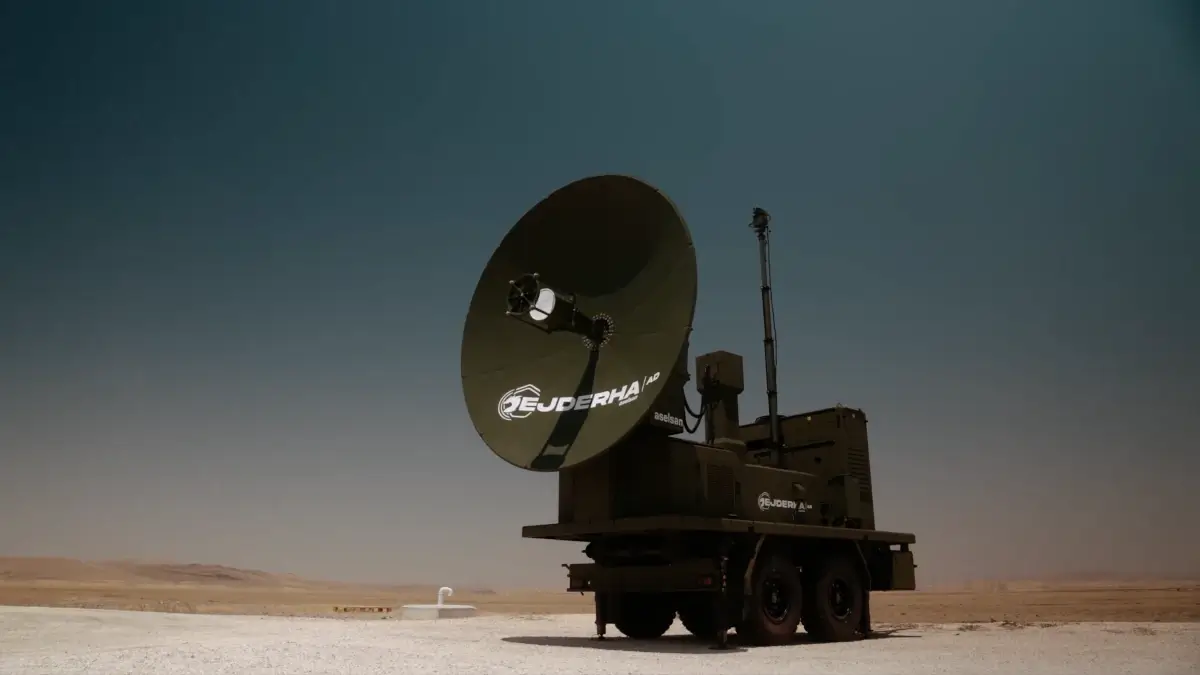
ASELSAN's EJDERHA High-Power Electromagnetic UAV Defence System neutralised 51 drones launched simultaneously within seconds during a demonstration held to mark the company's 51st anniversary. The demonstration, carried out without the use of missiles or munitions, brought the electromagnetic interference targeting electronic circuits against drone swarms onto the agenda. To understand what sets this approach apart, it is necessary to look together at EJDERHA's earlier tethered FPV tests and at the laser and gun-based drone defence systems developed in Türkiye.
Why Is Stopping 51 Drones Without Using Munitions Important?
What matters in EJDERHA's demonstration is not only the number of targets but how those targets were engaged. Rather than striking the drones with the physical effect of a bullet or missile, the system disrupts the electronic circuits that keep them flying, using high-power electromagnetic waves. In an attack in which many drones approach simultaneously, the defence must keep up with every target and keep sufficient munitions ready. Being able to engage multiple targets with electromagnetic energy offers significant support in reducing this pressure. Nevertheless, conditions such as the targets being within the field of view and inside the effective engagement zone remain important.
The high-technology dimension of this capability is not limited to producing a powerful electromagnetic source. ASELSAN's EJDERHA/AD 200 technical brochure states that the pulse duration and repetition frequency can be adjusted according to mission requirements, and that the system features a target tracking algorithm and rapid antenna steering. The aim is not merely to emit energy, but to turn that energy into an effect that is useful against the target's electronic systems.
The 51-Drone Demonstration and the Tethered FPV Tests
ASELSAN's aBülten dated January 2026 describes how the EJDERHA/AD 200 system was tried in four different scenarios at the Gölbek Technology Base. In one of these tests, three tethered FPV drones were neutralised simultaneously, while in another, one tethered and one untethered FPV drone at different angles were neutralised. These scenarios show that the system was not designed as a solution limited to targets using wireless communication links.
Why Is the Tethered Drone Detail Important?
Radio-frequency jammers aim to interfere with a drone's communication or satellite navigation signals. A drone that carries its command data over a cable rather than a radio link may not be affected in the same way by jamming directed at that communication link. EJDERHA's approach, by contrast, is to affect the target's electronic components with high-power electromagnetic waves. ASELSAN explains that the system uses a vacuum-electronics-based wave generator and targets the navigation, communication and command-and-control systems of drones.
This difference explains the technical significance of the demonstration against tethered drones. However, it is not possible to generalise the results to all drone models. How effectiveness will change when electronic design, electromagnetic protection and engagement conditions vary must be assessed separately. The disclosed test sets out a result obtained under specific conditions; it does not show that every electronic target within range will be affected in the same way.
How Does It Differ from MKE's Laser and Gun-Based Systems?
Our earlier report on MKE's 20 kW laser system hitting a drone target at 760 metres described a different method of responding to the same defence need. While the laser concentrates energy on the target, EJDERHA engages electronic components with electromagnetic waves. The distances disclosed for the two systems in different tests do not on their own show which is more effective.
MKE's 20 mm twin-barrelled solution in the TOLGA family, meanwhile, is another approach that counters the threat with munitions. These examples show that Türkiye's drone defence is not shaped around a single type of weapon. ASELSAN, too, in its explanation describing the DroneDef architecture, defines electromagnetic, laser and kinetic interception systems as components that can be used together according to different mission requirements.
Which Other Countries Have This Technology?
The US and the UK are among the countries working on similar technologies. US-based Epirus, in a demonstration carried out in August 2025 with its Leonidas high-power microwave system, announced that it neutralised all 61 drones in total, including a swarm of 49 drones stopped with a single shot. The figure of 61 here refers to the total number of drones in the demonstration, while 49 is the size of the swarm the company neutralised with a single shot. These data are important when making comparisons with EJDERHA's 51-target demonstration.
The UK Ministry of Defence, in its statement dated 17 April 2025, announced that the RFDEW demonstrator developed under the leadership of Thales UK had been tested against drone swarms. The Ministry reported that more than 100 drones were neutralised across all trials, and that two swarms were engaged in a single engagement. This information does not mean the system downed 100 drones in total in a single instance.
Is the 51-Drone Demonstration a World First?
Describing the stopping of a drone swarm with electromagnetic energy as a world first on its own may be somewhat ambitious, given these publicly available examples. However, based on the information currently available to us, we can say that the simultaneous neutralisation of 51 targets is a world record. Leonidas's announcement of a single shot against 49 drones and EJDERHA's 51-target demonstration offer a striking numerical comparison. Yet rather than this kind of numerical competition, we see the concrete significance for EJDERHA as lying in the fact that it has proven its electromagnetic engagement capability against a multi-drone threat.
What Is the Effect of Not Consuming Munitions on the Cost Calculation?
EJDERHA's engaging targets with electromagnetic energy rather than munitions is noteworthy in terms of the logistical dimension of drone defence. Reducing the need to use new munitions in every engagement may be important, particularly in repeated drone attacks. However, this does not mean the system's use is cost-free. Energy requirements, maintenance, the platform and support infrastructure are also part of the total cost. Without comparable per-shot cost data, it is not currently possible to give a numerical saving ratio compared with missile, laser or gun-based systems.
Does Electronic Interference Always Mean Permanent Damage?
ASELSAN's technical brochure defines different effects on electronic circuits, such as suppression, restart, neutralisation or causing damage. A drone being stopped does not in every case mean its electronic components have been permanently destroyed. A result seen in a particular test does not guarantee the same effectiveness for all target types and distances.
To understand EJDERHA's role in drone defence, looking only at the number of targets is not enough. Its ability to engage threats using tethered connections, the strength of the effect it creates on electronic systems, and its ability to work alongside other detection and interception means must also be part of the assessment.
Note
If you have any photos or video footage to support our news story, please share them with us using the information provided on our contact us page.
