


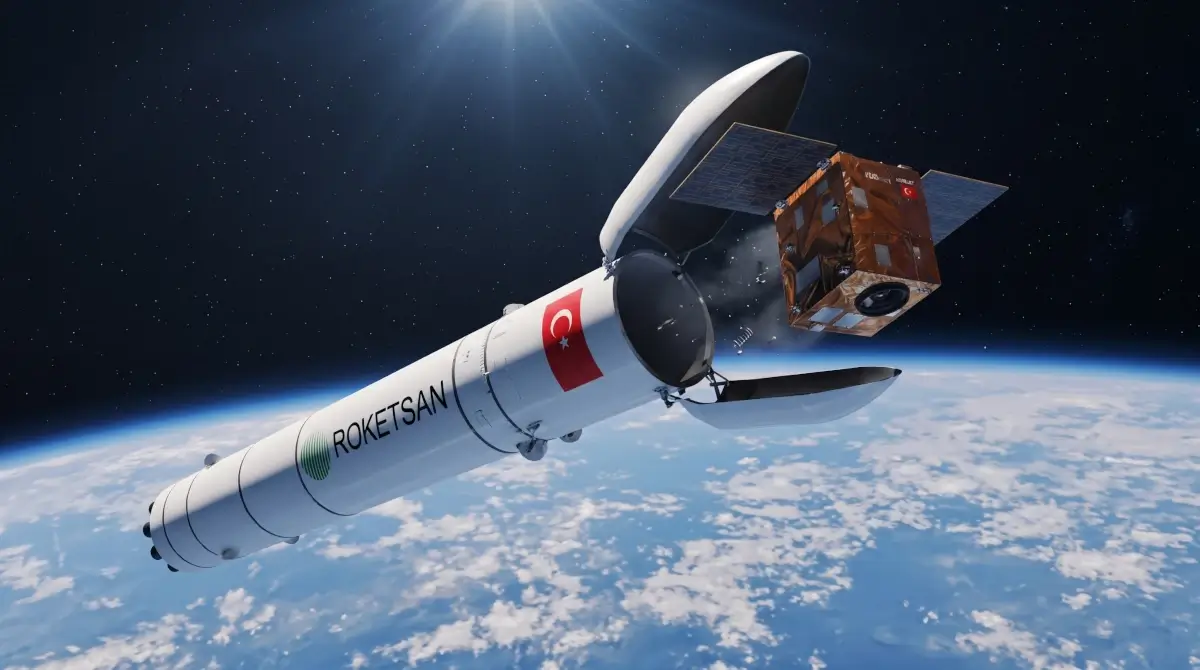
TAI has shared details regarding the HÜRSAT satellite system, which will carry Türkiye's space strategy into the "New Space" era. The HÜRSAT family, designed with a satellite constellation architecture, is creating a small satellite infrastructure that can be scaled according to different mission and orbit requirements. It is stated that the family's first member, HÜRSAT-1, will have the capacity to capture sub-metre resolution imagery despite weighing approximately 200 kilograms.
A Scalable Small Satellite Family of 100-650 Kilograms
HÜRSAT is being developed not for a single satellite class or orbit, but as a small satellite family that will respond to different mission requirements in the approximately 100-650 kilogram range. Satellites in the 100-500 kilogram class are planned to be used in Electro-Optical (E/O), Synthetic Aperture Radar (SAR) and thermal imaging missions in low Earth orbit. Satellites in the 500-650 kilogram class, meanwhile, are targeted for use in communications and artificial intelligence-supported data and image processing missions in space. While a development and production schedule of approximately 24 months is envisaged for HÜRSAT-1, this period is expected to shorten as serial production capability matures.
Sub-Metre Resolution and 14-Kilometre Swath
HÜRSAT-1, which will operate in a Sun-Synchronous Orbit at an altitude of approximately 500 kilometres, is targeted to have a Ground Sample Distance (GSD) of 0.9 metres for panchromatic imaging or higher resolution, and 3.6 metres for multispectral imaging or higher resolution. Alongside the panchromatic band, the satellite will also be able to image in the red, green, blue and Near-Infrared (NIR) spectral bands. Thanks to a ground swath width of at least 14 kilometres, it will have the capability to cover wide geographies at high resolution in a single pass. This technical capability makes it possible to scan Türkiye's geography repeatedly throughout the year.
Swarm Satellite Architecture and Integration with GÖKTÜRK
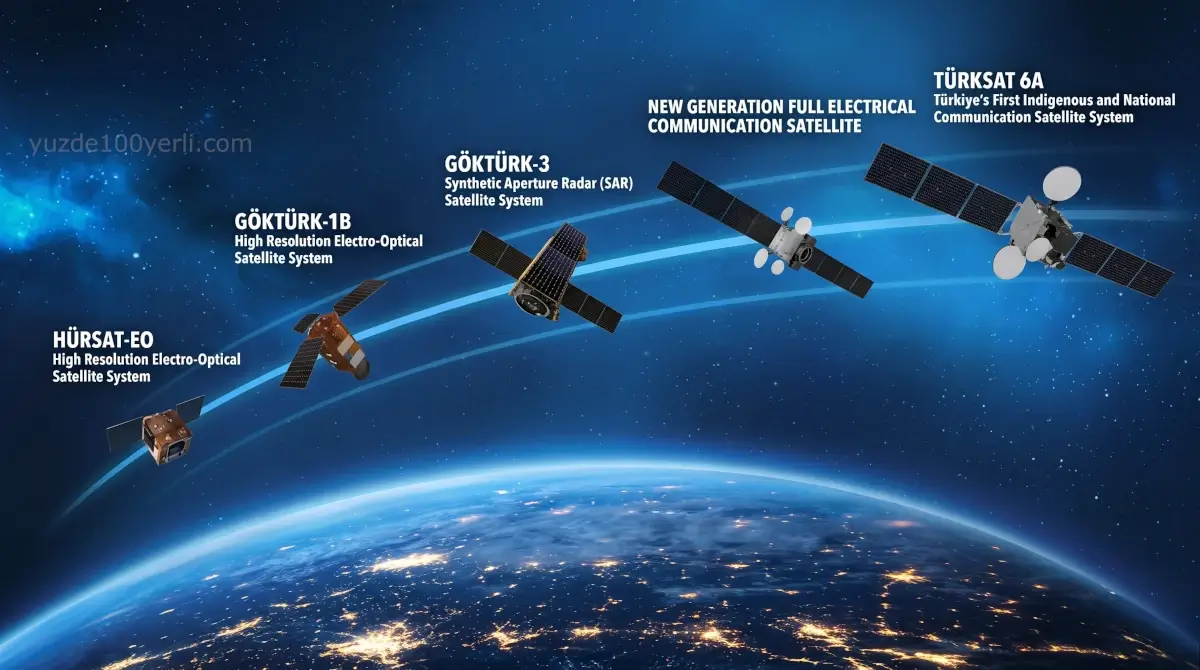
The greatest strength of the HÜRSAT Project comes from its constellation approach, which enables multiple satellites to work in coordination in low Earth orbit. This architecture allows the same region to be scanned more frequently and critical data to be accessed far more quickly. Although HÜRSAT-1's primary focus is civilian needs, the high-resolution imaging capability offered by the satellite can also be used in defence and security-oriented missions. HÜRSAT-1 is not being developed as an alternative to large and strategic Earth observation systems such as GÖKTÜRK; on the contrary, it is seen as a complementary force that enhances their capabilities. When a movement requiring detailed examination is detected during the routine scanning of HÜRSAT satellites, the region in question can be defined as a priority target area for GÖKTÜRK-class satellites.
End-to-End Domestic Systems in Flight and Ground Computers
In the HÜRSAT project, TAI is developing not only the satellite platform but also the entire critical software and hardware infrastructure required for the satellite's operation domestically and nationally. Within this scope, the flight and ground station software, satellite computer, power and interface units are being developed domestically by the company. It is targeted that the satellite ground station infrastructure needed to carry out satellite operations will also be established with domestic and national capabilities. HÜRSAT-1's command and control activities are planned to be conducted via the ground station established within TAI. Thus, an end-to-end domestic and national system capability will be gained across all stages, from the satellite's design and development processes to its operations in space and the transfer of data to ground stations.
Domestic Launch System and the Somali Base
The weight of the HÜRSAT satellites is structured to be compatible with the carrying capacity of the ŞİMŞEK launch system developed by ROKETSAN. ŞİMŞEK-1 is being developed by ROKETSAN with the capacity to carry a 400-kilogram payload to a 550-kilometre circular Low Earth Orbit. ŞİMŞEK-2, meanwhile, will be able to carry a 1,500-kilogram payload to a 700-kilometre Sun-Synchronous Orbit. HÜRSAT-1's weight of approximately 200 kilograms positions it within ŞİMŞEK-1's capacity. It had previously been announced that HÜRSAT-2 would be launched with ŞİMŞEK-1. This compatibility demonstrates that all processes, from the development of the satellites to their launch, can be carried out with domestic systems.
Another pillar of this process is the space launch base being built in Somalia. Minister of Industry and Technology Mehmet Fatih Kacır, in his 2027 budget presentation at the Grand National Assembly's Planning and Budget Committee, had stated that the spaceport under construction in Somalia would pave the way for Türkiye's independent access to space. Somalia, a low-latitude launch point due to its proximity to the equator, provides a fuel advantage in placing satellites into orbit.
A National Step to Reduce Dependency on Foreign Sources
Public and private sector organisations in Türkiye require high-resolution satellite data in various fields. When this requirement cannot be met with domestic systems, imagery is procured from commercial operators abroad. With HÜRSAT-1 entering service, it is aimed to reduce external dependency and increase national capacity, particularly in the high-resolution imagery requirement in the civilian field. Thanks to the project, public institutions will be able to access critical data far more quickly, while a significant budget saving will also be achieved in the long term. The HÜRSAT family's structure, suited to serial production and scalable, will allow new satellites to be carried into orbit rapidly in line with growing needs and Türkiye's total space mission capacity to be expanded gradually.
Five-Year Design Life and High Export Potential
HÜRSAT-1 is being designed to serve in the space environment for five years or longer. The engineering expertise TAI has gained in GÖKTÜRK and other major satellite programmes forms the basis of HÜRSAT's design approach. HÜRSAT's serial-production-ready and customisable structure offers competitive solutions for the international market beyond national needs. The HÜRSAT platform can be configured across a broad spectrum, from a single satellite to complex constellation configurations, and from different mission payloads to integrated ground segment solutions.
Note
If you have any photos or video footage to support our news story, please share them with us using the information provided on our contact us page.
