


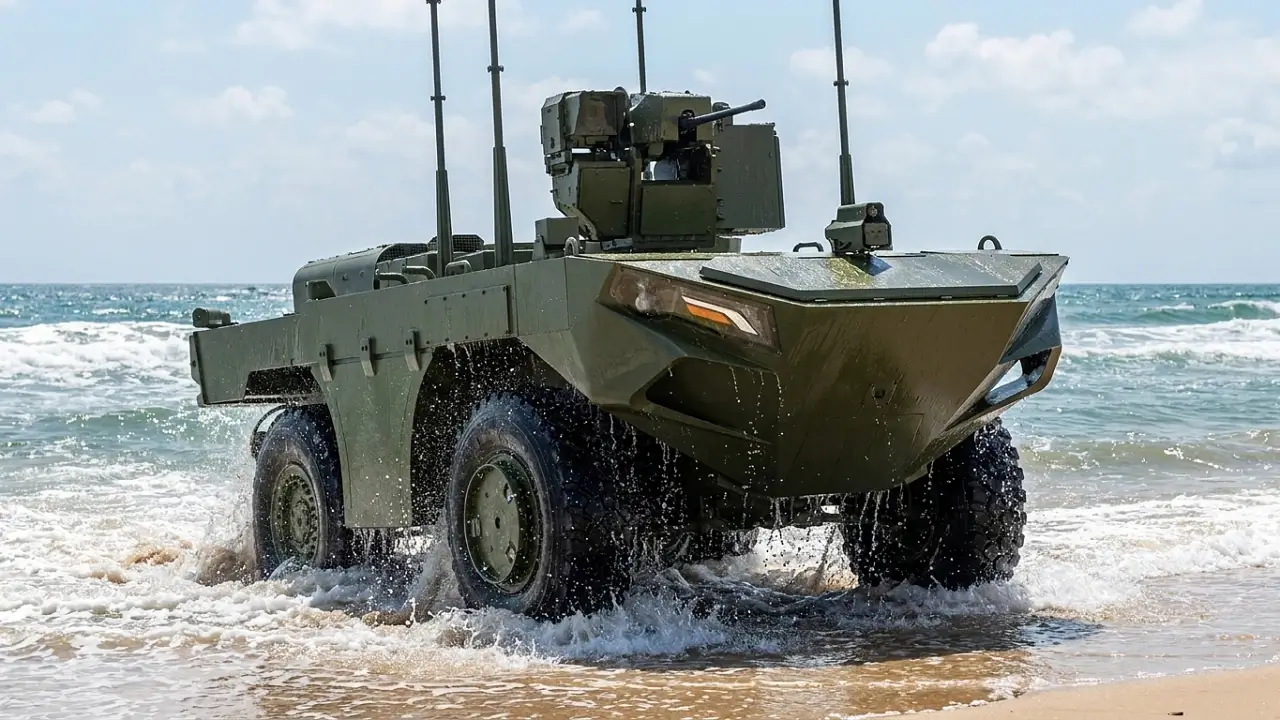
The first landing on the shore — the most risky phase of an amphibious operation — will now be carried out with unmanned vehicles. FNSS has announced the Multi-Purpose Modular Unmanned Amphibious Vehicle İ-ZAHA, which will serve alongside the ZAHA vehicles in the Naval Forces inventory. By establishing first contact with the opposing forces' coastal defences ahead of manned vehicles, İ-ZAHA allows the operator to remain in a safe area throughout the mission.
Unmanned Vanguard in the Most Risky Phase
An amphibious assault operation is one of the most challenging types of operation and carries the highest risk of casualties. The opposing force closes off the shoreline with mines and engineering obstacles, deploying machine gun and anti-tank missile positions to overlook the coast. Every second the first landing wave is delayed works in favour of the defending side. İ-ZAHA comes into play precisely at this critical phase. Designed to operate in coordination with marine infantry units using the ZAHA, İ-ZAHA neutralises mines and obstacles, preparing the shore for the landing of manned vehicles.
10 Different Mission Modules Swappable in 40 Minutes
One of İ-ZAHA's strongest features is the ability to swap payload modules suited to different mission profiles on the same platform. This module change, which can be carried out in the field in approximately 40 minutes, makes possible ten different mission configurations, from Fire Support to Mine Clearance, and from Electronic Warfare to Casualty Evacuation. The 8-tonne platform reaches 7 knots in water and 70 km/h on land. Keeping detectability to a minimum with its low silhouette, low thermal signature and low noise level, the vehicle can move to the shore without being caught by enemy surveillance.
Artificial Intelligence and Armor Integrity Integration
İ-ZAHA's artificial intelligence-supported image processing architecture analyses camera feeds in real time. Detected elements are marked according to threat score, type and status, and automatic target detection systems reduce the operator's workload. The vehicle also holds the distinction of being the first unmanned vehicle to be integrated with the Armor Integrity structural integrity monitoring system developed by Nurol Technology. Since there is no crew, the human judgement that would assess a hit on the vehicle is replaced by the system integrated into the platform's digital backbone. Sensors detect the location, direction and severity of the impact in real time, calculate the remaining structural capacity of the affected area and transmit it to the chain of command.
"The Door to a New Era"
FNSS CEO Selim Baybaş says the following about İ-ZAHA's significance:
"İ-ZAHA stands out as the new-generation heavy-class unmanned amphibious vehicle that brings together FNSS's engineering capabilities, the ZAHA's field-proven success and ongoing R&D efforts. The number of companies worldwide capable of producing an amphibious unmanned ground vehicle at this scale and with this scope of capability is extremely limited; with its more than 35 years of experience in the sector and its active production line, FNSS is one of the few NATO suppliers capable of producing different platforms simultaneously."
Can İ-ZAHA Change the Rules of the Game in the Aegean?
Amphibious operations have been the setting for some of the bloodiest battles in military history. The technology that has changed since the Normandy landings has not entirely eliminated the risk faced by the soldier who first sets foot on the shore. İ-ZAHA offers a paradigm shift precisely at this point. The first wave is no longer manned, but unmanned. The first element to encounter the opposing force's mines, engineering obstacles and machine gun positions is İ-ZAHA. This not only reduces soldier casualties but also renders the opposing side's defence planning obsolete. Because classic defence doctrines are built on the slowness and vulnerability of manned landing vehicles.
The ability to reconfigure İ-ZAHA in the field in 40 minutes with 10 different mission modules means that a single platform can be used across different operational phases. A vehicle that clears mines one day can become a fire support or electronic warfare platform the next. This flexibility reduces the logistical burden while keeping the level of operational readiness high. FNSS's production of an unmanned version of a platform proven in the field with the ZAHA, meanwhile, takes Türkiye's amphibious operation capabilities to a higher level.
The Armor Integrity integration, meanwhile, enhances an unmanned vehicle's situational awareness and offers a solution to one of the greatest handicaps of unmanned systems. The biggest problem with unmanned systems is that the operator cannot clearly know the condition of a vehicle that has taken damage. The sensor-based structural integrity monitoring system fills this gap by providing the commander with data on whether the vehicle can continue its combat capability. This also paves the way for the effective use of unmanned systems throughout an operation. Türkiye's reshaping of its amphibious operation doctrine with unmanned systems will be a step that directly contributes to its deterrence in the Aegean and the Mediterranean.
Note
If you have any photos or video footage to support our news story, please share them with us using the information provided on our contact us page.
