


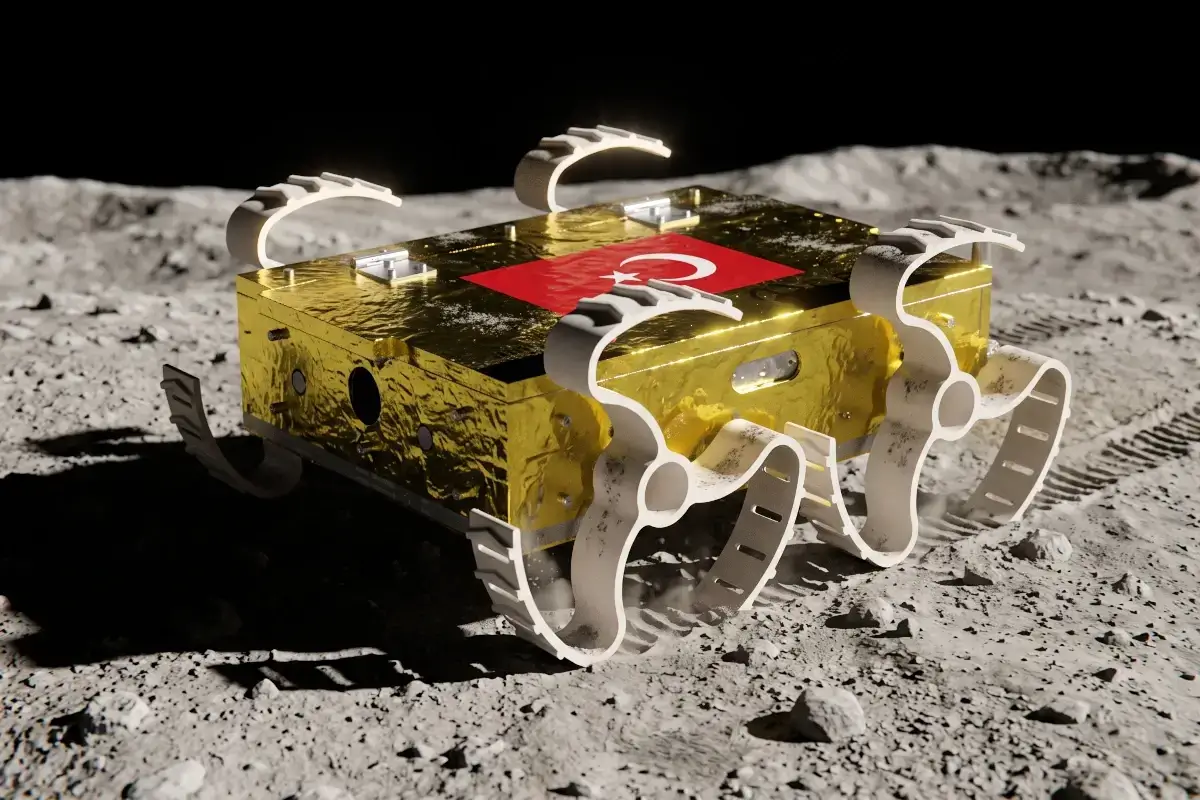
The lunar rovers developed through a partnership between Chinese space technology company StarVision and METU (Middle East Technical University) were displayed at the 77th International Astronautical Congress held in Antalya. The rovers, developed under the CHERI project, aim to be sent to the lunar south surface in 2029 with China's Chang'e 8 mission.
What Is CHERI?
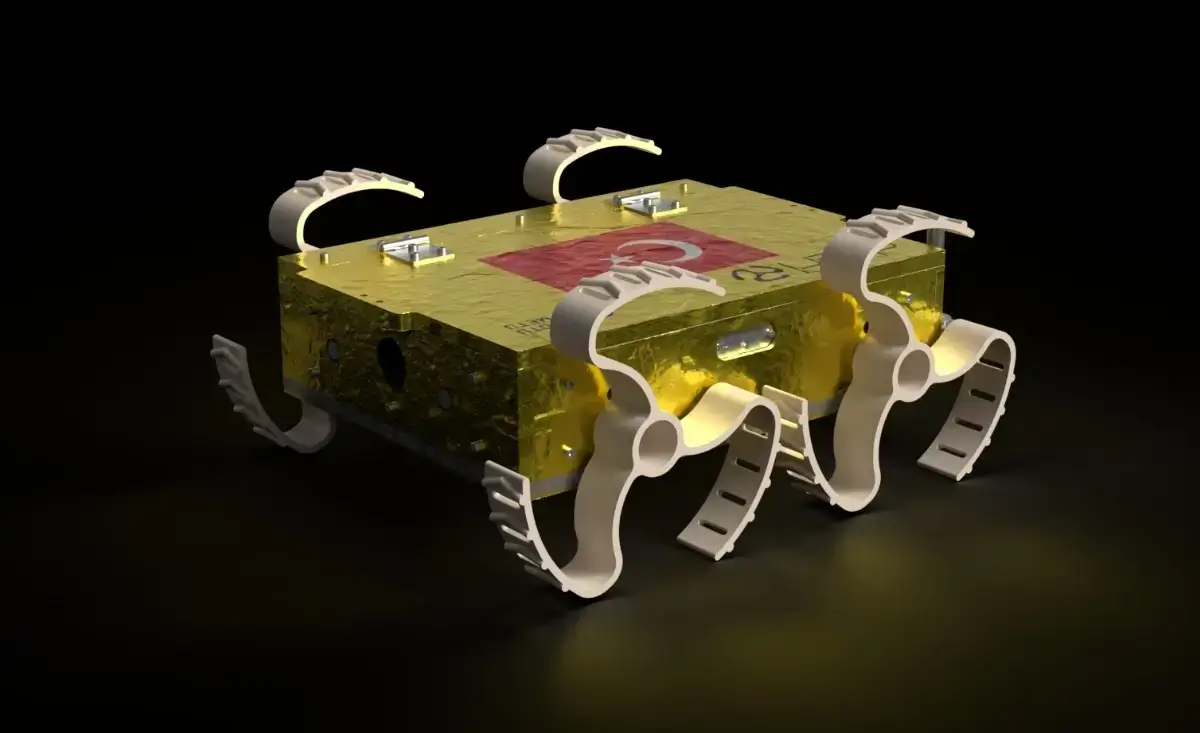
CHERI is the abbreviation for "Challenging Environment Exploration Robot for Intelligence." This name, which could be translated into Turkish as "a challenging environment exploration robot designed to gather information," emphasises both the harsh conditions of the lunar south pole and the exploration vehicle's scientific observation and data collection tasks. Under the project, two micro exploration vehicles, each weighing 5 kilograms, are being developed. Türkiye will thus join the ranks of countries that have sent two exploration robots to the Moon.
The Chang'e 8 Mission and International Cooperation
Chang'e 8 is a robotic mission designed to test the technologies necessary for establishing a permanent base on the Moon. The mission, consisting of a lander, an exploration vehicle and a construction robot, aims to take the first steps towards the foundations of the International Lunar Research Station, planned for construction in the 2030s. In the mission, a continuation of Chang'e 7, a landing will be made at the lunar south pole and the region's physical structure will be examined in detail. Experimental tasks such as producing construction materials through 3D printing using lunar soil will also be carried out.
The project is being conducted through cooperation between Chinese commercial satellite company StarVision, Zhejiang University and METU. A larger 100-kilogram exploration vehicle will also take part in the mission. The development processes for this larger robot are being led by the Hong Kong University of Science and Technology, with the participation of various Chinese universities and the South African National Space Agency.
Technical Specifications of CHERI
The CHERI micro exploration vehicles are equipped with advanced camera systems. These cameras will obtain images by observing the lunar surface, other exploration vehicles and the lander from multiple angles. The camera system will not only capture images but will also track other rovers to determine their position and orientation, calculate distance to the lander, and analyse environmental variables such as dust density in the external environment using the data collected.
The vehicles will use a semicircular rotating, flexible and mobile "Rex-type" leg-like wheel system to enable them to travel over both hard and soft terrain. Thanks to this special system, the robots will be able to easily pass over rocks and travel without becoming stuck in the lunar soil. Since sunlight reaches the lunar south pole at very low angles, the vehicles' solar panels are being designed to open upwards like a book cover.
Resistance to the Moon's Harsh Conditions
It is of critical importance that the micro vehicles can withstand extremely harsh conditions. During the day on the Moon, temperatures can reach up to +121 degrees Celsius. At night, these values drop to as low as -246 degrees Celsius. A day-night cycle on the Moon lasts 29.5 Earth days. This means the vehicles must be able to survive the extremely cold lunar nights, which last approximately 15 days. To overcome these challenges, high-accuracy computer simulations are first created, followed by durability tests in special test environments called "Moon studios."
Why the Lunar South Pole?
The lunar south pole is a strategic region for space research. NASA's Lunar Reconnaissance Orbiter found evidence that there may be frozen water in craters near the lunar south pole. Temperature values in these regions are low enough to allow ice to persist permanently. The presence of water strengthens the idea that sustainable infrastructure could be established for both life and fuel production. The Moon is also regarded as a strategic transit point that could serve as a "space station" for deep space missions, thanks to its low gravity.
"This Partnership Matters for All Humanity"
StarVision CEO Arden Liu drew attention to the importance of Türkiye-China cooperation in a statement to TRT Haber. Liu said: "This partnership matters for all humanity. Going to the Moon, deploying these rovers and giving them their own intelligence so they can complete their missions is truly very important." Noting that StarVision works on artificial intelligence infrastructure in space, Liu said they cooperate with more than 40 countries internationally.
Project Details: 30-40 Students Working Actively
Prof. Halil Ersin Söken from METU's Department of Aerospace Engineering provided information on the project's details. Noting that the work is being carried out predominantly at METU, Söken said: "In 2029, with the Chinese Chang'e 8 mission, we plan to send 2 micro rovers to the Moon. The two will operate in cooperation on the lunar south surface. We have been actively working on this project for about a year and a half."
Emphasising that the project is being developed entirely by students and engineers working and studying at METU, Söken stated: "Approximately 30-40 of our students are currently actively working on this project. All the work, from the robots' design from scratch to this point, belongs predominantly to us. At the same time, we have a partnership with the StarVision company, in front of whose stand we are standing at the project."
Note
If you have any photos or video footage to support our news story, please share them with us using the information provided on our contact us page.
