


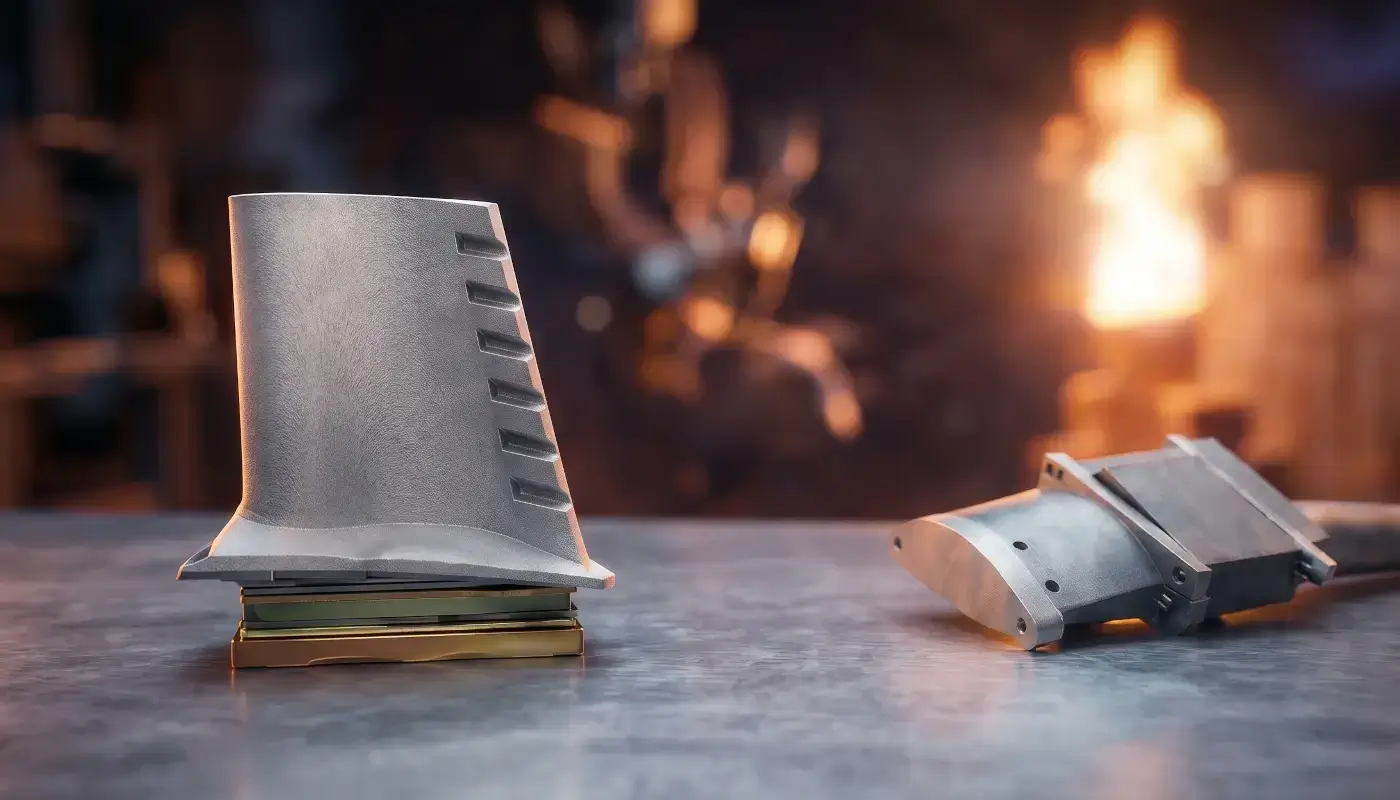
The Turkish aviation industry has permanently overcome one of the greatest technological obstacles in indigenous engine projects. TUSAŞ Motor Industries (TEI) announced that, within the scope of the KRİSTAL Project carried out with the support of the Presidency of Defence Industries (SSB), it has brought single crystal and directional solidification nickel superalloy casting technologies, considered the heart of aircraft and helicopter engines, to the country. This strategic move, successfully completed in partnership with Gür Metal and TÜBİTAK MAM, enables the production of turbine blades operating at high temperatures entirely with domestic resources. Consequently, Türkiye is ending foreign dependency in aviation engines while solidifying its place in the league of global engine manufacturers.
Technology Defying High Temperatures
In modern gas turbine engines (turbofan or turboshaft), the temperature of the gases exiting the combustion chamber often rises far above the melting point of metal. Standard metals would react to this immense heat by melting within seconds. To increase engine efficiency and overcome this physical limit, TEI engineers cast nickel-based superalloy materials in single crystal form.
Standard cast metals contain millions of microscopic grain boundaries. Heat and pressure can intrude through these boundaries, eventually fracturing the metal over time. However, single crystal casting technology forms the entire part in a flawless single crystal structure. Thus, the material never loses its structural integrity under high temperatures and incredible centrifugal force.
After the casting process, engineers apply a special thermal barrier coating onto the part. Furthermore, specialists complete the production by drilling microscopic cooling holes inside the blades using lasers. This ensures that the blade guarantees the safe operation of the engine even at hellish temperatures far above its own melting point.
The Strategic Importance of the KRİSTAL Project
While Türkiye was bringing its domestic aerial platforms to the skies, it faced its greatest hidden embargoes in engine components. Only a few developed countries in the world can produce these blades, the most critical part of the turbine module. Foreseeing this strategic bottleneck, the Presidency of Defence Industries (SSB) launched the KRİSTAL Project in 2015.
The project, with TEI as the main contractor, received massive scientific support from subcontractors Gür Metal and the TÜBİTAK MAM Materials Institute. The companies carried out a very challenging process from the design phase to process development, from prototype manufacturing to engine-level tests. The project, successfully completed in 2021, is now being realised on TEI's mass production lines.
Full Independence in Indigenous Engines
The KRİSTAL Project represents one of the most strategic material revolutions in Turkish aviation history. Today, all indigenous projects, from the TS1400 engine powering the GÖKBEY helicopter to the TF6000 turbofan engine being developed for unmanned combat aircraft, benefit from this technological accumulation.
With this acquired nickel superalloy casting capability, TEI completely eliminates the greatest physical constraint in aircraft engine design. In the coming period, further development of these advanced manufacturing technologies will directly increase the thrust power and flight life of domestic engines.
Note
If you have any photos or video footage to support our news story, please share them with us using the information provided on our contact us page.
