
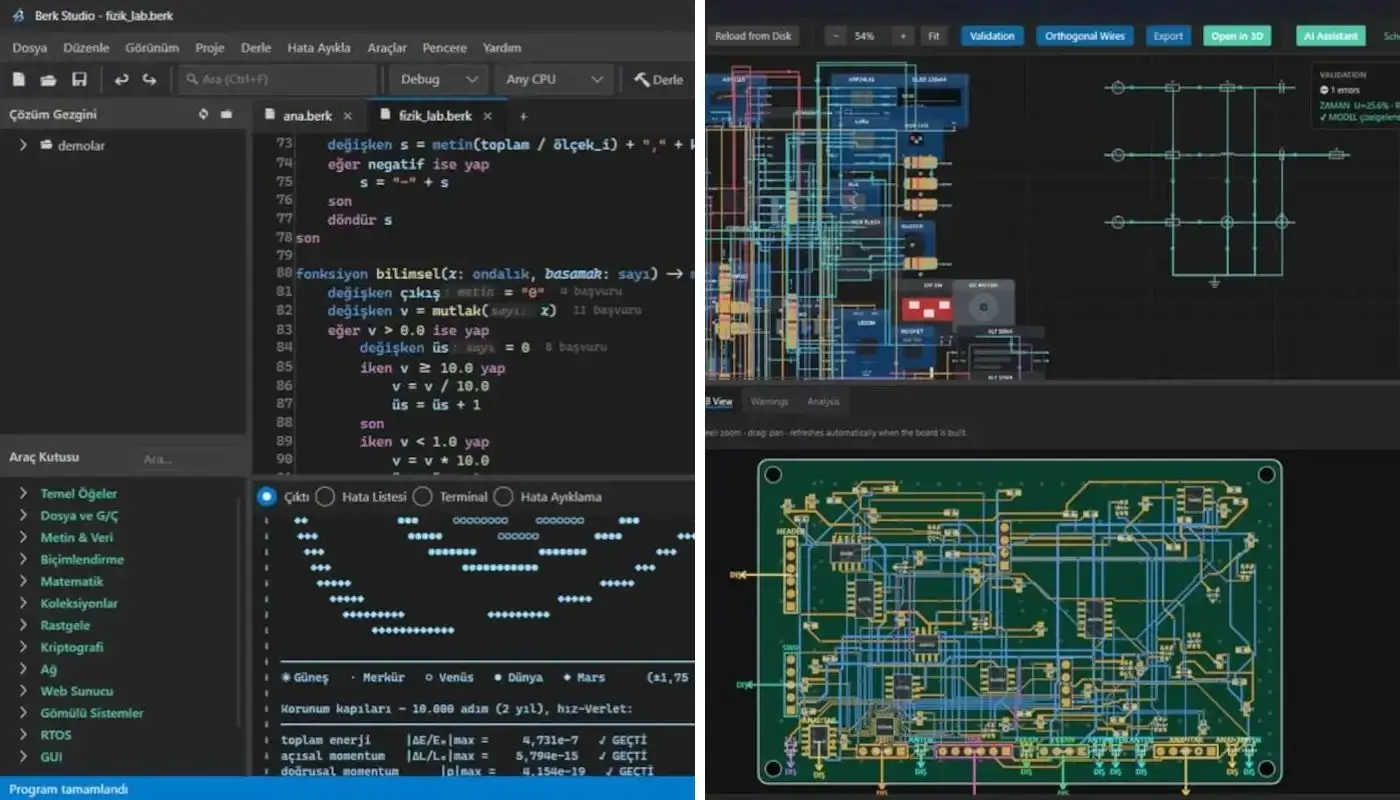
Muğla-based LL BERK Software Technologies released its BERK programming language and its development environment, Berk Studio, on 14 October 2026. The language has two standout features: code can be written in Turkish, and certain errors in the software are caught before the program is run, at the compilation stage. The basic version is free and runs on Windows 10 and 11.
Programming Languages Can Now Also Be Turkish
Programming languages generally operate with English words. In BERK, however, more than 360 Turkish and English spellings are mapped to the same equivalent. This means the same program can be read in both languages. For example, a programmer can type a sentence such as "eğer negatif ise yap" on their screen, and this sentence is transformed into a real command the computer understands. The application's interface can also be used in Turkish.
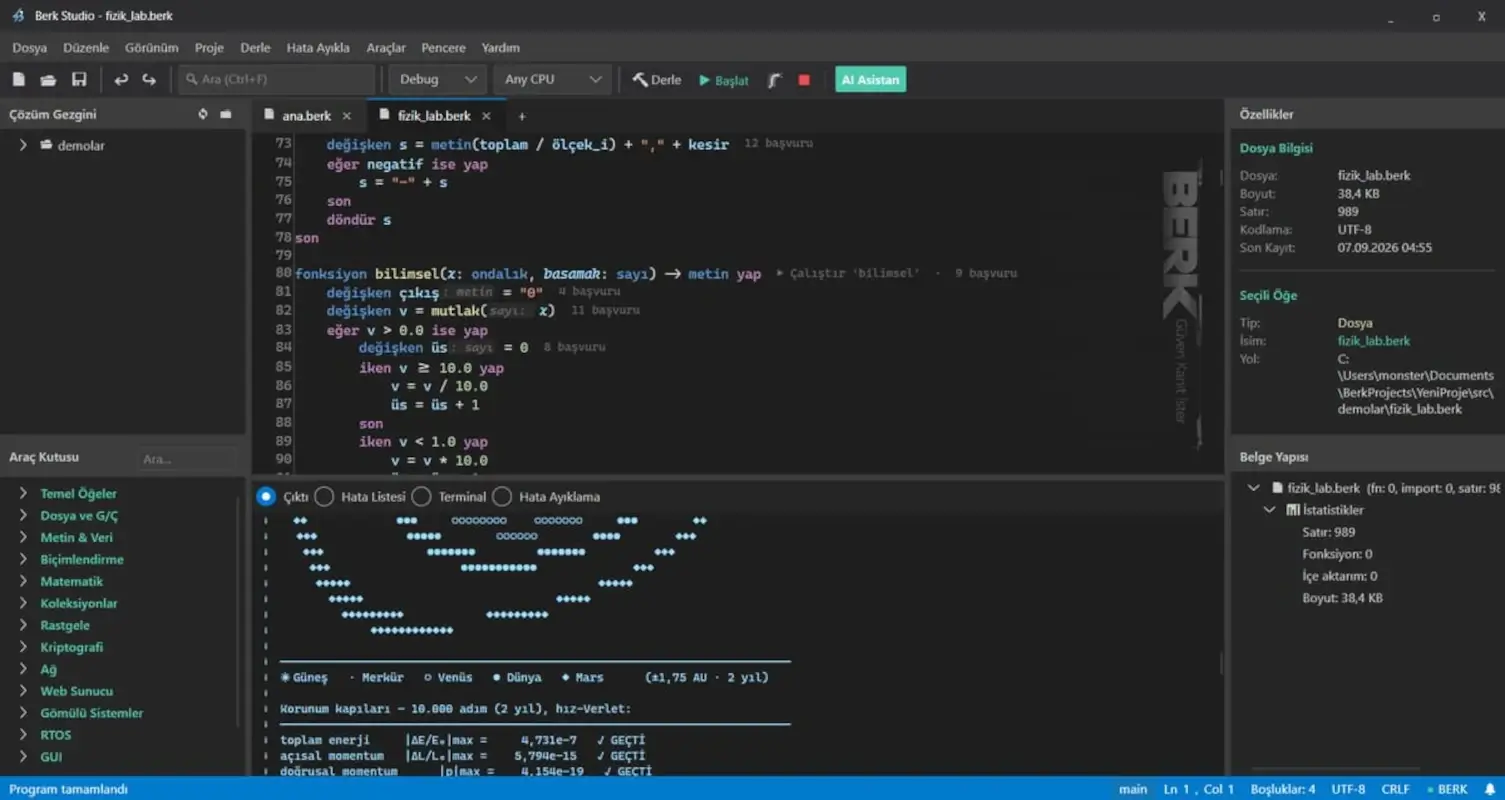
It is stated that the aim here is not to exclude English. According to the company, the real goal is for technicians, engineers and students who are held back by the English barrier to be able to participate in the software production process as well. International teams, meanwhile, can continue to write the same code in English. In this respect, BERK offers an approach aimed at removing the language barrier.
Errors Are Caught Before the Program Runs
The company sets out BERK's real target as systems where the cost of error is high: automotive, medical devices, aviation and industrial automation. In these fields, it is said, software "mostly working correctly" is not enough. Emphasising that a car's brake software must give the same response every time, the company stresses the importance of software behaving deterministically.
Today, this assurance is largely sought through testing. Software is run repeatedly and the results examined. However, according to LL BERK, testing has an important limitation: a test only proves the case that was tried. An error in an untried case, meanwhile, can emerge in the field.
At this point, BERK follows a different method. The developer writes a promise into a function, such as "I do not look at the clock or a random number," "I do not allocate memory," "I do not crash." The compiler — the program that translates the written code into a form the computer understands — verifies this promise before the code is even run. Moreover, it looks not only at that function but also at the other functions the function calls. Code that does not keep its promise does not compile, meaning the program cannot be run at all. The company states that the compiler itself is continuously measured with approximately 6,200 checks across 645 test files.
Why Was a New Language Developed?
There are three methods commonly used today in safety-critical software. MISRA C restricts the C language with a list of rules, and compliance must be audited with separate analysis tools. Rust prevents memory errors but does not make promises about what the software will do. Ada/SPARK, meanwhile, can prove behaviour mathematically, but this requires expertise and knowledge of a separate proof language.
BERK aims to bring together the strengths of these three approaches. It aims to provide the same assurance while writing code, without the developer needing to learn a separate tool or proof language. Founder Mustafa B. Arslantaş says: "The same input must produce the same result on every machine. We wanted to write this into the language itself rather than testing for it afterwards."
Berk Studio: Code, Circuit Board and Design in the Same Environment
Berk Studio is not merely an environment for writing code. The company says that electronic boards, mechanical design, artificial intelligence models and web API design can all be done in the same place.
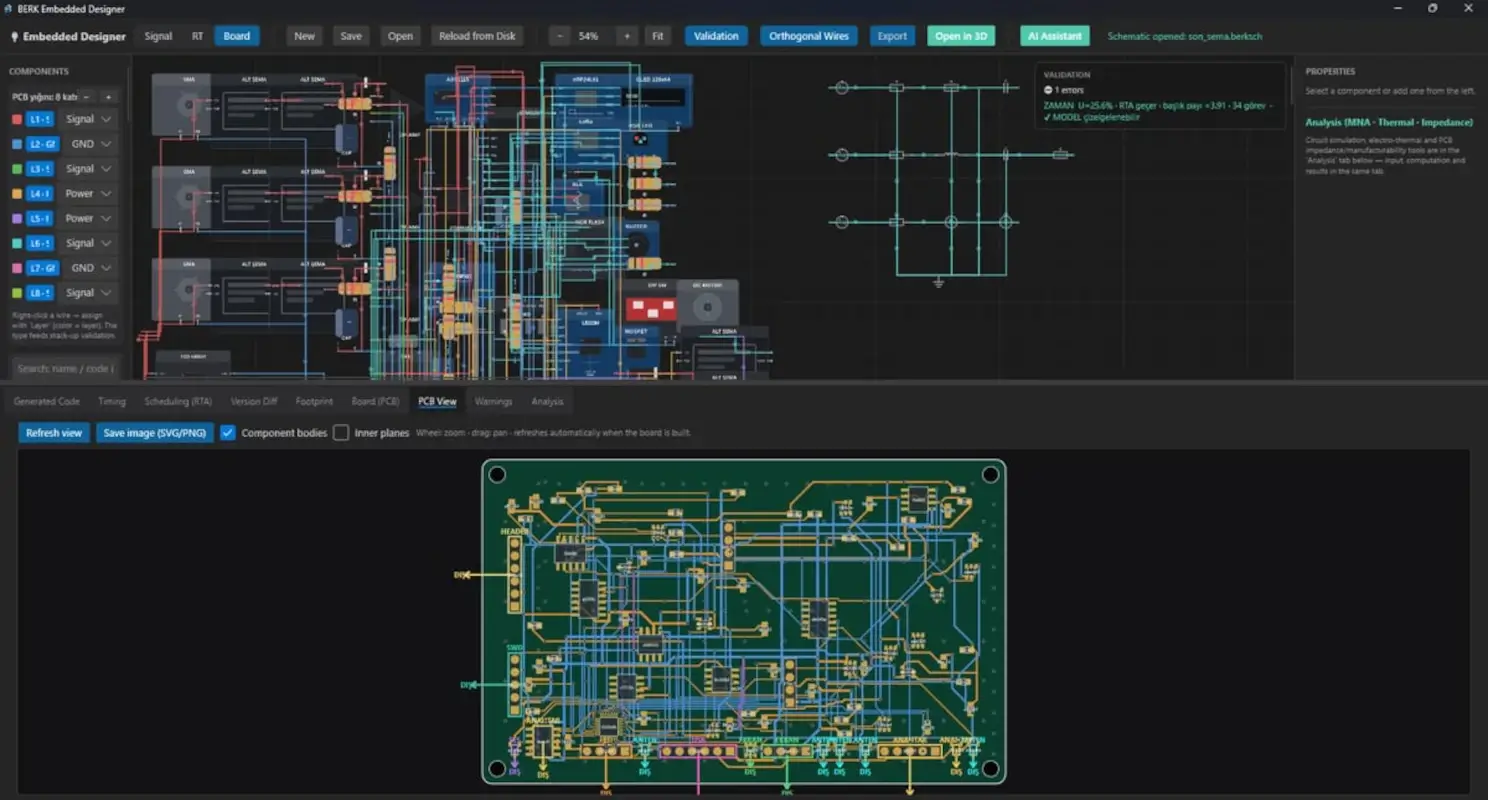
The environment does not require an internet connection and can run on closed networks. Data stays on the user's computer, and packages are digitally signed.
Who Will Use Berk?
BERK's target is software that directly controls machines. Examples such as brake controllers and robot arms fall within this scope. In other words, the target is not phone applications or websites, but systems that control hardware. Alongside the language, the company states that it is also developing the in-vehicle communication software BERK DDS, the real-time operating system BERK-RTOS and the digital twin platform Berk Digital Twin.
However, there is not yet a disclosed reference customer or a project running in the field. We were unable to find an article or review in which the programming language and the tools it offers have been assessed by experts. The company also does not yet make a certification claim. Considering that software used in this field must additionally be verified according to sector standards, whether BERK will find a place in real products will become clear in the period ahead.
Free Pro Licence for Individuals with Disabilities
Individuals with disabilities can receive a Berk Studio Pro licence free of charge for one year. The licence is renewable, watermark-free and open to commercial use. In other words, the user can sell the work produced with this tool. The application does not ask for the type of disability, and the submitted document is stored encrypted and deleted as soon as a decision is made. The company also openly states that Berk Studio is not yet equally accessible to everyone today. An improvement schedule for shortcomings in screen reader support has been published on the programme page. For students and teachers, all design tools are free for one year, but for educational purposes only.
Open Source Next
The compiler, standard library and tools are planned to be released under the Apache 2.0 licence. The source code is currently in the debugging and clean-up phase, meaning it has not yet been published. The company states that the language is at version 1.0 and that the syntax has been frozen.
Note
If you have any photos or video footage to support our news story, please share them with us using the information provided on our contact us page.
