


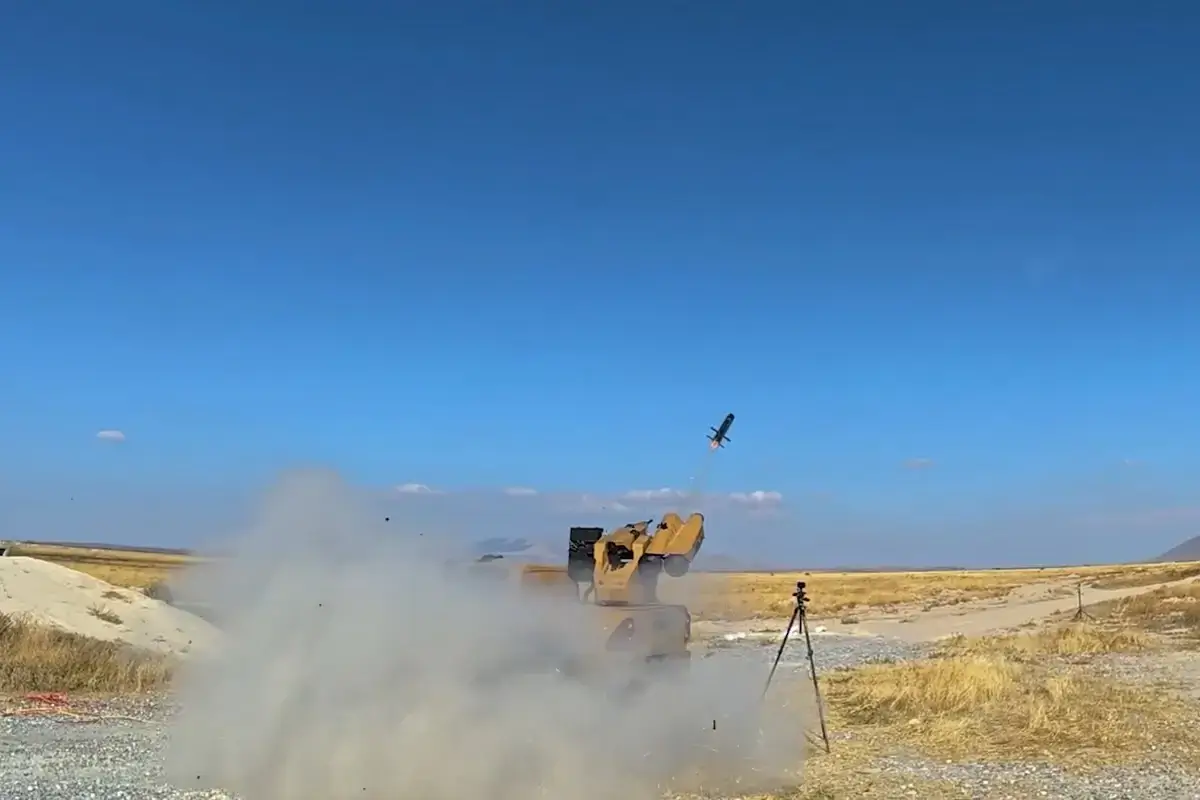
ROKETSAN's shoulder-launched anti-tank missile KARAOK has successfully hit an aerial target for the first time. In a post from the company's social media account, it was stated: "KARAOK, the agile force of the battlefield, has successfully hit an aerial target for the first time. By extending KARAOK's effectiveness against ground targets to aerial targets as well, we are strengthening our multi-directional engagement capability against diverse threats."
From Anti-Tank Missile to Air Defence System
KARAOK is known as a shoulder-launched short-range anti-tank missile developed by ROKETSAN. The system had stood out for its effectiveness against armoured vehicles and ground targets. With this test, however, KARAOK has proven its usability against aerial targets as well. This capability means that, on the battlefield, an anti-tank missile can also be used effectively against low-flying UAVs, helicopters or other aerial assets.
The Flexibility Afforded by Domestic Design
KARAOK's adaptability against aerial targets is one of the most tangible advantages of Türkiye developing its own defence systems. Since all design, software and integration processes of the system are carried out by ROKETSAN engineers, expanding KARAOK's mission profile does not require obtaining permission from any external supplier or requesting access to software source code. Using the same munition, the same seeker head and the same fire control infrastructure, it can be configured against aerial threats as well as ground targets.
International Equivalents and Its Position
KARAOK's closest equivalent is the US-made FGM-148 Javelin. The Javelin is a system with a range of 2.5 kilometres, operating on a "fire-and-forget" principle and featuring a top-attack mode. However, the Javelin was designed for use only against ground targets, and aerial target engagement is not among its official mission profiles.
The Israeli-made Spike family stands out with its multi-platform structure. The Spike MR can reach 2.5 kilometres, the Spike LR 4 kilometres, and the Spike ER 8 kilometres. The ER version of the Spike can also be fired from helicopters and naval platforms. However, the Spike's aerial target engagement capability is limited, with the system primarily optimised against armoured vehicles and structures.
The French-Italian jointly produced Akeron MP (formerly MMP) is a fifth-generation system with a range of 5 kilometres and a weight of 15 kilograms. Thanks to its fibre-optic data link, the Akeron MP offers the ability to update targets during flight. However, aerial target engagement is not a primary mission profile for this system either.
The Russian-made Kornet-E has a range of 5.5 kilometres and a laser guidance system. There are reports that the Kornet-E can be used against aerial targets, and it is noted as being particularly effective against low-flying helicopters. However, because the Kornet-E operates with semi-automatic command guidance, the operator must continuously track the target, which makes its use against moving aerial targets difficult.
KARAOK distinguishes itself from these competitors through its imaging infrared seeker head and fire-and-forget capability. Because the infrared seeker tracks the target's heat signature, it can also be effective against moving aerial targets. This makes KARAOK one of the systems among its equivalents best suited to an air defence role.
Why Is Multi-Directional Engagement Critical?
Threats on the modern battlefield are becoming increasingly diverse. An infantry unit can simultaneously be under threat from both an armoured vehicle and a low-flying UAV. KARAOK's usability against both ground and aerial targets means that two different threat categories can be addressed with a single system. This provides a significant logistical and operational advantage, particularly for highly mobile units.
KARAOK's usability against aerial targets also brings a complementary low-altitude capability to Türkiye's layered air defence architecture, ÇELİKKUBBE. SUNGUR's air defence role and its integration onto the AKINCI had previously been on the agenda; the testing of KARAOK with this capability is regarded as part of ROKETSAN's strategy of adapting its various munitions to multi-directional mission profiles.
Note
If you have any photos or video footage to support our news story, please share them with us using the information provided on our contact us page.
