


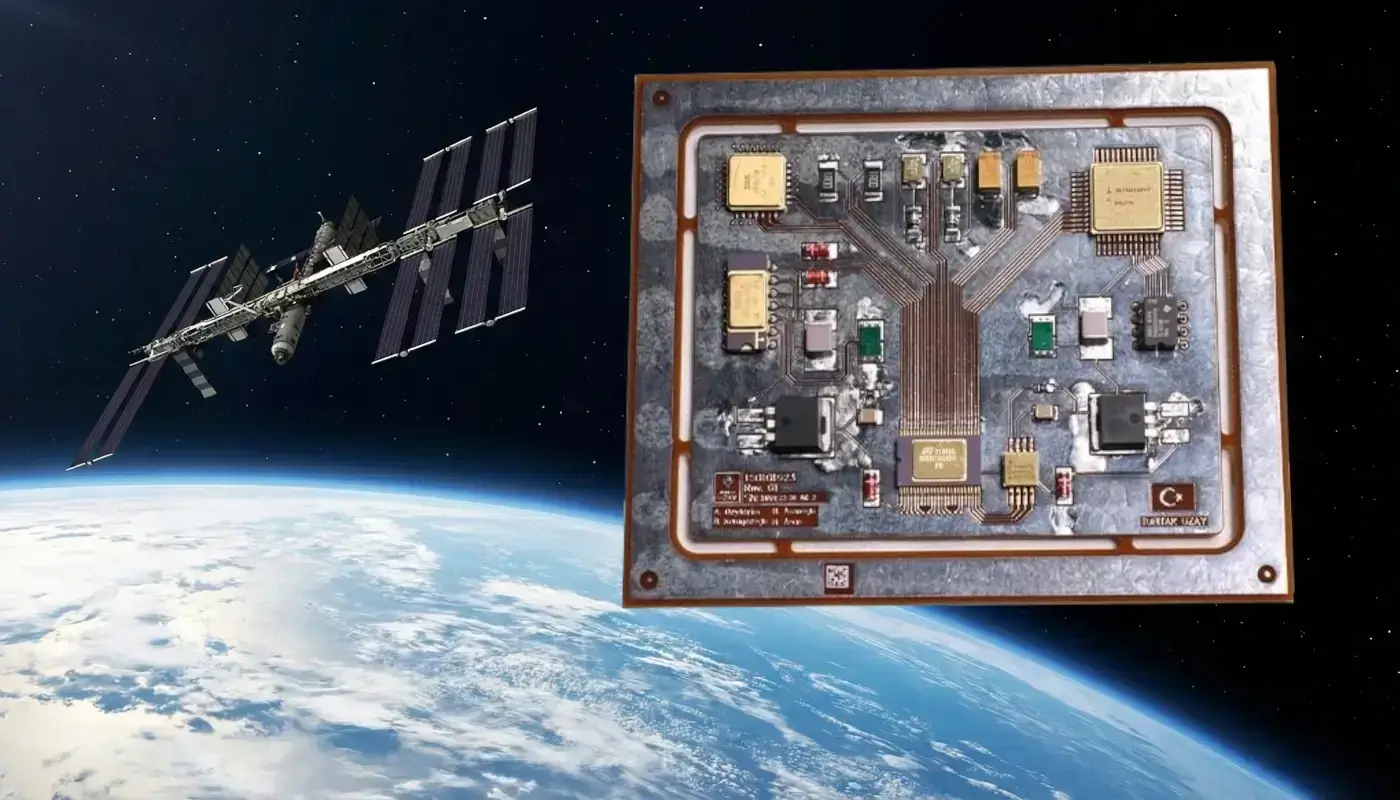
A critical experiment from Türkiye is being sent to the International Space Station (ISS) tonight. Developed by TÜBİTAK UZAY, the MIYOKA Phase-2 experimental hardware is scheduled for launch on 13 May at 02:16 AM (TSİ) as part of the SpX-34 Commercial Resupply Services mission, conducted in collaboration with NASA and SpaceX. So, why is soldering in space of such vital importance?
The Difficulty of Soldering in Microgravity
Soldering on Earth is relatively straightforward; the heated metal alloy melts, flows to the contact points with the help of gravity, and solidifies upon cooling to create a reliable electrical connection. However, in the microgravity environment of space, the process changes entirely.
In zero gravity, instead of flowing where intended, molten solder can collect into spheres due to surface tension forces. Temperature distribution becomes unpredictable, and the internal structure of the resulting connections may develop crystal formations different from those on Earth. This directly impacts the long-term reliability of the connection. This is precisely the core question MIYOKA will investigate: how do lead-free solder alloys behave in microgravity?
What is MIYOKA and What Does Phase-2 Signify?
MIYOKA is an experimental platform developed by TÜBİTAK UZAY to test electronic assembly technologies in the space environment. The "Phase-2" designation indicates that this is a follow-up study. Building upon the data obtained in the first phase, this new stage is expected to conduct tests with more advanced parameters.
The experimental setup will perform controlled soldering operations inside the ISS over a specific period. The resulting connections will then be returned to Earth for detailed analysis. These analyses will provide concrete data regarding the mechanical durability, electrical conductivity, and long-term degradation characteristics of solder joints made in space.
Why Now and Why Is It Important?
Looking at the recent roadmaps of space agencies, the capability for in-orbit manufacturing and repair is clearly a common goal. NASA's plans to establish a permanent base on the Moon through the Artemis programme, along with private sector initiatives to produce pharmaceuticals and optical fibres in orbit, all point to the same necessity: the ability to repair equipment on-site rather than sending a replacement from Earth when something malfunctions.
MIYOKA is a cornerstone of this future. Once the ability to perform reliable soldering in space is proven, repairing a faulty circuit board or even manufacturing electronic modules from scratch moves from theory to practice. This also means self-sufficiency for crews on long-duration missions far from Earth, such as lunar missions. The risk of losing a multi-billion dollar mission due to a faulty avionics card is significantly reduced.
The International Standing of TÜBİTAK UZAY
TÜBİTAK UZAY has gained recognition in recent years, particularly for its successes in satellite technologies. Its roles in developing the BİLSAT, RASAT, and GÖKTÜRK-2 satellites demonstrated the institution's competence in space hardware. Now, this expertise is expanding into more niche areas such as materials science and space qualification.
Participating in the same mission as two industry giants like NASA and SpaceX is noteworthy as it demonstrates the level of international integration of space research in Türkiye. The SpX-34 mission is one of SpaceX's regular resupply flights to the ISS using the Dragon capsule. To participate in these missions, experimental hardware must pass NASA's stringent safety and compatibility tests. MIYOKA's successful completion of this process is a tangible proof of technical proficiency.
Live Broadcast and Monitoring
The launch will be broadcast live via SpaceX's official website and YouTube channel. Planned for 02:16 AM Turkish time, the launch can be followed live at https://spacex.com/launches/crs-34 However, it should be noted that the launch may be postponed depending on weather conditions; therefore, monitoring SpaceX's social media accounts is advisable. The operational process of the MIYOKA experiment on the ISS and the initial results will be shared through TÜBİTAK UZAY channels in the coming months.
Note
If you have any photos or video footage to support our news story, please share them with us using the information provided on our contact us page.
