


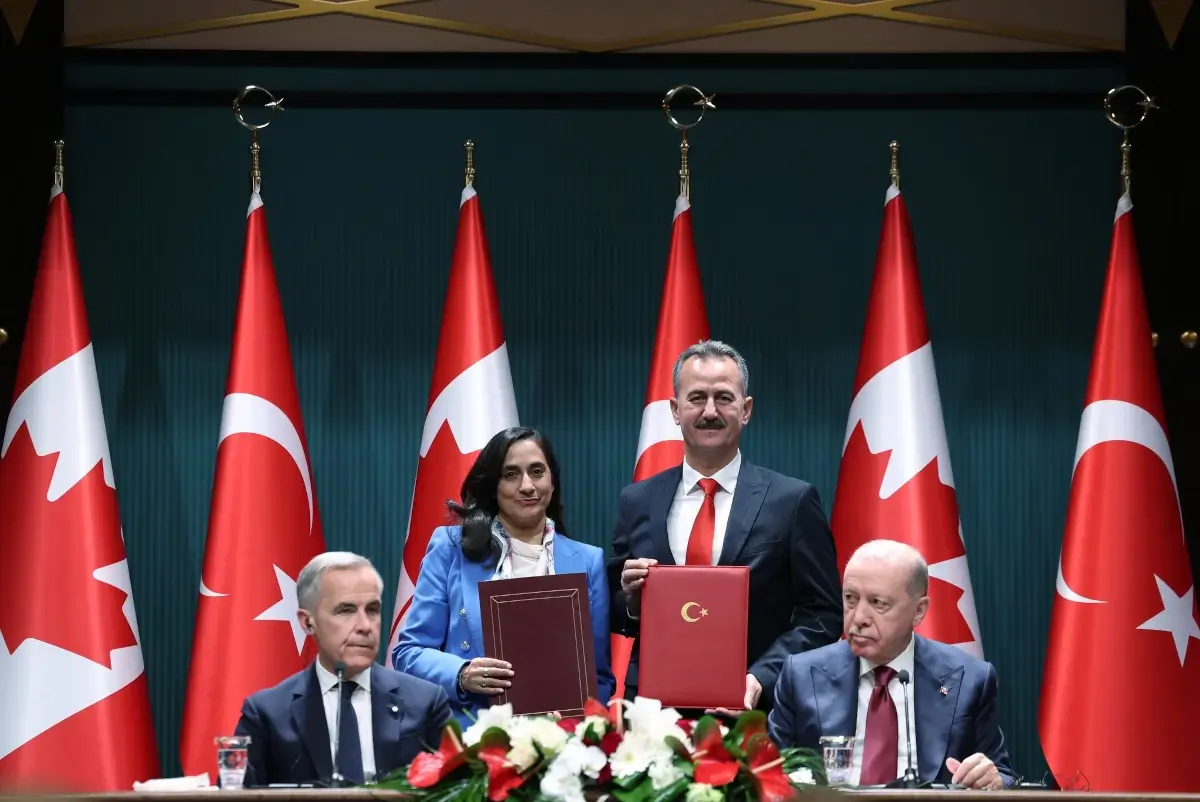
Türkiye and Canada have elevated their relations to the level of strategic partnership by signing three agreements in the fields of defence, transport and energy. The signing ceremony took place following the meeting between Canadian Prime Minister Mark Carney and President Recep Tayyip Erdoğan within the scope of the former's visit to Ankara. Following the signing ceremony, the leaders of the two countries also made statements regarding Türkiye-Canada relations and the point reached.
At the signing ceremony, agreements were signed in the following three critical areas respectively. Defence Industry Agency President Professor Dr. Haluk Görgün and Canadian Foreign Minister Anita Anand signed the memorandum of understanding on defence sector partnerships. Minister of Transport and Infrastructure Abdulkadir Uraloğlu and Canadian Foreign Minister Anita Anand signed the air transport agreement. Minister of Energy and Natural Resources Alparslan Bayraktar and Canadian Minister of Energy and Natural Resources Tim Hodgson, meanwhile, signed a joint declaration on cooperation in the field of energy.
Joint Work to Be Carried Out in Defence Industry and Nuclear Energy
In his speech at the joint press conference, President Erdoğan emphasised that elevating relations to the level of strategic partnership is not a symbolic step. President Erdoğan stated: "As you are aware, we are in close contact with Canada in the fields of defence industry and nuclear energy. Just now, signatures were put to the Defence Sector Partnerships Memorandum of Understanding. We expect the Defence Security and Resilience Bank, being established under Canada's leadership to provide financing to Allies' defence industries, to support our defence industry cooperation." Erdoğan stated that with the updated Air Transport Agreement, direct flights between the countries will be approximately doubled, and that they hope the memorandum of understanding to be signed tomorrow between Türk Eximbank and Export Development Canada (EDC) will pave the way for joint projects in third countries.
Trade Opening Between Türkiye and Canada, Restrictions on Cargo Flights Removed
Canadian Prime Minister Mark Carney, in his speech, stated that the two countries have launched a strategic partnership supported by a three-year action plan. Noting that the action plan rests on four main pillars — trade and investment, defence and security, energy, and people-to-people ties — Carney said: "Next month, our negotiators will come together in Ankara for the first round of free trade negotiations." Carney also announced that with the air transport agreement, weekly passenger flights will be increased from 12 to 21, and that no restrictions will be imposed on cargo flights.
The Process from Sanctions to Strategic Partnership
The process with Canada also lays bare how dependency in the defence industry led to a transformation. The Ottawa government suspended military export permits to Türkiye in 2019, citing the Syria operation, and in 2020, citing Türkiye's stance in the Karabakh war, before completely cancelling these permits in April 2021. This decision targeted Canadian-origin L3Harris Wescam electro-optical camera systems used particularly in the UAVs of Baykar and TUSAŞ, which were frequently in the spotlight at the time.
Following the embargo, Baykar Chief Technology Officer Selçuk Bayraktar made statements regarding Canada's decision. Bayraktar had said: "Canada's refusal to sell a component/camera — what we call a payload, which we attach to our UCAV at the user's choice — citing the Karabakh One Homeland Operation, in which our UAVs/UCAVs virtually wrote an epic, does not constitute any problem for us, given that a domestic equivalent has already been developed and produced by our country and made available for use both at home and abroad." Selçuk Bayraktar had also stated: "However, the day may come when Türkiye's refusal to sell UCAVs to Canada when it has an urgent need could be a serious problem for them. Because combat-proven UCAVs exist in only 4 countries in the world, including Türkiye. Türkiye is the world leader in this field thanks to the successful combat use of our systems by our security forces across a very wide spectrum."
As Selçuk Bayraktar also pointed out, Türkiye overcame its dependency in this field in a short time with the national electro-optical systems developed by ASELSAN. With the CATS electro-optical system it developed, ASELSAN first met the existing need, and then brought into service more advanced systems such as ASELFLIR-500 and finally ASELFLIR-600. At the point reached today, ASELFLIR-500 has been exported to 22 countries, turning into a picture in which a far more advanced version of the technology Canada once restricted is being sold to the world. This process reached an ironic point when Canada, which had once imposed sanctions on Türkiye, lifted the restrictions in 2024 and then began official talks to procure Turkish UAVs. At the point we have reached today, Türkiye and Canada have now officially elevated their bilateral relations to the level of strategic partnership.
The Impact of the Türkiye-Canada Partnership on National Projects
From 2019, the breaking point in Türkiye-Canada relations, to the present day, Türkiye has largely resolved its dependency on technology-intensive products it procured from Canadian companies through domestic and national products.
This process caused difficult days for both Canadian companies and the Turkish defence industry. Today, this dependency appears to have been largely resolved on the Turkish side in terms of domestic and national electro-optical systems.
But things are not always as they appear; defence industry cooperation between Türkiye and Canada extends far beyond electro-optical systems. The crises experienced in the supply of Rotax engines (within the Canadian company BRP), which formed the power group of Bayraktar TB2s in the past, and Canada-based NovAtel GNSS (GPS) receivers, which provided the precision navigation of the UAVs, demonstrated how deep this supply chain runs. One of the best-known dependencies still continuing today is that the engine of the HÜRKUŞ, developed by TUSAŞ, is supplied by Canada-based Pratt & Whitney.
Although the capabilities of Turkish companies in technology development are indisputable, spending the money and time that would be lost on producing certain systems in Türkiye — described as reinventing the wheel — on the development of new technologies and systems certainly appears to be the most beneficial path for Türkiye as well.
The improving relations between the two countries have led Canada to initiate official procurement talks regarding Turkish UAVs and munitions. While this confirms the global prestige of the Turkish defence industry and its national products, it will undoubtedly also contribute to the diversification of export markets.
In addition, there is a high level of foreign demand for the high-technology defence industry products produced in Türkiye. In this field, where competition is extremely fierce, it is also evident that the advantages to be brought by this strategic partnership and the new trade arrangements, along with the use in national and domestic projects of proven, high-technology systems Türkiye will obtain from Canadian companies, will increase the competitiveness abroad of Turkish companies manufacturing in the defence industry.
Note
If you have any photos or video footage to support our news story, please share them with us using the information provided on our contact us page.
