


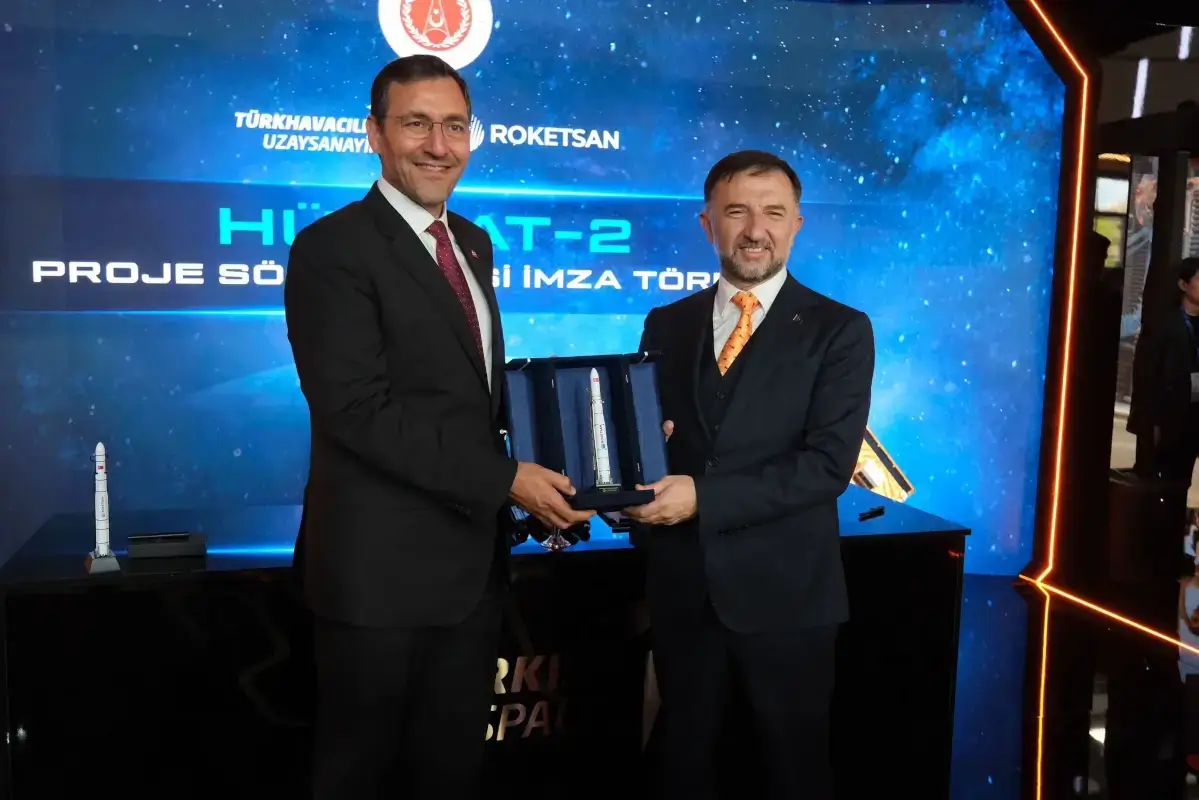
The door to a new era in Türkiye's space journey is being opened. TUSAŞ and ROKETSAN signed the HÜRSAT-2 project contract in Antalya within the scope of the 77th International Astronautical Congress (IAC 2026). The most striking aspect of the signed contract is that HÜRSAT-2 will be sent into orbit using the ŞİMŞEK-1 satellite launch system developed by ROKETSAN.
ŞİMŞEK-1: Türkiye's Own Launch System
ROKETSAN General Manager Murat İkinci announced the details of the signed contract with the words: "We have signed the Project Contract with the Defence Industry Agency and TUSAŞ for HÜRSAT-2, which will be launched with our ŞİMŞEK-1 Satellite Launch System." İkinci commented: "Through this cooperation, we are bringing together our national capabilities in satellites and launch systems, contributing to Türkiye's goals for independent access to space."
The fact that HÜRSAT-2 will be launched with ŞİMŞEK-1 is the element determining the project's strategic weight. Until now, Türkiye has had to send its satellites into orbit using foreign launch vehicles. TÜRKSAT 6A was sent into space aboard SpaceX's Falcon 9 rocket. With ŞİMŞEK-1 entering service, Türkiye aims to join the ranks of countries capable of sending their own satellites into space using their own launch systems.
Space and Port Project in Somalia
Another pillar of Türkiye's strategy for independent access to space is the space infrastructure planned in Somalia. Türkiye aims to position its launch infrastructure not only on its own territory but also in a strategically located geography. The launch site to be established in Somalia stands out as a low-latitude launch point due to its proximity to the equator. Low-latitude launch points provide a fuel advantage in placing satellites into orbit. Somalia's position constitutes a strategic option for long-term launch infrastructure.
Sub-Metre Resolution and Sun-Synchronous Orbit
TUSAŞ General Manager Dr. Mehmet Demiroğlu stated in a post from his social media account: "We are opening the door to a new era in Türkiye's space journey with HÜRSAT." According to the information provided by Demiroğlu, HÜRSAT will carry out special missions including sub-metre resolution, wide-area imaging capability and operation in a sun-synchronous orbit.
Sub-metre resolution means the satellite can image objects on the Earth's surface at a level of detail below one metre. This capability makes the satellite a strategic asset in critical areas such as military reconnaissance, intelligence, mapping and disaster management. A sun-synchronous orbit enables the satellite to capture the same local time on each pass over a given region of the Earth. Wide-area imaging capability, meanwhile, allows the satellite to scan a broad geography in a single pass.
IAC 2026 Convened in Antalya
The signing ceremony was held in Antalya within the scope of the 77th International Astronautical Congress. The International Astronautical Congress is regarded as the world's largest space event and is held in a different country each year. The holding of the congress in Antalya in 2026 stands out as a development strengthening Türkiye's international position in the space field.
Note
If you have any photos or video footage to support our news story, please share them with us using the information provided on our contact us page.
